

Hire Employees in Egypt Without Entity
You can hire employees in Egypt without entity setup by working with an Employer of Record in Egypt. Instead of opening a local company, registering for payroll, managing employment contracts, and handling social insurance directly, an Employer of Record becomes the legal employer on paper while your business manages the employee’s day-to-day work. This gives international companies a faster, more compliant way to hire Egyptian talent.
Need help arranging employment? Explore our Employer of Record Egypt service for the service scope and quotation process. This guide explains the hiring model; the service page is the place to discuss your team requirements.
For companies entering Egypt for the first time, the traditional route can feel heavy: company incorporation, local tax registration, labor documentation, payroll setup, employee file management, and ongoing compliance. An Employer of Record service in Egypt simplifies that process by giving your business a legal employment structure without requiring you to create a local entity first.
This guide explains how to hire employees in Egypt without a local entity, when an EOR makes sense, what compliance areas matter, how payroll and social insurance are handled, and when opening your own Egyptian company may be the better long-term move.
Short Answer: How Can a Foreign Company Hire Employees in Egypt Without a Local Entity?
A foreign company can hire employees in Egypt without a local entity by using an Employer of Record, also called an EOR. The EOR legally employs the worker in Egypt, issues a compliant employment agreement, manages local payroll, handles statutory deductions, supports social insurance administration, maintains employment records, and helps keep the working relationship aligned with Egyptian employment requirements.
The client company still manages the employee’s daily responsibilities, role expectations, performance, tools, reporting lines, and business outcomes. The EOR manages the legal employment administration.
In simple terms: your company gets the talent and operational control, while the EOR handles the local employment framework.
Why Companies Want to Hire in Egypt Without Opening a Company
Egypt has become a strong hiring destination for international employers because of its skilled workforce, multilingual talent, strategic time zone, and deep pools of professionals across technology, engineering, customer support, finance, healthcare, construction, oil and gas, hospitality, and administrative operations.
Many companies want to hire employees in Egypt before they are ready to create a full legal presence. This is especially common when a company is testing market demand, hiring a single remote employee, building a regional support team, replacing contractor arrangements with compliant employment, or delivering a project that requires local talent but not a permanent subsidiary.
Opening a local entity can be the right choice for large, long-term, asset-heavy operations. But for many employers, it is not the right first step. It can create cost, delay, and administrative obligations before the company has proven the commercial case for a permanent presence.
An EOR gives businesses a practical middle path. It allows hiring to begin while the business validates the market, builds a team, and decides whether a local entity is eventually needed.

What Is an Employer of Record in Egypt?
An Employer of Record in Egypt is a local employment partner that legally hires employees on behalf of a foreign or out-of-country company. The EOR becomes the formal employer for compliance, payroll, employment documentation, and statutory administration. The client company directs the employee’s daily work.
An EOR typically helps with:
- Employment agreement preparation
- Employee onboarding
- Payroll processing
- Salary payments
- Tax withholding coordination
- Social insurance administration
- Leave tracking
- Employment record management
- HR support
- Offboarding and termination process support
This model is useful when your company wants to hire employees in Egypt without entity creation, especially when speed and compliance matter. Instead of building a full Egyptian back office before hiring, you can use an EOR to manage the employment foundation while your internal team focuses on work delivery.
How the EOR Model Works in Practice
The EOR model separates legal employment responsibilities from daily work management. This distinction is important for international employers.
| Responsibility | Client Company | Employer of Record |
|---|---|---|
| Daily work direction | Defines role, tasks, goals, reporting lines, and performance expectations. | Does not manage day-to-day work unless separately agreed. |
| Legal employment | Does not directly employ the worker through its foreign entity. | Acts as the legal employer in Egypt. |
| Employment contract | Provides role and compensation inputs. | Prepares and administers compliant employment documentation. |
| Payroll | Funds payroll and service fees. | Processes salary, deductions, and payroll administration. |
| Compliance | Follows local guidance and avoids unauthorized employment decisions. | Supports local employment compliance, records, and HR administration. |
| Employee support | Handles performance, projects, and internal team integration. | Supports HR questions, local employment documentation, and administrative needs. |
This structure helps companies move quickly while keeping employment administration local. It is especially valuable when hiring in Egypt from Europe, the GCC, the United States, or other markets where the company does not yet have an Egyptian subsidiary.
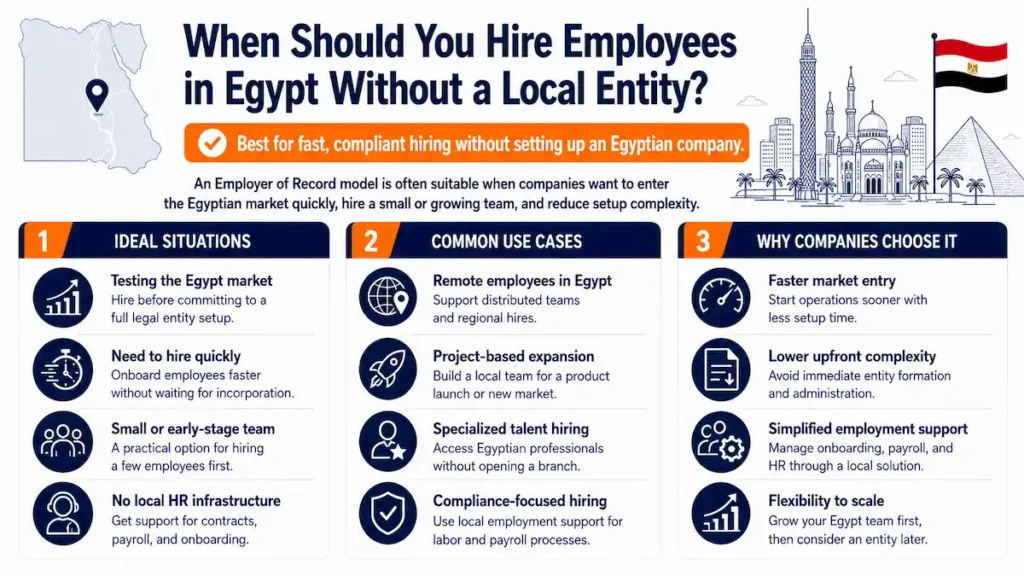
When Should You Hire Employees in Egypt Without a Local Entity?
Hiring without a local entity is usually best when your company wants flexibility, speed, and lower setup complexity. It is not just for startups. Larger companies also use EOR services when entering a new country, launching a pilot team, hiring specialist talent, or supporting a distributed workforce.
1. You Need to Hire One or a Few Employees
If you only need one employee, a small team, or a project-based group, opening a company may be more than you need. Entity setup can require legal, accounting, payroll, banking, and HR infrastructure. An EOR can often support the same hiring goal with a lighter operational footprint.
2. You Want Faster Market Entry
Companies often lose strong candidates because local setup takes too long. If a candidate is ready to start, but the employer is still working through incorporation or payroll registration, the hiring process can stall. EOR hiring reduces that delay by using an existing local employment framework.
3. You Are Testing the Egyptian Market
Egypt may be a strong location for customer support, engineering, sales, sourcing, back-office operations, or regional delivery. But before making a long-term investment, many companies want to test performance, hiring quality, and operational fit. EOR hiring supports that test without forcing a permanent entity decision too early.
4. You Are Building a Remote Team
Remote and distributed companies often want to employ team members legally, not rely on long-term contractor arrangements. A remote hiring Egypt solution can help companies employ remote workers with local payroll and HR administration rather than leaving the relationship informal or misclassified.
5. You Need Local Compliance Support
Employment rules differ by country. Contracts, leave, termination, social insurance, payroll deductions, and employee records all need local review. A local EOR partner helps foreign companies avoid applying home-country assumptions to Egyptian employment relationships.
EOR vs Opening a Local Entity in Egypt
One of the biggest decisions for international companies is whether to use an EOR or open a local Egyptian entity. Both options can be valid. The right choice depends on your timeline, team size, budget, operational plans, and long-term commitment to Egypt.
| Factor | Employer of Record in Egypt | Local Entity in Egypt |
|---|---|---|
| Best for | Fast hiring, small teams, market testing, remote employees, pilot projects. | Large operations, long-term physical presence, direct local contracting, permanent expansion. |
| Setup complexity | Lower. The EOR already has a local employment framework. | Higher. Requires registration, tax, banking, HR, payroll, and administration. |
| Hiring speed | Usually faster because employment infrastructure is already available. | Usually slower because setup must happen before direct hiring. |
| Control | You manage daily work, while the EOR manages employment administration. | You manage all legal, HR, payroll, and operational responsibilities directly. |
| Compliance burden | Shared with the EOR as local employment partner. | Managed internally by your company and local advisors. |
| Cost profile | Predictable service fee and payroll funding. | Entity setup costs, ongoing accounting, legal, payroll, HR, banking, and administration. |
| Scalability | Good for scaling early-stage teams quickly. | Better for mature, large-scale local operations. |
As a rule of thumb, use an EOR when you need to start hiring before you are ready for permanent infrastructure. Consider an entity when Egypt becomes a long-term strategic base with enough headcount, commercial activity, and operational needs to justify direct local presence.
What Compliance Areas Matter When Hiring Employees in Egypt?
Hiring employees in Egypt without a local entity does not remove compliance obligations. It changes who manages them. The EOR should help administer local employment requirements, while the client company should follow the EOR’s guidance and avoid decisions that create compliance risk.
Key compliance areas include employment contracts, payroll, tax withholding, social insurance, working time, leave, benefits, employee records, termination procedures, and data handling. Because employment and tax rules can change, companies should verify details with official Egyptian sources, legal counsel, or Begory Advance Hire’s compliance team before publishing fixed rates or making binding employment decisions.
Employment Contracts
Employment contracts in Egypt should clearly define the employee’s role, compensation, working arrangement, start date, benefits, probation terms if applicable, confidentiality duties, working hours, leave, and termination conditions. For foreign companies, the contract also needs to match the local employment structure used by the EOR.
A strong employment contract reduces ambiguity. It helps the employee understand their rights and responsibilities. It also helps the company avoid disputes caused by unclear reporting lines, salary terms, or benefits expectations.
Payroll And Tax Withholding
Payroll in Egypt involves more than paying a monthly salary. Employers need to consider applicable income tax withholding, statutory deductions, payslips, payroll records, and payment timing. The Egyptian Tax Authority is the official tax authority source to consult for tax-related context and updates.
Companies should avoid relying on outdated payroll tables, old tax brackets, or generic online summaries without verification. Tax and payroll rules may change, and the correct treatment can depend on the employee’s facts, compensation structure, residency status, and current regulations.
For employers that already have a local entity, dedicated Egypt payroll services can support salary calculations, statutory deductions, payment administration, and reporting. For employers without an entity, payroll is typically managed as part of the EOR arrangement.
Social Insurance
Social insurance is a core part of local employment compliance. Employers need to understand registration, contributions, employee coverage, and reporting obligations. The National Organization for Social Insurance is the official source for Egypt’s social insurance authority context.
For international companies, this is one of the main reasons to use an EOR. A local employment partner can help administer social insurance obligations as part of the employment relationship. Businesses should still verify the latest contribution rules and administrative procedures before making salary offers or publishing compensation guidance.
Leave, Holidays, And Employee Benefits
Employees in Egypt may be entitled to statutory leave, public holidays, sick leave rules, and other benefits depending on the applicable law and employment arrangement. Employers should not copy leave policies from another country and assume they work in Egypt. The EOR should align the employment package with local requirements and market expectations.
Competitive benefits also matter for retention. Egyptian professionals often compare offers based on base salary, job stability, flexibility, benefits, career path, manager quality, and the reliability of payroll. A compliant offer is the minimum. A clear and attractive offer helps win talent.
Termination And Offboarding
Termination is one of the highest-risk areas in cross-border employment. Employers should avoid informal termination decisions, sudden role changes, or unilateral changes to compensation without local review. The correct process can depend on contract type, reason for termination, employee status, notice requirements, documentation, and dispute risk.
An EOR can help guide offboarding steps, but the client company should involve the EOR early before making employment decisions. This protects the company, the employee, and the employment relationship.

Is Hiring Through an EOR Legal in Egypt?
Hiring through an EOR can be a lawful and practical structure when it is implemented properly by a qualified local provider. The key is that the EOR must operate with the right local employment infrastructure, issue proper employment documentation, manage payroll correctly, and support compliance with applicable Egyptian rules.
The client company should not treat the arrangement as a way to ignore local labor requirements. An EOR is not a loophole. It is a local employment structure. The purpose is to make employment compliant and manageable when the foreign company does not have its own entity in Egypt.
Before hiring, companies should confirm:
- Who will be the legal employer in Egypt
- What contract will be issued to the employee
- How payroll will be processed
- How social insurance will be administered
- How employee records will be maintained
- How leave and benefits will be handled
- How termination or resignation will be managed
- What responsibilities remain with the client company
Step-by-Step: How to Hire Employees in Egypt Without Entity Setup
The process can be straightforward when the role, compensation, and compliance structure are clear from the beginning.
Step 1: Define the Role and Hiring Need
Start by defining the job title, work location, remote or office arrangement, reporting line, salary range, language requirements, experience level, tools, working hours, and expected start date. This information helps the EOR assess the employment structure and helps recruiters source the right talent.
If you need help finding candidates, a local partner can also help you hire Egyptian workers across industries such as engineering, construction, healthcare, hospitality, manufacturing, and business support.
Step 2: Choose the Right Hiring Model
Decide whether the worker should be an employee, contractor, outsourced staff member, or recruited candidate for a future entity. For ongoing, controlled work, employment is often more appropriate than contractor engagement. If the person will work under your supervision, use your systems, follow your schedule, and operate like a team member, an EOR employment model may reduce misclassification risk.
Step 3: Confirm Compensation and Benefits
Build the compensation package before making a formal offer. Include base salary, bonus eligibility, benefits, leave, work equipment, working hours, expense reimbursement, and any remote-work expectations. Ask your local partner to review the package for market competitiveness and compliance.
Step 4: Prepare the Employment Agreement
The EOR prepares the employment documentation based on Egyptian requirements and the agreed commercial terms. The client company provides role details, reporting structure, and business expectations. The employee signs the applicable employment documents with the EOR as legal employer.
Step 5: Complete Onboarding
Onboarding should include identity documentation, payroll data, employment records, HR policy acknowledgment, equipment setup, internal introductions, role expectations, and manager check-ins. A strong onboarding process helps the employee feel part of your company even though the legal employer is the EOR.
Step 6: Run Payroll and HR Administration
Each payroll cycle, the EOR processes salary, deductions, payslips, and administrative requirements. The client company funds payroll according to the service agreement. The employee receives salary locally, and HR records are maintained through the EOR structure.
Step 7: Manage Performance Day to Day
Your company remains responsible for managing the employee’s work. This includes goals, feedback, training, communication, work assignments, promotion discussions, and performance concerns. The EOR should be involved when a performance issue may affect employment status, compensation, discipline, or termination.
EOR vs Contractor Hiring in Egypt
Some international companies consider hiring Egyptian workers as independent contractors instead of employees. Contractor hiring can work for genuinely independent project-based work, but it may not be suitable when the worker functions like an employee.
| Question | Contractor | EOR Employee |
|---|---|---|
| Who controls daily work? | Contractor usually controls how work is done. | Client company can manage daily tasks and performance. |
| Best for | Independent projects, specialist deliverables, limited scope. | Ongoing roles, integrated team members, long-term work. |
| Payroll | Usually invoice-based. | Processed through local employment payroll. |
| Benefits | Usually not employee benefits. | Handled according to local employment arrangement. |
| Risk | Misclassification risk if the worker acts like an employee. | Lower classification risk when employment is appropriate. |
If the role is permanent, supervised, integrated into your team, and dependent on your company’s systems and schedule, an EOR may be a better structure than a contractor arrangement.
EOR vs HR Outsourcing in Egypt
EOR and HR outsourcing are related, but they are not the same. An EOR is usually used when the foreign company does not have a local entity and needs a legal employer in Egypt. HR outsourcing is usually used when a company already has a local entity but wants support with HR administration, payroll, compliance, employee records, or workforce operations.
If you already have an Egyptian entity, HR outsourcing Egypt may be the right model. If you do not have an entity and want to employ people locally, EOR is usually the more relevant solution.
| Model | Best For | Legal Employer |
|---|---|---|
| Employer of Record | Foreign companies hiring employees in Egypt without a local entity. | The EOR provider. |
| HR Outsourcing | Companies with an Egyptian entity that need HR and payroll support. | The client company. |
| Recruitment | Companies that need help sourcing, screening, and hiring talent. | Depends on whether hiring is direct, EOR, or outsourced. |
What Roles Can You Hire in Egypt Without a Local Entity?
Companies use EOR hiring in Egypt for many roles, especially where the work can be managed remotely or through a distributed operating model. Common examples include:
- Software developers and IT specialists
- Customer support representatives
- Sales development representatives
- Finance and accounting support
- Administrative coordinators
- Engineers and technical specialists
- Healthcare recruitment support roles
- Construction and project coordination roles
- Hospitality operations support
- Marketing, content, and design professionals
- Data analysts and business operations staff
- Regional account managers
The right structure depends on the role, location, supervision level, employment duration, industry requirements, and whether the employee needs licenses, site access, immigration support, or special work documentation.
Benefits of Hiring Employees in Egypt Without Entity Setup
Faster Hiring
The most obvious benefit is speed. Instead of waiting for entity setup, bank accounts, payroll registration, and internal HR infrastructure, companies can move into hiring with an established local employment partner.
Lower Initial Expansion Cost
Opening a company can be expensive before a business has revenue or operational certainty in the country. EOR hiring replaces large upfront setup costs with a more predictable employment and service cost.
Reduced Administrative Burden
Local employment administration requires attention to documents, payroll, benefits, records, and employee questions. An EOR handles much of this operational load, allowing your internal HR team to support the employee without becoming experts in every local process.
Better Compliance Support
Foreign companies can unintentionally create risk by using templates, policies, or termination practices from their home market. A local partner helps align employment administration with Egypt-specific requirements.
Flexible Market Testing
If Egypt becomes a major strategic location, you can still decide to open an entity later. EOR hiring gives you a way to validate the market before making that commitment.
Risks to Avoid When Hiring in Egypt Without an Entity
An EOR makes hiring easier, but companies still need to manage the relationship responsibly. Avoid these common mistakes:
- Using contractors for roles that operate like employees
- Making salary offers before checking local payroll and benefits treatment
- Applying foreign employment policies without local review
- Changing compensation or working hours without involving the EOR
- Terminating employees without local process guidance
- Failing to define intellectual property, confidentiality, and data access clearly
- Assuming social insurance or tax obligations are optional
- Choosing an EOR based only on price rather than compliance capability
The ILO Egypt social protection profile provides useful international context around Egypt’s social protection system, but employers should always verify current rules with official Egyptian sources and qualified advisors.
How to Choose an Employer of Record Provider in Egypt
The right EOR partner should understand Egyptian employment practice, payroll administration, employee communication, HR documentation, and international client expectations. Your provider should be able to explain the process clearly before you sign.
Ask these questions:
- Are you able to legally employ workers in Egypt?
- What employment documents will the employee sign?
- How do you manage payroll, deductions, and payslips?
- How do you support social insurance administration?
- What employee benefits can be provided?
- How do you handle employee questions and HR support?
- What does the client company manage directly?
- How do you support resignation, termination, or role changes?
- How do you protect employee data and confidential information?
- What fees are included and what costs are separate?
A good EOR should make the hiring process easier, not more confusing. If the provider cannot clearly explain responsibilities, documentation, payroll handling, or offboarding support, keep asking questions before proceeding.
How Begory Advance Hire Supports Companies Hiring in Egypt
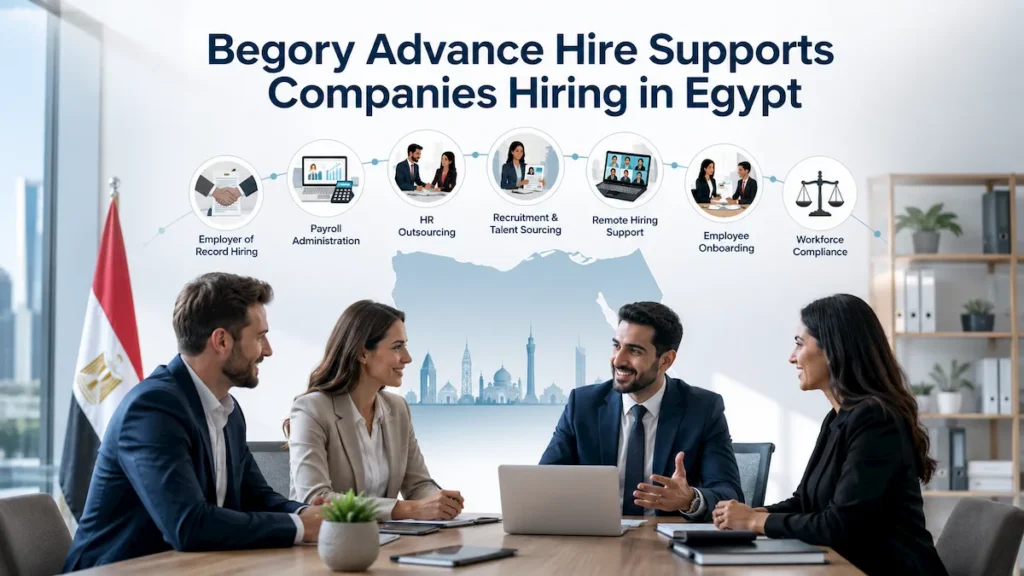
Begory Advance Hire helps international companies hire, onboard, pay, and manage employees in Egypt through local workforce solutions. For companies without an Egyptian entity, Begory’s Employer of Record support is designed to simplify compliant hiring while helping businesses access skilled Egyptian talent.
Begory can support:
- Employer of Record hiring in Egypt
- Payroll administration
- HR outsourcing
- Recruitment and talent sourcing
- Remote hiring support
- Employee onboarding
- Workforce compliance guidance
- Industry-specific hiring support
This makes Begory a practical partner for companies that want to hire employees in Egypt without a local entity, especially when they need both compliance support and access to local recruitment expertise.
When Should You Open a Local Entity Instead?
An EOR is not always the final destination. Some companies should eventually open a local entity in Egypt, especially when they plan to build a large team, sign local commercial contracts, lease offices or facilities, operate regulated activities, or maintain a permanent long-term presence.
Opening an entity may make sense when:
- You plan to hire a large number of employees
- You need direct local invoicing or contracting
- You are opening a physical office, factory, or branch
- You need licenses or permits tied to local operations
- You want full internal control of HR, payroll, and legal employment
- Egypt is a permanent strategic market for your business
Many companies use EOR first, then transition to a local entity once the business case is proven. This phased approach helps reduce early risk while preserving long-term flexibility.
Practical Checklist Before Hiring Your First Employee in Egypt
| Checklist Item | Why It Matters |
|---|---|
| Define the role clearly | Prevents confusion around work scope, reporting, and performance. |
| Confirm hiring model | Helps avoid contractor misclassification and entity issues. |
| Review compensation locally | Ensures the offer is competitive and payroll-ready. |
| Use compliant employment documents | Supports legal clarity and employee confidence. |
| Plan payroll before start date | Avoids salary delays and administrative friction. |
| Verify tax and social insurance treatment | Reduces compliance risk and prevents outdated assumptions. |
| Prepare onboarding | Helps the employee integrate quickly into the team. |
| Agree HR escalation process | Clarifies who handles leave, disputes, performance issues, and offboarding. |
Final Answer: Should You Hire Employees in Egypt Without an Entity?
If your company wants to hire in Egypt quickly, compliantly, and without the cost of opening a company first, an Employer of Record is often the most practical option. It allows you to employ Egyptian talent through a local legal employer while your team manages the employee’s daily work.
This approach is especially useful for first hires, remote teams, market testing, project-based expansion, and companies that want to reduce setup complexity before committing to a full entity.
However, EOR hiring should be handled carefully. Payroll, tax, social insurance, employment contracts, leave, and termination all need local compliance review. Before making binding decisions, verify current requirements with official Egyptian sources, legal counsel, or Begory Advance Hire’s compliance team.
Begory Advance Hire can help your company hire employees in Egypt without entity setup through local Employer of Record, payroll, HR outsourcing, recruitment, and workforce support.
-
Next Post
Employer of Record Cost in Egypt
Related Posts
Egypt Labor Law for Foreign Companies
Egypt Labor Law for Foreign Companies: Complete 2026 Employer Guide Egypt Labor Law for Foreign…
Hiring Remote Employees in Egypt
Hiring Remote Employees in Egypt: Complete Guide for Global Companies Hiring remote employees in Egypt…
Employee Contracts in Egypt
Employee Contracts in Egypt: Complete Employer Guide for 2026 Employee contracts in Egypt should be…
Egypt Employment Compliance
Egypt Employment Compliance: Complete Guide for Employers in 2026 Egypt employment compliance means hiring, paying,…
