

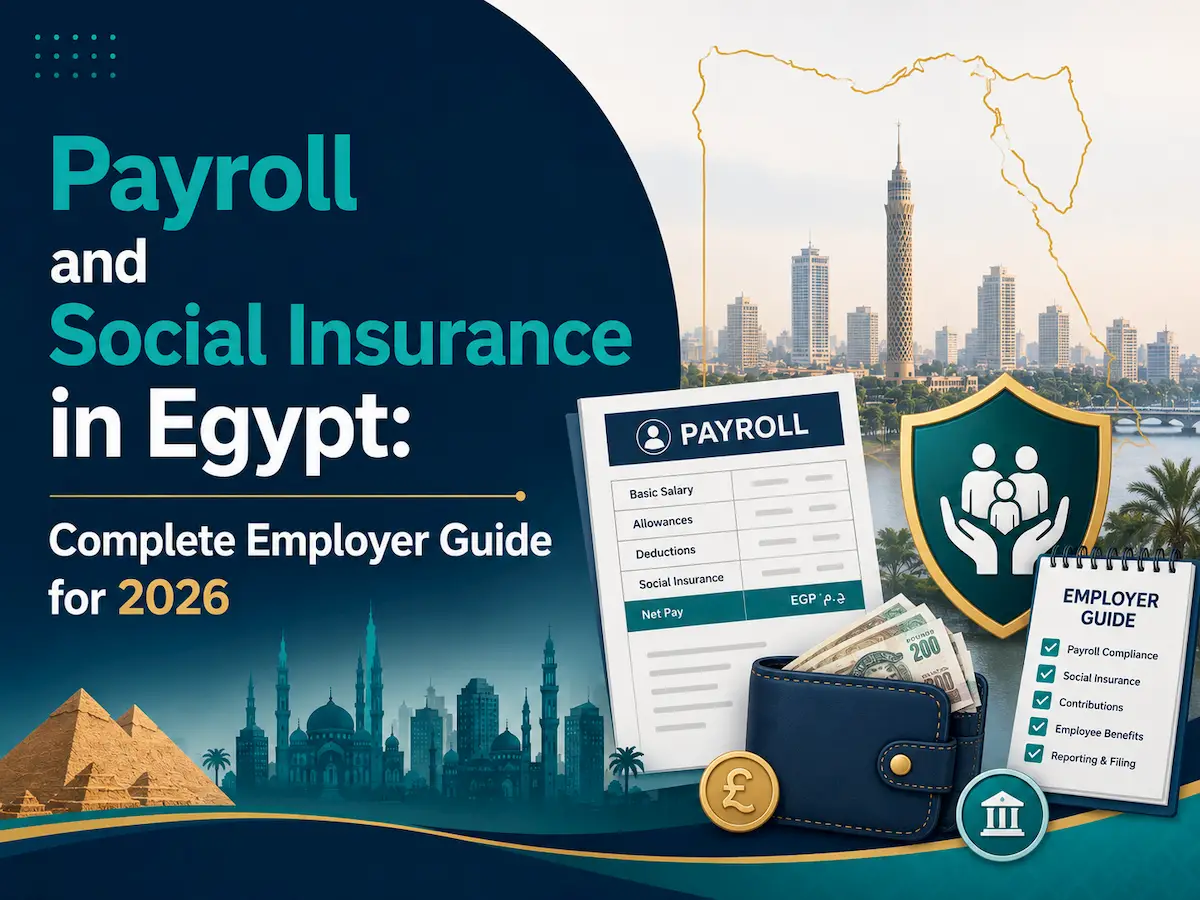
Payroll and Social Insurance in Egypt: Complete Employer Guide for 2026
Payroll and Social Insurance in Egypt require employers to calculate salaries correctly, withhold salary tax, register eligible employees for social insurance, apply employer and employee contributions, maintain payroll records, and submit required filings on time. For international companies, payroll compliance is one of the most important parts of hiring employees in Egypt.
Egypt offers a deep talent market, competitive employment costs, and strong access to Arabic, English, technical, finance, customer support, sales, and operations professionals. But hiring employees in Egypt also creates local payroll obligations. A company must understand salary tax withholding, social insurance contributions, insurable wage caps, employee files, payslips, employment contracts, and the difference between running payroll through a local entity and using a partner such as Begory Advance Hire.
This guide explains how payroll and social insurance in Egypt work from an employer’s point of view. It is written for HR leaders, finance teams, founders, international expansion teams, and companies that want to hire employees in Egypt while staying compliant.
Short Answer: How Do Payroll and Social Insurance Work in Egypt?
Employers in Egypt generally need to pay employees through a compliant payroll process, withhold employment income tax, administer social insurance, keep accurate payroll records, and follow current contribution rates and insurable wage limits. In 2026, PwC’s Egypt social security contribution summary states that employee social insurance contributions are 11% of total social insurance salary and employer contributions are 18.75%. PwC also states that, from 1 January 2026, the minimum social insurance salary is EGP 2,700 and the maximum is EGP 16,700.
Employers should verify exact payroll calculations, tax brackets, social insurance treatment, and reporting deadlines with official Egyptian sources, licensed tax advisers, legal counsel, or Begory Advance Hire’s compliance team before running payroll.
Why Payroll Compliance Matters in Egypt
Payroll is not just an accounting task. It is the monthly point where employment law, tax law, social insurance, HR records, employee trust, and financial reporting meet. A payroll error can affect employee net pay, tax filings, statutory contributions, labor claims, social insurance benefits, and audit readiness.
For international employers, payroll risk often appears when the company hires a worker in Egypt before deciding who the legal employer is. A foreign company may agree on salary, start work, and pay the person from abroad, only to discover later that the arrangement does not match Egyptian payroll, social insurance, or employment requirements.
Begory’s Payroll Services Egypt help employers structure payroll operations, calculate salaries, coordinate statutory deductions, prepare payslips, and keep payroll administration aligned with Egyptian employment practice.
What Is Included in Egypt Payroll?
Payroll in Egypt usually includes gross salary, allowances, deductions, social insurance contributions, salary tax withholding, net salary payment, payslip preparation, payroll reports, and employee records. The exact package depends on the employment contract, role, benefits, and legal structure.
| Payroll Component | What Employers Need to Manage | Why It Matters |
|---|---|---|
| Gross salary | Base salary, allowances, bonuses, and taxable compensation. | Forms the starting point for tax and contribution calculations. |
| Salary tax withholding | Monthly withholding from employment income. | Supports tax compliance and employee net pay accuracy. |
| Social insurance | Employee and employer contributions based on applicable insurable salary. | Supports statutory benefits and employer compliance. |
| Payslips | Payroll breakdown for salary, deductions, and net pay. | Improves transparency and employee trust. |
| Payroll filings | Tax and social insurance reporting where applicable. | Reduces audit and penalty risk. |
| Employee records | Contracts, IDs, payroll history, leave, and social insurance records. | Supports audits, claims, and lifecycle administration. |
Egypt Salary Tax Withholding
Employment income in Egypt is generally subject to salary tax withholding. Employers are responsible for calculating the taxable employment income, withholding the correct amount, and remitting or reporting it according to applicable tax rules.
PwC’s Egypt tax administration guide states that employment income tax is withheld at source monthly and that employers are required to file quarterly tax statements in January, April, July, and October. This makes payroll a recurring compliance process, not a once-a-year adjustment.
Companies should not rely on generic online calculators for final payroll decisions. Payroll calculations can depend on taxable income, exemptions, residency status, benefits, allowances, social insurance treatment, tax-law updates, and employee-specific facts. A payroll provider or local adviser should confirm live calculations before implementation.
What Is Social Insurance in Egypt?
Social insurance in Egypt is the statutory system that supports employee benefits such as pensions and other social protection categories. For employers, social insurance compliance usually means registering eligible employees, calculating contributions, applying the correct wage base, maintaining records, and updating employee status when salaries, roles, or employment dates change.
The ILO Egypt social protection profile explains that Egypt’s social insurance framework is linked to Social Insurance and Pensions Law No. 148 of 2019. The U.S. Social Security Administration’s international update on Egypt Law No. 148 of 2019 also notes that the law consolidated several social insurance programs into one framework from 1 January 2020.
For employers, this means social insurance is not optional HR administration. It is a core statutory obligation that should be built into onboarding, payroll, salary reviews, and termination processes.

Egypt Social Insurance Contribution Rates in 2026
According to PwC’s current Egypt tax summary, the employee contribution percentage is 11% of total social insurance salary and the employer contribution percentage is 18.75% of total social insurance salary. PwC also notes that managers or board members whose names are included in the commercial register may be subject to a different social insurance treatment as employers at a flat rate of 21% of the maximum social insurance salary.
| Contribution Type | 2026 Reference | Employer Action |
|---|---|---|
| Employee social insurance contribution | 11% of total social insurance salary, according to PwC. | Deduct through payroll where applicable. |
| Employer social insurance contribution | 18.75% of total social insurance salary, according to PwC. | Budget as employer cost and remit through the correct process. |
| Minimum social insurance salary | EGP 2,700 from 1 January 2026, according to PwC and ILO. | Review employees below or near the threshold. |
| Maximum social insurance salary | EGP 16,700 from 1 January 2026, according to PwC and ILO. | Cap contribution calculations correctly where applicable. |
Employers should confirm current figures before payroll processing because social insurance thresholds have been increasing over time. The ILO notes that Egypt’s National Organization for Social Insurance announced increases in the minimum and maximum insurable wages from 1 January 2026.
Minimum and Maximum Insurable Wage Limits
The insurable wage base is central to Egypt social insurance calculations. If payroll uses the wrong minimum or maximum, both employer cost and employee deductions can be wrong.
PwC states that the minimum and maximum social insurance salary limits increase by 15% on 1 January each year for a period of seven years starting from 1 January 2021. PwC lists the 2026 minimum social insurance salary as EGP 2,700 and the 2026 maximum as EGP 16,700.
This matters for budgeting. Employers hiring in Egypt should not only calculate gross salary and net salary. They should also forecast employer social insurance cost, payroll administration cost, benefits cost, and any EOR or payroll provider fees.
Payroll Setup Checklist for Employers in Egypt
| Step | Action | Owner |
|---|---|---|
| 1 | Confirm the legal employer: local entity, EOR, or another compliant model. | Leadership, Legal, HR |
| 2 | Collect employee documents and employment contract details. | HR |
| 3 | Set gross salary, allowances, benefits, and pay frequency. | HR, Finance |
| 4 | Determine salary tax withholding and social insurance treatment. | Payroll, Tax Adviser |
| 5 | Register or update employee social insurance records where applicable. | Payroll, HR Operations |
| 6 | Prepare payslip, payroll report, and employer cost report. | Payroll |
| 7 | Pay employee net salary and maintain records. | Finance, Payroll |
| 8 | Review payroll changes monthly and reconcile quarterly obligations. | Finance, Compliance |
Payroll for Companies Without a Local Entity in Egypt
A foreign company that does not have an Egyptian entity usually cannot treat local payroll as a simple international bank transfer. The key question is: who is the legal employer in Egypt?
If the company wants to hire an employee but does not want to establish a local entity, an Employer of Record Egypt solution may be the right route. In an EOR model, the local employer handles the compliant employment contract, payroll, social insurance administration, payslips, onboarding, and employee records. The client company manages day-to-day work and performance.
This model is especially useful when a business wants to test Egypt as a hiring market, hire one or a few employees quickly, convert contractors into employees, build a remote team, or avoid the delay and cost of entity setup before the market is proven.

Payroll for Remote Employees in Egypt
Remote work does not remove payroll compliance. If the employee works from Egypt and is employed in Egypt, the employer still needs a compliant payroll and social insurance process. This includes the employment contract, salary payment method, employee recordkeeping, social insurance review, tax withholding, leave tracking, and employee lifecycle documentation.
Companies building distributed teams can review Begory’s Remote Hiring Egypt support to understand how remote roles can be structured without treating local compliance as an afterthought.
Common Payroll and Social Insurance Mistakes in Egypt
- Hiring employees before deciding who the local legal employer is.
- Paying Egyptian employees from abroad without a compliant payroll structure.
- Using contractor agreements for employee-like working relationships.
- Applying outdated social insurance wage caps.
- Forgetting employer social insurance cost when budgeting total employment cost.
- Not issuing clear payslips or payroll breakdowns.
- Not maintaining employee payroll and social insurance files.
- Failing to review quarterly salary tax statement obligations.
- Assuming a global HR policy automatically works in Egypt.
Payroll Records Employers Should Keep
Payroll records are important for employees, audits, tax administration, social insurance, and labor disputes. A clean payroll file should connect the employment contract, compensation package, monthly calculations, deductions, payments, leave, and final settlement records.
Recommended records include:
- Signed employment contract and salary annexes.
- Employee identification and onboarding documents.
- Salary structure and allowance details.
- Monthly payroll register.
- Payslips and salary payment confirmations.
- Social insurance registration and update records.
- Tax withholding calculations and filings.
- Leave records and unpaid absence records.
- Bonus, commission, and incentive records.
- Termination, resignation, and final settlement documents.
For companies with a local entity, HR Outsourcing Egypt can help align employee records, payroll inputs, leave tracking, onboarding documents, and ongoing HR administration.
Payroll, Contractors, and Misclassification Risk
Some companies try to avoid payroll complexity by engaging Egyptian workers as independent contractors. This can be appropriate for genuinely independent services, but it becomes risky when the contractor works like an employee.
Misclassification warning signs include fixed working hours, manager supervision, exclusive work, company equipment, monthly salary-style payment, integration into internal teams, and long-term dependency on one client. If the relationship looks like employment, the company may face claims related to employee rights, tax withholding, social insurance, leave, notice, and other statutory protections.
If your company wants to access Egyptian talent but does not yet have a local payroll structure, it may be better to use an EOR model or local payroll partner instead of stretching contractor arrangements beyond their proper use.

Payroll and Social Insurance Budgeting in Egypt
When budgeting for employees in Egypt, employers should calculate total employment cost, not only gross salary. Total cost may include gross salary, employer social insurance, payroll administration, benefits, equipment, recruitment fees, EOR fees, HR support, and compliance review.
| Cost Item | Included in Budget? | Notes |
|---|---|---|
| Gross salary | Yes | Base compensation before deductions. |
| Employer social insurance | Yes | Statutory employer cost where applicable. |
| Employee deductions | Payroll calculation | Withheld from employee gross salary where applicable. |
| Payroll administration | Yes | Provider, internal payroll, or EOR administration. |
| Benefits | Yes | May include private medical, allowances, or company benefits. |
| Compliance review | Yes | Important when laws, thresholds, or policies change. |
How Begory Advance Hire Supports Payroll and Social Insurance in Egypt
Begory Advance Hire supports companies hiring and paying employees in Egypt through payroll services, Employer of Record, HR outsourcing, recruitment, and remote hiring support. The right solution depends on whether your company already has a local entity, how many employees you plan to hire, and whether you need payroll-only support or full employment administration.
For companies without an entity, Begory’s Employer of Record support can help employ workers locally and manage payroll and social insurance administration. For companies with an entity, Begory’s payroll and HR outsourcing support can help keep monthly operations organized, accurate, and compliant.
Begory can also support companies that want to Hire Egyptian Workers by connecting recruitment, onboarding, payroll planning, and compliance from the beginning of the hiring process.
Final Employer Takeaway
Payroll and social insurance in Egypt should be treated as a core employment compliance system. Employers need a clear legal employer structure, accurate salary tax withholding, correct social insurance treatment, updated insurable wage limits, reliable payslips, and strong payroll records.
The most important practical step is to confirm the payroll model before the employee starts work. If your company has an Egyptian entity, set up payroll and social insurance administration properly. If your company does not have an entity, consider an Employer of Record or compliant payroll partner before making salary promises or signing offer letters.
Because tax, social insurance, and labor rules can change, employers should verify details with official Egyptian sources, the Egypt Ministry of Labor, tax advisers, legal counsel, or Begory Advance Hire’s compliance team before finalizing payroll processes.
-
Previous Post
Egypt Employment Compliance
-
Next Post
Employee Contracts in Egypt
Related Posts
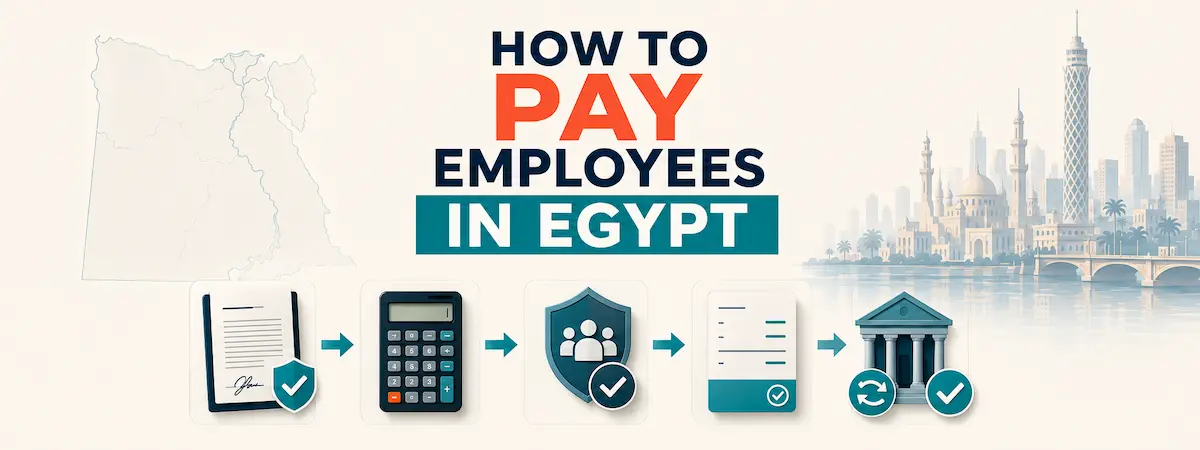
How to Pay Employees in Egypt
How to Pay Employees in Egypt Reviewed by: Selvana Abdelnour, Business Development & Operations ManagerLast…
Egypt Payroll Taxes for Employers
Egypt Payroll Taxes for Employers: 2026 Guide Egypt Payroll Taxes for Employers involve more than…

How Payroll Outsourcing Works in Egypt
Learn how payroll outsourcing works in Egypt, compare payroll outsourcing fees and clarify setup charges,…
