

Employee Contracts in Egypt: Complete Employer Guide for 2026
Employee contracts in Egypt should be written, clear, locally compliant, and aligned with Egypt’s labor, payroll, social insurance, and HR administration requirements. For international companies, employee contracts in Egypt are not just hiring documents. They are the legal foundation for salary, working hours, benefits, probation, leave, confidentiality, termination, payroll registration, and employee recordkeeping.
If your company wants to hire in Egypt, the contract should not be copied from another country and lightly edited. Employee contracts in Egypt need to reflect Egyptian employment practice, the Arabic-language requirement, the agreed wage, the type of work, the employee’s details, the employer’s details, and any mandatory employment terms that apply. EY’s overview of Egypt’s Labor Law No. 14 of 2025 highlights that employment contracts should be prepared in writing in Arabic in four copies, with copies retained or submitted to the relevant parties, and that the law became enforceable from September 1, 2025. EY overview of Egypt’s new labor law
For businesses that do not have an Egyptian company, Begory Advance Hire can support compliant hiring through Employer of Record Egypt. For businesses that already have a local entity, Begory can support payroll, HR administration, recruitment, onboarding, and contract workflows through payroll services in Egypt and HR outsourcing Egypt.

Short Answer: What Are Employee Contracts in Egypt?
Employee contracts in Egypt are written agreements that document the employment relationship between an employer and an employee. They should identify the parties, start date, job role, work type, wage, payment method, benefits, work location, working hours, leave, probation if applicable, confidentiality, termination process, and other employment terms. For private-sector employment, local law and practice require employers to treat the contract as part of a wider compliance system that includes payroll, tax withholding, social insurance, employee files, and HR records.
In simple terms, employee contracts in Egypt answer four questions:
- Who is the legal employer?
- What work will the employee perform?
- How will the employee be paid and managed?
- What rights, obligations, and procedures govern the employment relationship?
For international employers, the most important point is this: employee contracts in Egypt should match the actual hiring model. If your company has an Egyptian legal entity, your entity may be the direct employer. If your company does not have an entity, an Employer of Record can act as the local legal employer while your business manages the employee’s day-to-day work.
Why Employee Contracts in Egypt Matter for International Employers
Employee contracts in Egypt matter because they reduce ambiguity. A strong employment contract gives the employee clarity about pay, work expectations, benefits, leave, reporting lines, confidentiality, and termination rules. It gives the employer a documented basis for HR management, payroll administration, employee files, and compliance review.
For international companies, employee contracts in Egypt are especially important because cross-border hiring creates extra risk. A foreign company may understand employment rules in its home market, but that does not mean its templates work in Egypt. A contract drafted for the United States, United Kingdom, Germany, Saudi Arabia, or the UAE may not fit Egyptian labor practice. Even if the commercial terms are similar, local documentation, language, payroll, social insurance, and employee record obligations may be different.
Good employee contracts in Egypt help employers avoid common mistakes such as:
- Using a foreign employment template without local review.
- Leaving salary, allowances, or benefits unclear.
- Failing to define the legal employer.
- Using contractor agreements for workers who behave like employees.
- Ignoring payroll and social insurance implications.
- Changing working hours or compensation without proper process.
- Terminating employment without checking local requirements.
- Assuming remote work removes local employment obligations.
When companies treat employee contracts in Egypt as part of a full employment compliance system, they make hiring smoother and reduce future disputes.

What Law Governs Employee Contracts in Egypt?
Private-sector employee contracts in Egypt are primarily shaped by Egypt’s labor law framework, including Labor Law No. 14 of 2025, related decrees, social insurance rules, tax requirements, and other employment-related regulations. ICLG’s Egypt employment law guide explains that Article 89 of the Egyptian Labor Law requires employment contracts to be made in writing, prepared in Arabic, and issued in four copies, including copies for the employer, employee, competent social insurance office, and competent administrative authority. ICLG Egypt employment law guide
That means employee contracts in Egypt should be reviewed through more than one lens. The contract itself is important, but employers also need to think about:
- Labor law requirements.
- Payroll and wage treatment.
- Social insurance registration and contribution administration.
- Tax withholding and payroll reporting.
- Work permits and immigration rules for foreign nationals.
- Employee file retention.
- Leave and benefits administration.
- Termination, resignation, and settlement procedures.
This article is for general business education. It is not legal advice. Before publishing fixed legal details, issuing contracts, changing contract terms, or making termination decisions, employers should verify the latest requirements with official Egyptian government sources, qualified Egyptian legal counsel, or Begory Advance Hire’s compliance team.

Do Employee Contracts in Egypt Need to Be in Arabic?
Yes. Employee contracts in Egypt should be prepared in Arabic. For non-Arabic-speaking foreign employees, a bilingual version may be used, but the Arabic version is generally the controlling version if there is a conflict in interpretation. This is one reason international companies should avoid sending an English-only employment agreement to a worker in Egypt and assuming it is enough.
For practical HR purposes, bilingual contracts can be useful. A bilingual contract helps foreign managers, international HR teams, and non-Arabic-speaking employees understand the document. But the Arabic version should be properly drafted and locally reviewed, not treated as an afterthought.
A sensible approach for employee contracts in Egypt is:
- Prepare the Arabic version first or in parallel with the English version.
- Make sure the English text mirrors the Arabic meaning.
- Avoid vague translations of salary, benefits, termination, confidentiality, and working hours.
- Have the final version reviewed by local employment specialists.
- Keep signed copies and related employee documents in an organized HR file.
How Many Copies Are Needed for Employee Contracts in Egypt?
Current legal summaries describe a four-copy requirement for employee contracts in Egypt. The contract is generally prepared for the employer, employee, competent social insurance office, and competent administrative authority. EY’s summary of the new labor law also highlights the written Arabic contract requirement in four copies. EY overview of Egypt’s new labor law
Employers should confirm the latest filing and administrative process before issuing contracts, because implementation details and official procedures can change. The practical lesson is simple: employee contracts in Egypt should be handled as formal employment documents, not casual offer letters.
What Should Employee Contracts in Egypt Include?
Employee contracts in Egypt should be specific enough to document the employment relationship clearly. A vague contract creates risk because it leaves room for disputes about the employee’s role, compensation, working hours, leave, benefits, and termination rights.
A strong contract normally includes:
| Contract Area | What It Should Cover | Why It Matters |
|---|---|---|
| Parties | Employer name, employee name, addresses, identification details | Confirms who is legally bound by the contract |
| Start date | Employment start date and onboarding details | Supports payroll, social insurance, and service calculations |
| Job title and duties | Role, department, responsibilities, reporting line | Reduces disputes over expectations |
| Work location | Office, site, hybrid, remote, or field location | Important for remote work, safety, supervision, and operations |
| Contract type | Indefinite, fixed-term, project-based, part-time, or other arrangement | Determines duration and termination planning |
| Wage and benefits | Base salary, allowances, bonus terms, payment method, benefits | Essential for payroll and employee expectations |
| Working hours | Schedule, rest days, overtime process if applicable | Supports compliance and workforce planning |
| Leave | Annual leave, sick leave, maternity/paternity rules, public holidays | Helps HR administer entitlements |
| Probation | Probation period and review process if applicable | Clarifies early employment assessment |
| Confidentiality | Business information, data access, client information | Protects company information |
| Termination | Notice, process, grounds, handover, settlement | Reduces offboarding risk |
| Policies | Code of conduct, data protection, safety, remote work rules | Connects the contract to daily HR management |
ICLG summarizes that mandatory contract details include the start date, employer identity and address, employee details, qualifications and occupation, nature and type of work, and agreed wage including payment timing and method. ICLG Egypt employment law guide
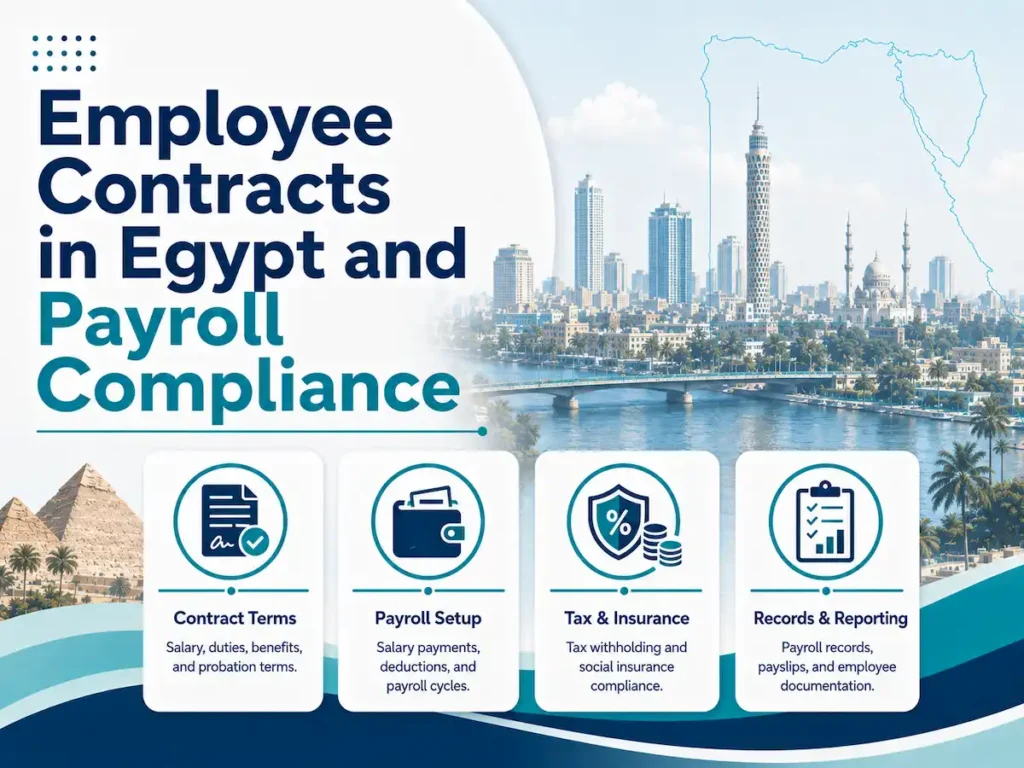
Employee Contracts in Egypt and Payroll Compliance
Employee contracts in Egypt should match payroll reality. If the contract states one salary but payroll records, payslips, allowances, or bank payments show something different, the employer creates avoidable compliance and dispute risk.
Payroll alignment means the contract should clearly explain:
- Gross salary.
- Payment currency and timing.
- Allowances and whether they are fixed or variable.
- Bonus eligibility and whether bonuses are discretionary.
- Benefits and in-kind compensation.
- Overtime or additional payment process if applicable.
- Deductions and statutory withholding treatment.
- Expense reimbursement process.
Payroll in Egypt is not only about transferring salary. Employers need to consider withholding, filings, payroll records, and salary documentation. PwC’s Egypt tax administration summary notes that employment income tax is withheld monthly, employers file quarterly tax statements, and employers submit annual reconciliation information to the tax authority. PwC Egypt tax administration summary
Begory’s payroll services in Egypt can help employers align employment contracts, salary calculations, statutory deductions, payroll calendars, payslips, and HR records. For companies without a local entity, payroll is usually handled through the Employer of Record structure.
Employee Contracts in Egypt and Social Insurance
Employee contracts in Egypt should also align with social insurance administration. The employment contract is one of the documents that supports the formal employment relationship. Social insurance, payroll, and employee records should tell the same story.
Social insurance is not a minor back-office detail. It affects employee protection, employer compliance, contribution administration, and workforce formalization. The ILO’s Egypt social protection profile describes Egypt’s social insurance framework and notes updates to minimum and maximum insurable wage thresholds from January 1, 2026. ILO Egypt social protection profile
Because social insurance rules can change, employers should not publish contribution amounts or fixed calculations unless they have verified them. Instead, employee contracts in Egypt should be coordinated with current payroll and social insurance procedures.
Fixed-Term vs Indefinite Employee Contracts in Egypt
Employee contracts in Egypt may be structured in different ways depending on the role and business need. The two common categories employers ask about are fixed-term and indefinite employment.
Fixed-term employee contracts in Egypt
A fixed-term contract runs for a defined period or project. It may be useful when the employer has a temporary need, project-based assignment, seasonal requirement, or defined business case. Fixed-term employee contracts in Egypt should be carefully drafted because renewal, early termination, and actual working practice can affect risk.
Indefinite employee contracts in Egypt
An indefinite contract does not have a predetermined end date. It is usually more suitable for ongoing roles, permanent functions, and long-term team members. Indefinite employee contracts in Egypt should still include clear termination procedures, role expectations, salary, benefits, and policy obligations.
The choice should reflect the real relationship. If a role is ongoing, supervised, integrated into the team, and expected to continue, employers should be careful about using repeated fixed-term documents simply to avoid long-term obligations.
Probation Clauses in Employee Contracts in Egypt
Many employers want a probation period in employee contracts in Egypt. A probation clause helps the employer and employee assess fit during the early stage of employment. However, probation language should be locally reviewed and aligned with current law and practice.
A good probation clause should explain:
- Whether probation applies.
- How long the probation period lasts.
- What performance or conduct standards apply.
- How feedback will be given.
- What happens if the employee passes probation.
- What process applies if employment ends during probation.
Probation should not be used casually. Even during probation, employers should keep records, communicate clearly, and involve HR or the EOR before making decisions that affect employment status.
Remote Work and Employee Contracts in Egypt
Remote work has made employee contracts in Egypt more important, not less important. Some international companies assume that if an Egyptian employee works from home, the contract can be informal. That is risky. Remote workers still need clear employment documentation, payroll treatment, social insurance administration, and HR support.
For remote employee contracts in Egypt, employers should define:
- Work location and whether remote work is permanent or hybrid.
- Working hours and availability expectations.
- Equipment and internet support.
- Data security and confidentiality rules.
- Health, safety, and work environment expectations.
- Expense reimbursement.
- Performance management and reporting lines.
- Whether the employee can work from outside Egypt.
Begory’s remote hiring Egypt support can help companies structure remote employment properly, especially when the employer is outside Egypt and needs local HR administration.
Employee Contracts in Egypt for Foreign Companies Without an Entity
If your company does not have an Egyptian entity, you generally cannot treat a foreign company template as a complete local employment setup. Employee contracts in Egypt need a legal employer in Egypt, payroll administration, social insurance handling, and employee record management.
This is where an Employer of Record can help. An Employer of Record in Egypt becomes the local legal employer for the worker, issues compliant employment documentation, manages payroll and statutory administration, and supports HR processes. The client company manages the employee’s daily tasks, projects, performance, and business outcomes.
Begory Advance Hire’s Employer of Record Egypt service is designed for international companies that want to hire employees in Egypt without opening a local company. Begory’s EOR service supports employment contracts, payroll, tax compliance coordination, social insurance administration, HR operations, onboarding, and ongoing employee management.
Employee Contracts in Egypt vs Independent Contractor Agreements
Some companies try to avoid employee contracts in Egypt by using independent contractor agreements. Contractor arrangements can be legitimate when the worker is truly independent, project-based, and not managed like an employee. But if the person works under company supervision, follows company hours, uses company systems, reports to a manager, and performs an ongoing role, the relationship may look like employment.
| Question | Employee Contract | Independent Contractor Agreement |
|---|---|---|
| Who directs daily work? | Employer or manager | Contractor usually controls method of work |
| Is the role ongoing? | Often yes | Usually project or deliverable based |
| Is payroll used? | Yes, employment payroll | Usually invoice payment |
| Are employee benefits relevant? | Yes, according to employment structure | Usually no employee benefits |
| What is the main risk? | Employment compliance | Misclassification if the person functions like an employee |
Employers should not use contractor agreements as a shortcut when employee contracts in Egypt are the more accurate structure. Misclassification can create payroll, tax, social insurance, and termination exposure.
Employment Offers vs Employee Contracts in Egypt
An offer letter and an employment contract are not the same thing. An offer letter usually summarizes the commercial offer: job title, salary, start date, benefits, and reporting line. Employee contracts in Egypt go further by documenting the legal employment relationship and the detailed terms that govern it.
A practical hiring process may look like this:
- Define the role and salary range.
- Screen and select the candidate.
- Issue a conditional offer or offer summary.
- Collect required employee information.
- Prepare the local employment contract.
- Review payroll and social insurance setup.
- Sign the employment contract.
- Complete onboarding and employee file setup.
If you need help finding local talent before issuing employee contracts in Egypt, Begory can help you hire Egyptian workers across professional, technical, industrial, hospitality, healthcare, engineering, and support roles.
Common Mistakes in Employee Contracts in Egypt
Many contract problems are preventable. The issue is rarely that the employer had bad intentions. More often, the employer used a template, rushed onboarding, or assumed that one country’s HR process would work in another country.
Avoid these mistakes when preparing employee contracts in Egypt:
- Using an English-only template. Employee contracts in Egypt should be prepared in Arabic, with bilingual support where needed.
- Leaving compensation unclear. Salary, allowances, bonus eligibility, benefits, and deductions should be clearly explained.
- Ignoring payroll records. The contract and payroll process should match.
- Forgetting social insurance. Employment documentation should support formal registration and administration where applicable.
- Using the wrong employer name. The legal employer should be accurately identified.
- Overusing fixed-term contracts. Contract type should match the actual business need.
- Skipping local review. Employment contracts in Egypt should be checked by local specialists.
- Not involving HR before termination. Offboarding decisions should be reviewed before action is taken.
- Forgetting remote-work terms. Remote work should be documented clearly.
- Not updating old templates. Egypt’s employment framework has changed, and outdated contracts should be reviewed.
How Begory Advance Hire Supports Employee Contracts in Egypt
Begory Advance Hire supports international and local employers with practical workforce solutions in Egypt. Employee contracts in Egypt are one part of the wider employment lifecycle, and Begory helps connect contracts to hiring, onboarding, payroll, HR administration, employee support, and compliance coordination.
Begory can support employers through:
- Employer of Record Egypt: For companies that want to hire employees in Egypt without opening a local entity.
- Payroll services in Egypt: For companies that already have an entity and need accurate payroll administration.
- HR outsourcing Egypt: For companies that need ongoing HR, employee records, compliance support, and workforce administration.
- Recruitment and hiring support: For companies sourcing Egyptian employees across industries.
- Remote hiring Egypt: For companies building distributed teams with Egyptian talent.
With the right structure, employee contracts in Egypt become more than documents. They become the foundation for compliant, predictable, and scalable workforce management.
Step-by-Step: How to Prepare Employee Contracts in Egypt
Step 1: Confirm the hiring model
First, decide who will legally employ the worker. If you already have a local entity, your company may employ the worker directly. If not, an EOR may be the right structure. This decision affects employee contracts in Egypt because the legal employer must be correctly named.
Step 2: Define the role clearly
Document the job title, duties, reporting line, work location, schedule, start date, and whether the role is remote, hybrid, site-based, or office-based.
Step 3: Confirm compensation and benefits
Before signing, confirm salary, allowances, bonus eligibility, benefits, leave, expense reimbursement, and payroll timing. Employee contracts in Egypt should not leave compensation to informal side conversations.
Step 4: Prepare the Arabic contract
Prepare the employment contract in Arabic, with bilingual text where appropriate. Make sure the Arabic and English versions align.
Step 5: Review payroll and social insurance implications
Check the employment contract against payroll administration, tax withholding, and social insurance requirements. Contract terms should not create payroll confusion.
Step 6: Sign and file the contract correctly
Follow the required signing, copy, and filing process. Keep the employee file organized and accessible for HR administration.
Step 7: Onboard the employee properly
Onboarding should include HR policy acknowledgment, payroll data, manager introduction, equipment setup, access control, confidentiality, and role expectations.
Step 8: Manage changes carefully
If salary, role, location, working hours, or contract type changes later, document the change properly. Employee contracts in Egypt should be kept aligned with reality.
Employee Contracts in Egypt: Practical Checklist for Employers
Before issuing employee contracts in Egypt, use this checklist:
- Is the legal employer correctly identified?
- Is the contract prepared in Arabic?
- Is a bilingual version needed?
- Is the employee’s full information included?
- Is the start date clear?
- Is the role and job description clear?
- Is the work location clear?
- Is the contract type appropriate?
- Are salary, allowances, benefits, and payment timing clear?
- Are working hours and rest days addressed?
- Are leave entitlements referenced correctly?
- Is probation included only if appropriate?
- Are confidentiality and data obligations included?
- Are termination and resignation procedures locally reviewed?
- Does the contract align with payroll setup?
- Does the contract align with social insurance administration?
- Are employee file requirements addressed?
- Has the contract been reviewed by local counsel, Begory’s compliance team, or another qualified advisor?
When Should Employers Review Existing Employee Contracts in Egypt?
Employers should review existing employee contracts in Egypt whenever the law changes, the business changes, or the employment relationship changes. Contract review is especially important after Egypt’s labor law updates, when companies may still have older templates in circulation.
Review employee contracts in Egypt when:
- You are hiring your first employee in Egypt.
- You are switching from contractors to employees.
- You are opening an Egyptian entity.
- You are moving employees to an EOR structure.
- You are changing payroll or benefits.
- You are introducing remote work.
- You are promoting employees into new roles.
- You are preparing for termination or restructuring.
- You are acquiring or merging a local team.
- You have not reviewed contracts since the new labor law framework took effect.
Conclusion: Employee Contracts in Egypt Need Local Precision
Employee contracts in Egypt are the foundation of compliant hiring. They define the employment relationship, support payroll and social insurance administration, reduce ambiguity, and protect both employer and employee. For international companies, the main lesson is clear: do not rely on foreign templates alone. Employee contracts in Egypt should be locally reviewed, Arabic-ready, payroll-aligned, and connected to the real hiring model.
If your company wants to hire in Egypt without opening a local entity, Begory Advance Hire can support you through Employer of Record Egypt. If you already have a company in Egypt, Begory can help with payroll services in Egypt, HR outsourcing Egypt, recruitment, onboarding, and ongoing HR operations.
Before issuing or revising employee contracts in Egypt, contact Begory Advance Hire to discuss the right hiring model, contract workflow, payroll setup, and compliance support for your workforce.
-
Previous Post
Payroll and Social Insurance in Egypt
-
Next Post
Hiring Remote Employees in Egypt
Related Posts
Egypt Labor Law for Foreign Companies
Egypt Labor Law for Foreign Companies: Complete 2026 Employer Guide Egypt Labor Law for Foreign…
Hiring Remote Employees in Egypt
Hiring Remote Employees in Egypt: Complete Guide for Global Companies Hiring remote employees in Egypt…
Egypt Employment Compliance
Egypt Employment Compliance: Complete Guide for Employers in 2026 Egypt employment compliance means hiring, paying,…
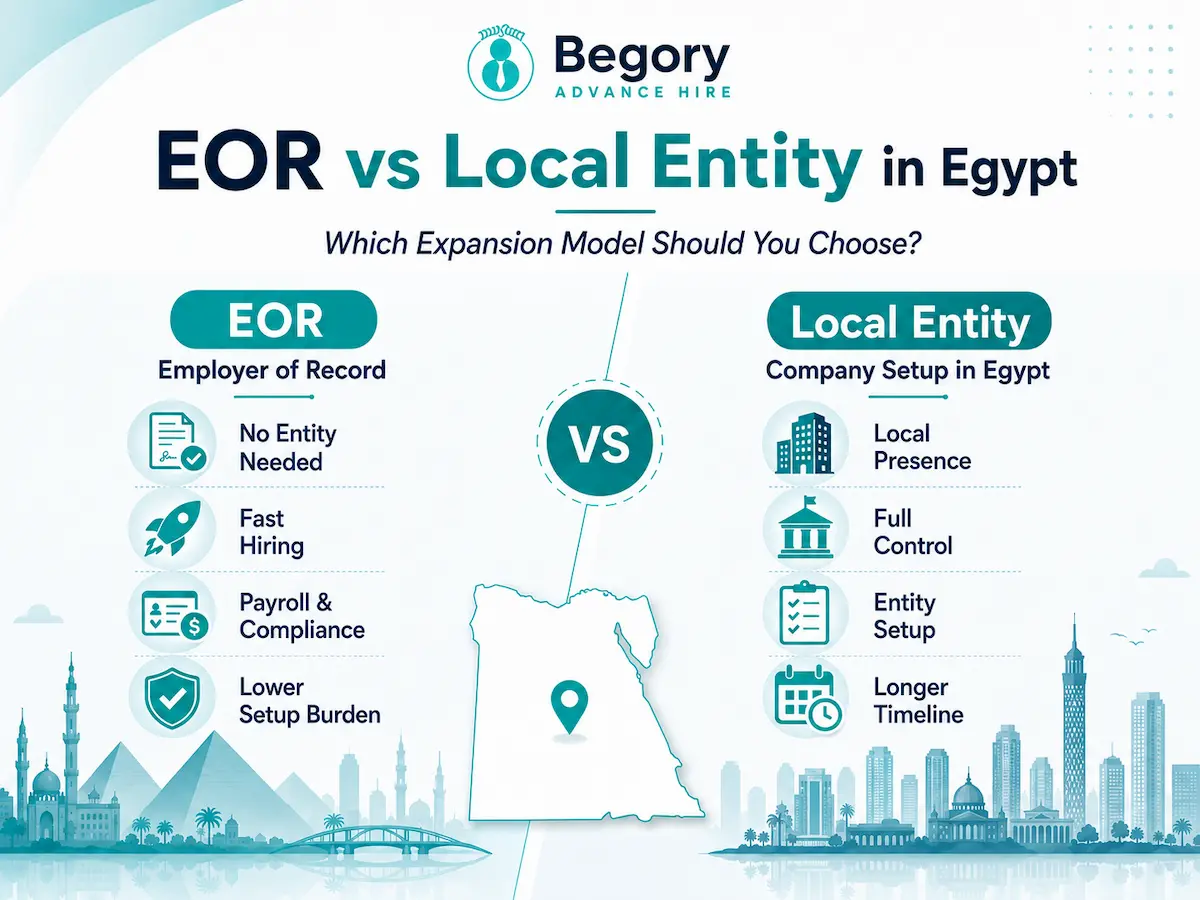
EOR vs opening a local entity in Egypt
EOR vs Opening a Local Entity in Egypt: Which Expansion Model Should You Choose? EOR…
