

Egypt Employment Compliance: Complete Guide for Employers in 2026
Egypt employment compliance means hiring, paying, managing, and terminating employees in line with Egyptian labor law, payroll tax rules, social insurance obligations, contract requirements, leave entitlements, and employee recordkeeping duties. For international employers, compliance starts before the first offer letter: you need the right hiring model, a compliant employment contract, payroll setup, social insurance registration, and a clear HR process.
If you are still choosing the hiring route, start with how to hire employees in Egypt. For ongoing employee administration, see our HR outsourcing service and pricing factors.
Egypt is one of the most important hiring markets in the Middle East and North Africa. It offers a large workforce, competitive salary structures, multilingual professionals, and a strategic location connecting Africa, Europe, and the Gulf. But the opportunity comes with serious compliance responsibilities. Employers must understand written employment contracts, payroll withholding, social insurance, leave, working time, termination procedures, data documentation, and the practical difference between hiring through a local entity and using an Employer of Record Egypt solution.
This guide explains the core areas of employment compliance in Egypt for companies hiring in 2026. It is written for international companies, HR leaders, finance teams, legal departments, and founders who want to hire Egyptian talent confidently while reducing avoidable employment risk.
Short Answer: What Must Employers Comply With in Egypt?
Employers in Egypt generally need to comply with employment contract rules, labor-law protections, payroll tax withholding, social insurance registration, wage and working-time rules, statutory leave, employee file retention, workplace policies, lawful termination procedures, and work authorization requirements for non-Egyptian employees.
Since Egypt introduced Labor Law No. 14 of 2025, employers should review their employment templates, policies, payroll operations, leave rules, resignation processes, and recordkeeping practices. According to EY’s employer update on Egypt’s new Labor Law No. 14 of 2025, the new law became effective from 1 September 2025 and introduced important reforms across employment relationships, modern work patterns, maternity leave, paternity leave, annual leave, resignation processes, employee records, and non-national employment.
Why Egypt Employment Compliance Matters
Employment compliance in Egypt is not only a legal requirement. It affects hiring speed, employee trust, payroll accuracy, audit readiness, employer reputation, and expansion risk. A company can attract excellent Egyptian talent and still create risk if it uses the wrong employment model or treats a full-time employee as an informal contractor.
For global companies, the most common compliance problems appear in five areas:
- Hiring employees before a legal employer structure is ready.
- Using contracts that are not aligned with Egyptian employment requirements.
- Running payroll without correct tax and social insurance administration.
- Applying home-country HR policies that conflict with Egyptian labor rules.
- Ending employment without proper documentation, notice, or procedure.
Begory Advance Hire supports companies that want to hire employees in Egypt through compliant workforce solutions, including Employer of Record, payroll, recruitment, remote hiring, and HR outsourcing support.
What Laws Shape Employment Compliance in Egypt?
Employment compliance in Egypt is shaped by labor law, social insurance law, tax rules, immigration and work authorization requirements, and sector-specific regulations. For private-sector employers, the key employment-law development is Labor Law No. 14 of 2025, which replaced the older labor framework and modernized several areas of employment regulation.
Employers should also consider Social Insurance and Pensions Law No. 148 of 2019. The ILO Egypt social protection profile explains that Law No. 148 of 2019 unified Egypt’s social insurance framework and expanded coverage across categories of workers. This matters because payroll compliance is not just salary payment. It includes registration, contributions, reporting, and accurate employee records.
Because employment, tax, and social insurance rules can change through laws, executive regulations, ministerial decrees, and official administrative practice, employers should verify specific decisions with the Egypt Ministry of Labor, the Egyptian Tax Authority, the National Organization for Social Insurance, legal counsel, or Begory Advance Hire’s compliance team before publishing policies or making binding employment decisions.

Egypt Employment Compliance Checklist for Employers
| Compliance Area | Employer Responsibility | Risk if Ignored |
|---|---|---|
| Hiring model | Choose local entity, EOR, outsourcing, or another compliant structure. | Unlawful employment setup or permanent establishment concerns. |
| Employment contract | Use written, locally compliant employment documentation. | Disputes over role, pay, leave, notice, and termination. |
| Payroll | Calculate salary, deductions, tax, and statutory payments accurately. | Tax exposure, employee dissatisfaction, penalties, and audits. |
| Social insurance | Register eligible employees and maintain contribution records. | Contribution liabilities and employee benefit issues. |
| Working time | Track hours, overtime, rest days, and applicable work arrangements. | Wage disputes and labor claims. |
| Leave | Administer annual, maternity, sick, study, and other leave correctly. | Employee claims and policy non-compliance. |
| Records | Maintain employee files, payroll records, and HR documentation. | Poor audit readiness and weak defense in disputes. |
| Termination | Follow lawful grounds, notice, documentation, and final-pay process. | Wrongful dismissal claims and compensation exposure. |
Choosing the Right Hiring Model in Egypt
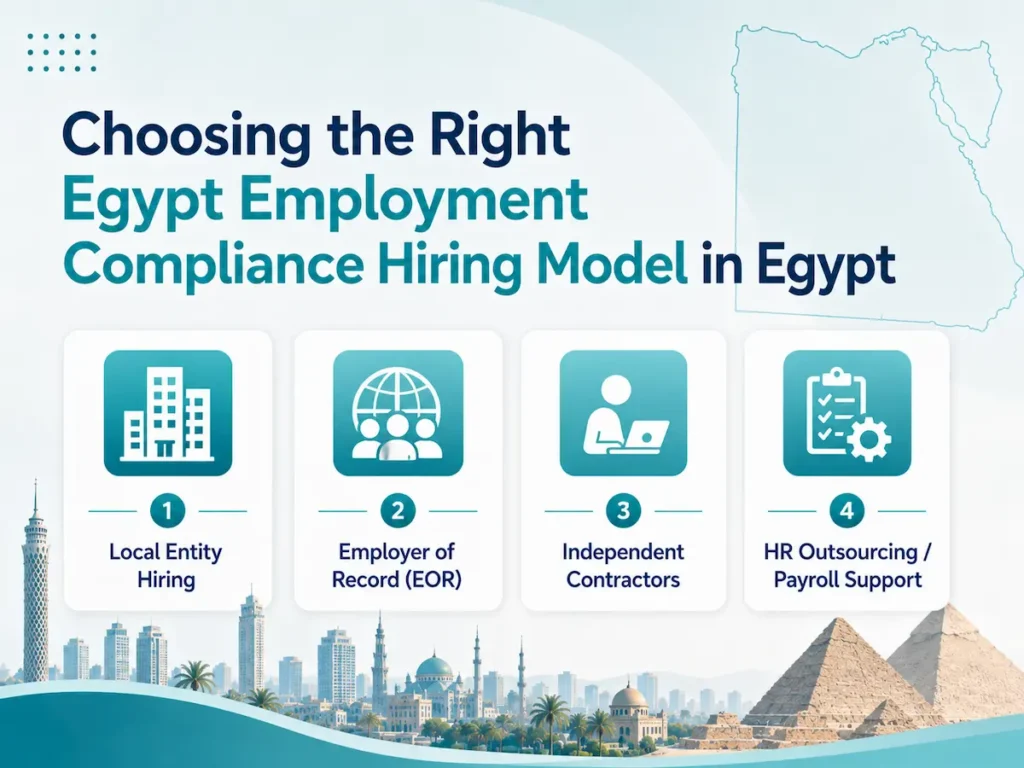
The first compliance decision is not the contract template. It is the hiring model. A company hiring in Egypt usually has four practical options: open a local entity, use an Employer of Record, outsource HR support for an existing entity, or recruit workers who are employed directly by another approved structure.
Opening a local entity can make sense when a company plans to build a large permanent operation, sign local commercial contracts, lease office space, or operate a regulated business. But entity setup takes time, creates recurring administration, and requires ongoing tax, payroll, HR, corporate, and legal management.
An Employer of Record is often the faster option for companies that want to hire one employee, test the market, build a remote team, replace contractor arrangements, or expand without waiting for a full subsidiary. In an EOR model, the local employer handles employment contracts, payroll administration, social insurance, HR documentation, and employee lifecycle support while the client manages daily work.
Companies that already have an Egyptian entity may not need an EOR, but they may need HR Outsourcing Egypt support to manage policies, onboarding, employee files, payroll coordination, benefits, performance processes, and compliance administration.
Employment Contracts in Egypt
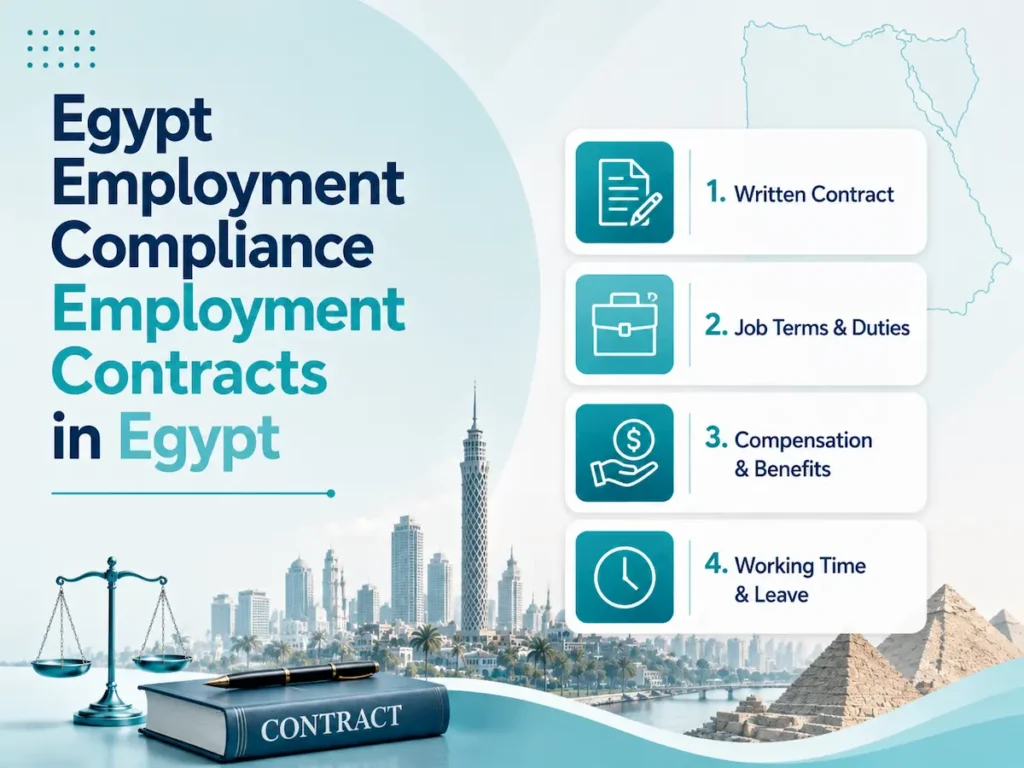
Employment contracts are a foundation of Egypt employment compliance. A strong contract should define the employer, employee, job title, duties, workplace or remote-work arrangement, salary, benefits, working hours, leave, confidentiality, probation if applicable, term of employment, notice rules, and any role-specific obligations.
Under Egypt’s updated labor framework, employers should pay close attention to written Arabic employment documentation and copy requirements. EY’s summary of Law No. 14 of 2025 notes that employment contracts should be prepared in writing in Arabic in four copies, with copies retained by the employer, employee, social insurance office, and competent administrative authority. Where a non-national employee does not speak Arabic, bilingual documentation may be needed.
For international companies, the practical lesson is simple: do not reuse a UK, US, UAE, or EU employment contract and assume it works in Egypt. Contract wording should be localized. A global template can be useful, but it should be adapted to Egyptian legal requirements and reviewed before signature.
Payroll Compliance
Payroll compliance in Egypt includes more than transferring salary. Employers must calculate gross-to-net pay, apply deductions, handle tax withholding, manage statutory contributions, issue payroll records, and coordinate social insurance reporting. Payroll must also align with the employment contract and the employee’s actual compensation package.
For tax administration context, PwC’s Egypt individual tax administration guide notes that employment income tax is withheld at source on a monthly basis and that employers have periodic filing obligations. Employers should verify current tax brackets, withholding deadlines, payroll reporting forms, and e-filing requirements with Egyptian tax advisers or official tax channels before implementation.
Begory’s Payroll Services Egypt support is relevant for companies that need salary processing, tax calculation support, payslip preparation, payroll records, and statutory payroll administration aligned with Egyptian employment practice.

Social Insurance Administration
Social insurance is one of the most important compliance areas in Egypt. Employers should determine whether employees must be registered, what wage base applies, what employer and employee contributions are required, and how records should be maintained.
The ILO notes that Egypt’s Social Insurance and Pensions Law No. 148 of 2019 unified the regulatory framework and provides a comprehensive package including old-age, disability, survivors’, work injury, unemployment, and sickness benefits. The ILO also notes that insurable wage thresholds have been adjusted over time, including announced increases from 1 January 2026. This is a strong reminder that payroll settings should be reviewed regularly, not configured once and forgotten.
For employers, social insurance compliance usually requires coordination between HR, payroll, finance, and local counsel. Employee start dates, salary changes, job changes, leave status, and termination dates all need clean documentation because they can affect reporting and contribution obligations.
Working Hours, Overtime and Modern Work Patterns
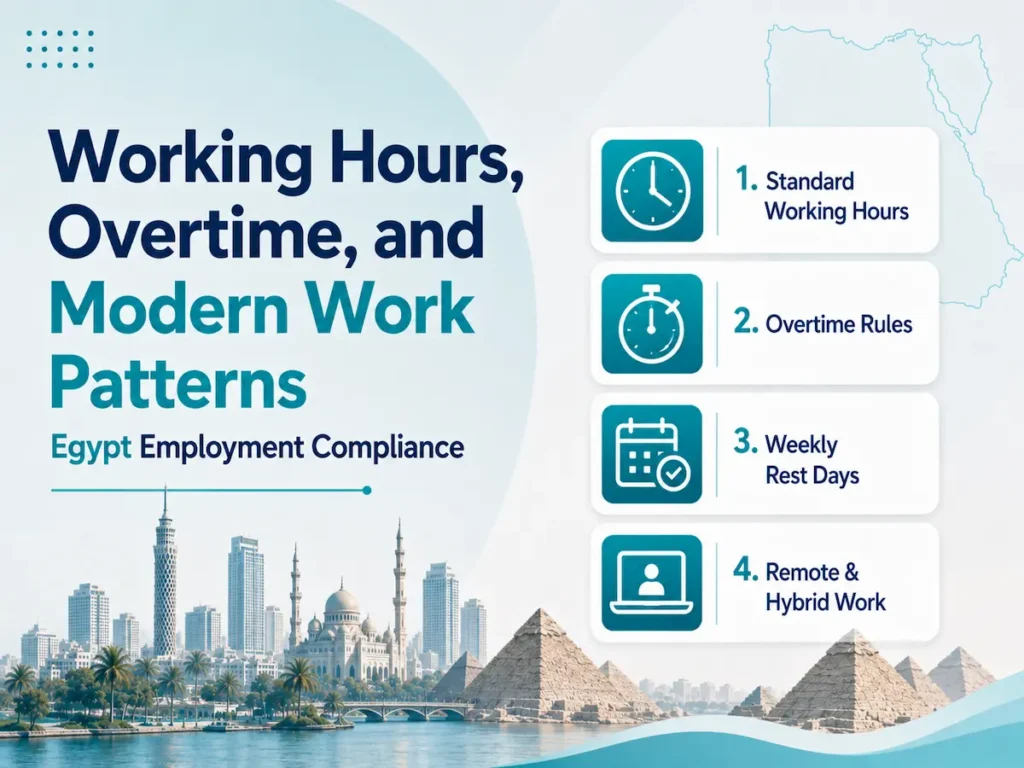
Working-time compliance requires employers to define normal working hours, rest days, overtime approval, timekeeping, and remote-work expectations. Egypt’s new labor framework also recognizes modern work arrangements, including remote work, part-time work, flexible work, and job sharing, according to employer summaries of Labor Law No. 14 of 2025.
This is important for international companies hiring remote employees in Egypt. Remote work does not remove local employment compliance duties. If an employee is legally employed in Egypt, the employer still needs compliant contracts, payroll, social insurance, leave administration, and recordkeeping. Companies building distributed teams should review Begory’s Remote Hiring Egypt support to structure remote employment correctly.
Leave and Employee Benefits
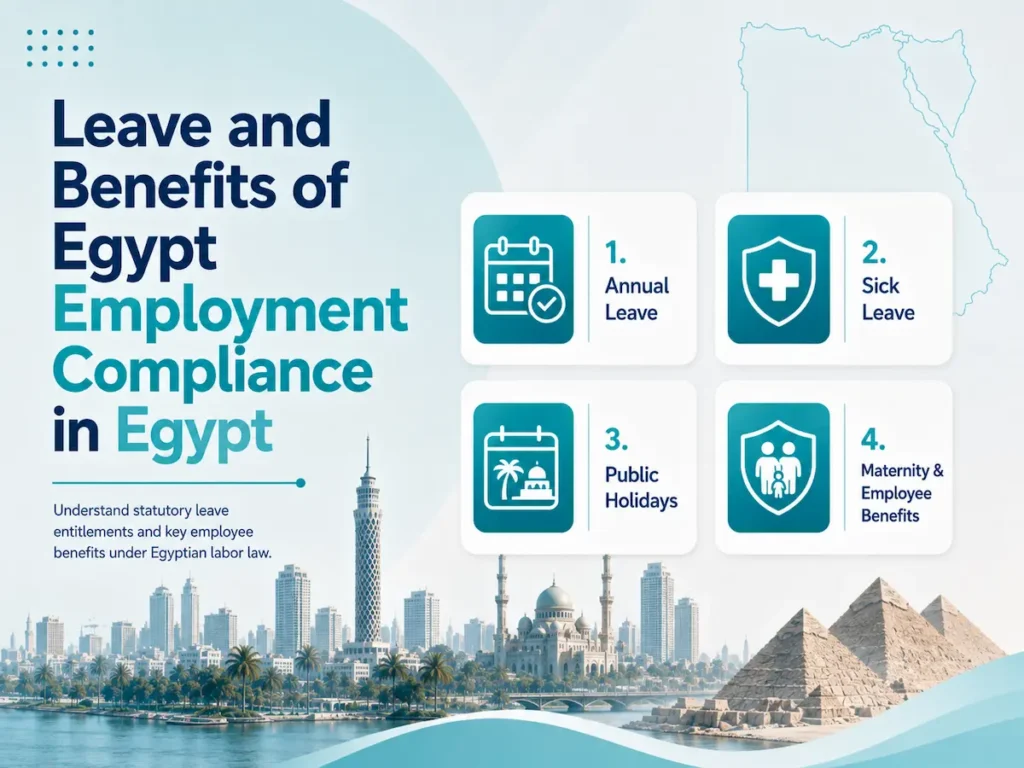
Leave administration is a common source of employment disputes. Employers should document annual leave, public holidays, sick leave, maternity leave, paternity leave, study leave, and any company benefits that exceed statutory minimums.
EY’s overview of Law No. 14 of 2025 highlights several leave-related reforms, including annual leave starting at 15 working days during the first year and increasing afterward, maternity leave of four months, paternity leave on the child’s day of birth up to three times during employment, and expanded rights for study leave in certain circumstances. Employers should verify the exact application of these rules based on employee category, implementing regulations, and internal policy design.
Best practice is to maintain a written leave policy and a reliable leave-tracking system. The policy should explain eligibility, approval workflow, carryover rules if applicable, documentation requirements, and how leave interacts with payroll.
Termination and Resignation Compliance
Termination in Egypt should be handled carefully. Employers need lawful grounds, documentation, internal review, notice handling, final pay calculations, and proper employee file updates. Poorly documented termination is one of the fastest ways to turn a performance issue into a labor dispute.
Law No. 14 of 2025 also introduced updates around resignation procedures. EY’s summary notes that employers must respond to employee resignations within 10 days and that the competent administrative authority must ratify resignations. Employers should confirm the practical process with local counsel or compliance specialists before relying on internal resignation workflows.
For limited-term contracts, employers should also review how early termination is treated under the new framework. Do not assume that ending a fixed-term agreement is low risk simply because the contract has an end date. Termination wording, reason, timing, documentation, and final settlement all matter.

Hiring Non-Egyptian Employees in Egypt
Non-national employees require special attention. Employers should verify work authorization, residence status, licensing requirements, role eligibility, and documentation before employment begins. EY’s summary of Law No. 14 of 2025 notes that non-national employees are not permitted to work in Egypt before obtaining the relevant license and authorization to enter and reside for work purposes.
For employers, this means immigration and labor compliance should be coordinated before the start date. The offer letter should not create a start-date promise that the company cannot legally satisfy. Work permit and residency timelines should be built into onboarding plans.
Contractor Misclassification Risk in Egypt
Many international companies first enter Egypt by engaging contractors. This can be practical for limited independent services, but it becomes risky when the worker behaves like an employee. Warning signs include fixed working hours, direct supervision, company equipment, exclusive service, monthly salary-like payments, integration into the team, and long-term dependency on one client.
If the relationship looks like employment, the company may face claims for employee rights, social insurance, tax withholding, leave, notice, and other statutory protections. A contractor agreement alone does not decide the legal reality. The actual working relationship matters.
If your company wants to access Egyptian talent but does not yet have a local entity, consider whether an EOR model is cleaner than pushing employee-like workers into contractor arrangements. Begory can help companies Hire Egyptian Workers through workforce solutions that support recruitment and compliant engagement.
Employee Records and HR Documentation
Good documentation is the quiet backbone of Egypt employment compliance. Employers should maintain employee contracts, IDs, job descriptions, payroll records, social insurance records, leave records, performance notes, disciplinary records, policy acknowledgments, training documents, and termination files.
EY’s summary of the 2025 labor reform notes an extended retention requirement for employee files for five years after termination. Employers should confirm final retention details with official sources and make sure HR systems can store files securely and retrieve them during audits or disputes.
For global companies, documentation should be both locally compliant and internally usable. HR teams need enough structure to support audits, employee questions, payroll checks, and management decisions. A clear file checklist is often more valuable than a long policy that nobody follows.
Employment Compliance for Companies Without a Local Entity
If your company does not have an Egyptian entity, you cannot simply place an employee on a foreign payroll and assume the arrangement is compliant. Employment law usually follows where the employee works and where the employment relationship is performed. That means Egyptian requirements can apply even if the parent company is based abroad.
The most practical solution is often an Employer of Record. The EOR becomes the legal employer in Egypt and handles local employment administration while the client company directs the employee’s work. This model can reduce setup time, help avoid entity formation costs, and create a cleaner compliance structure for early-stage hiring.
However, EOR is not a replacement for thoughtful workforce planning. Companies should still define the role, salary, reporting line, equipment, working hours, performance process, data access, confidentiality requirements, and long-term plan for the Egypt team.
Egypt Employment Compliance Roadmap
Hiring employees in Egypt requires employers to follow a structured compliance process before issuing an offer, onboarding staff, running payroll, and managing the employment relationship. International companies should confirm the correct worker classification, choose a compliant hiring structure, prepare localized employment documents, and keep payroll, tax, social insurance, leave, working time, and employee records aligned with Egyptian labour requirements.
| Step | Action | Owner |
|---|---|---|
| 1 | Confirm the worker classification: employee, independent contractor, or consultant. | HR, Legal |
| 2 | Select the legal hiring structure: local entity, Employer of Record, or another compliant employment route. | Leadership, Legal, Finance |
| 3 | Prepare a localized Egypt employment contract before the employee starts work. | HR, Legal, EOR |
| 4 | Complete onboarding documents and collect required employee information. | HR, HR Operations |
| 5 | Set up payroll, salary tax withholding, and social insurance administration. | Payroll, Finance |
| 6 | Document working hours, leave entitlements, benefits, workplace policies, and HR procedures. | HR |
| 7 | Maintain employee records throughout the employment relationship. | HR Operations |
| 8 | Review termination, resignation, notice, and end-of-service procedures before ending employment. | HR, Legal |
| 9 | Review compliance updates at least annually or whenever Egypt labour, tax, or social insurance rules change. | Compliance, Legal Counsel |
Common Egypt Employment Compliance Mistakes
- Hiring before deciding who the legal employer is.
- Using non-local employment contracts without Egyptian review.
- Misclassifying long-term full-time workers as independent contractors.
- Running payroll without proper tax and social insurance administration.
- Forgetting to update policies after Labor Law No. 14 of 2025.
- Not tracking leave balances or working-time records.
- Terminating employees without evidence, notice review, or proper procedure.
- Assuming remote workers are outside Egyptian employment rules.
How Begory Advance Hire Supports Egypt Employment Compliance
Begory Advance Hire helps international companies hire, onboard, pay, and manage employees in Egypt with local workforce support. Depending on your situation, Begory can support Employer of Record hiring, payroll administration, HR outsourcing, recruitment, remote hiring, employee onboarding, and employment compliance coordination.
For companies without an Egyptian entity, Begory’s EOR support can help create a compliant employment foundation. For companies with an entity, Begory can support HR operations and payroll administration. For companies still searching for talent, Begory can help source Egyptian professionals while aligning the hiring process with compliance needs from the start.
Final Answer: How Should Employers Approach Egypt Employment Compliance?
Employers should approach Egypt employment compliance as a full employee lifecycle system. The process starts with the hiring model, continues through contract drafting, payroll, social insurance, leave, HR documentation, and working-time management, and ends with compliant resignation or termination handling.
Egypt is a strong hiring market, but companies should not treat compliance as an afterthought. Labor Law No. 14 of 2025, social insurance rules, payroll tax withholding, and documentation requirements all make local expertise important. Before hiring, updating policies, or ending employment, verify details with official Egyptian sources, legal counsel, or Begory Advance Hire’s compliance team.
If your company wants to hire in Egypt without building a local HR and payroll operation from scratch, Begory Advance Hire can help you choose the right employment model and manage the local compliance details.
-
Previous Post
EOR vs opening a local entity in Egypt
-
Next Post
Payroll and Social Insurance in Egypt
Related Posts
Egypt Labor Law for Foreign Companies
Egypt Labor Law for Foreign Companies: Complete 2026 Employer Guide Egypt Labor Law for Foreign…
Hiring Remote Employees in Egypt
Hiring Remote Employees in Egypt: Complete Guide for Global Companies Hiring remote employees in Egypt…
Employee Contracts in Egypt
Employee Contracts in Egypt: Complete Employer Guide for 2026 Employee contracts in Egypt should be…
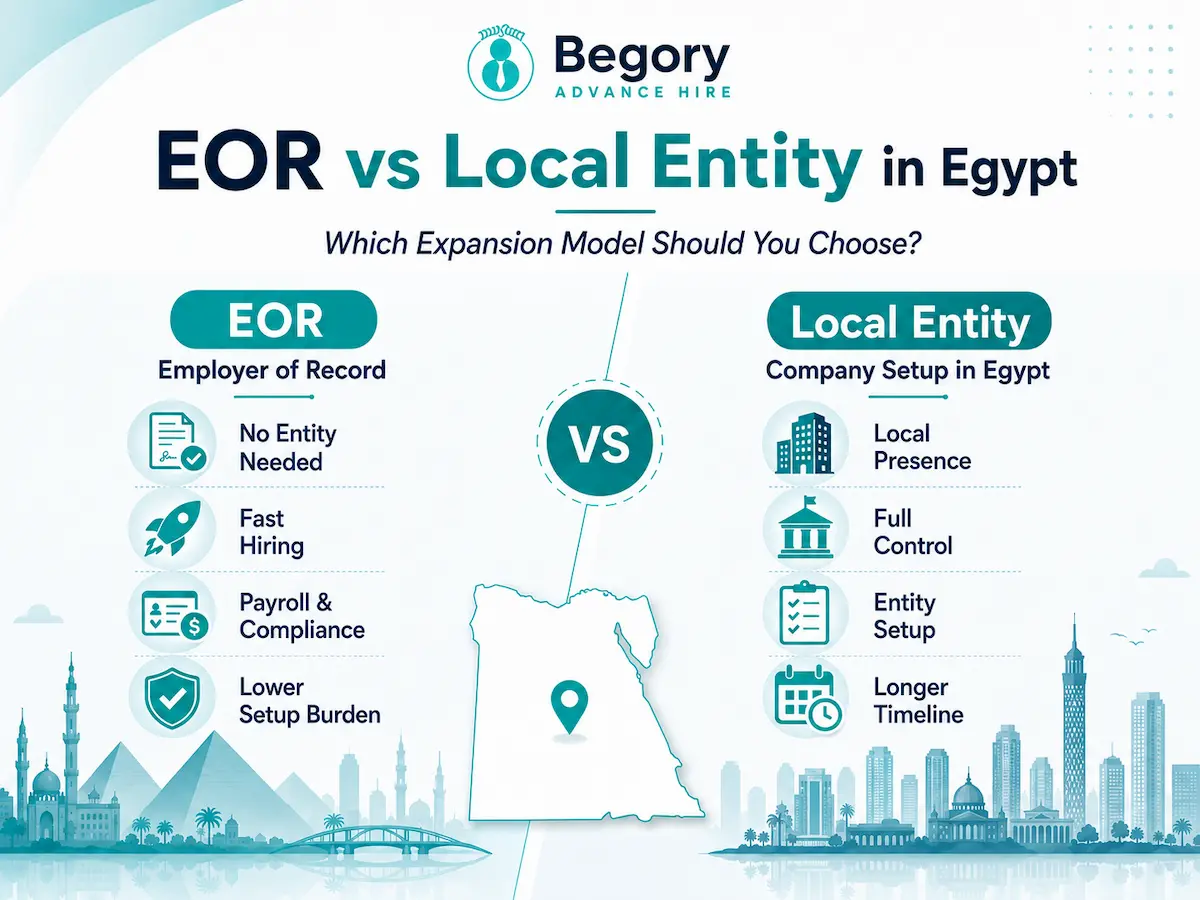
EOR vs opening a local entity in Egypt
EOR vs Opening a Local Entity in Egypt: Which Expansion Model Should You Choose? EOR…
