

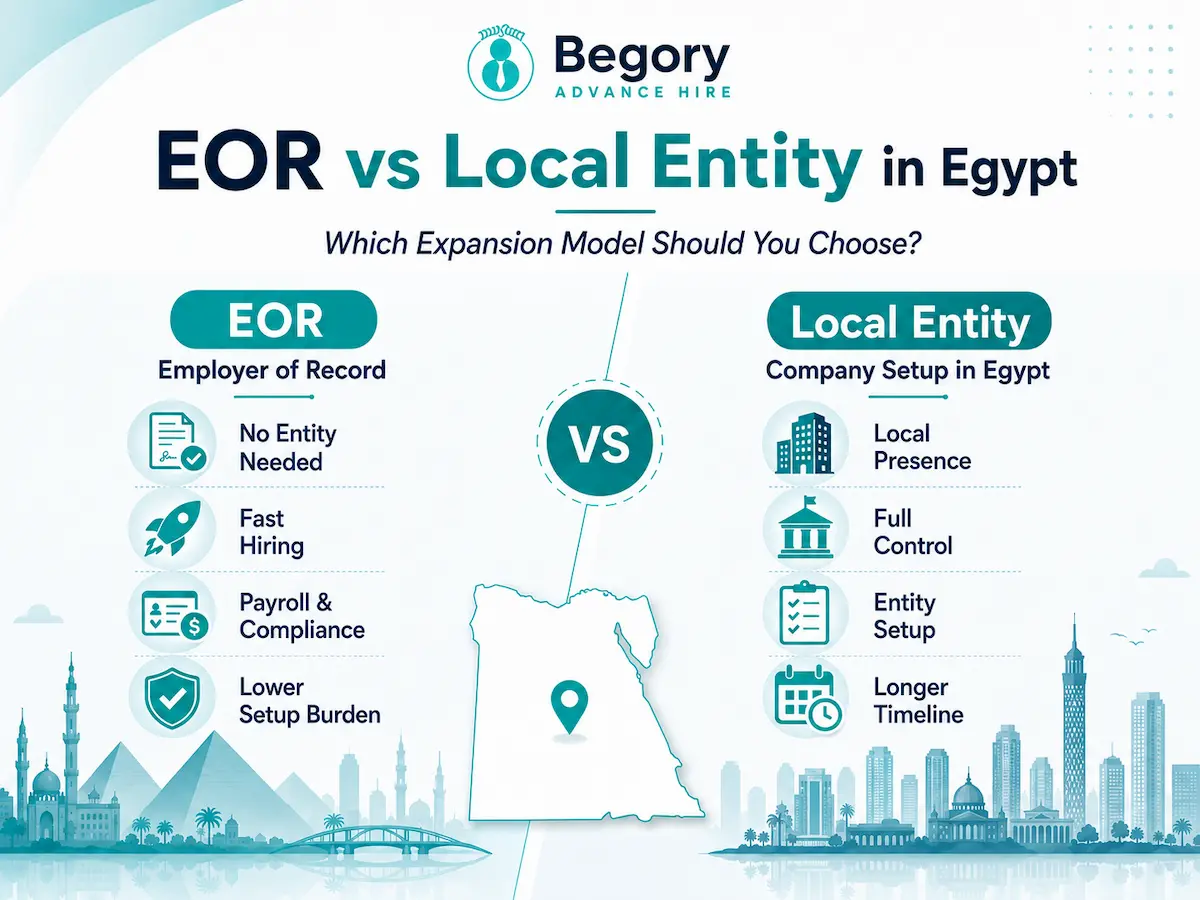
EOR vs Opening a Local Entity in Egypt: Which Expansion Model Should You Choose?
EOR vs opening a local entity in Egypt comes down to speed, commitment, compliance responsibility, and long-term control. An Employer of Record helps international companies hire employees in Egypt without creating a local company, while opening a local entity gives the business direct legal presence, full employer responsibility, and more long-term operational control.
Considering an EOR for your team? Review our Egypt Employer of Record service and EOR cost guide alongside the entity comparison below.
For many foreign companies, Egypt is an attractive hiring market. The country offers a large workforce, strong regional positioning, competitive talent availability, and access to professionals across technology, engineering, construction, healthcare, customer support, hospitality, manufacturing, and oil and gas. But hiring employees in Egypt also means dealing with employment contracts, payroll, tax withholding, social insurance, HR records, labor compliance, and local authority processes.
That is why companies often compare two options before hiring: using an Employer of Record service in Egypt or opening a local legal entity. Both models can work. The right choice depends on whether your company needs fast hiring, market testing, long-term investment, direct control, or full local operations.
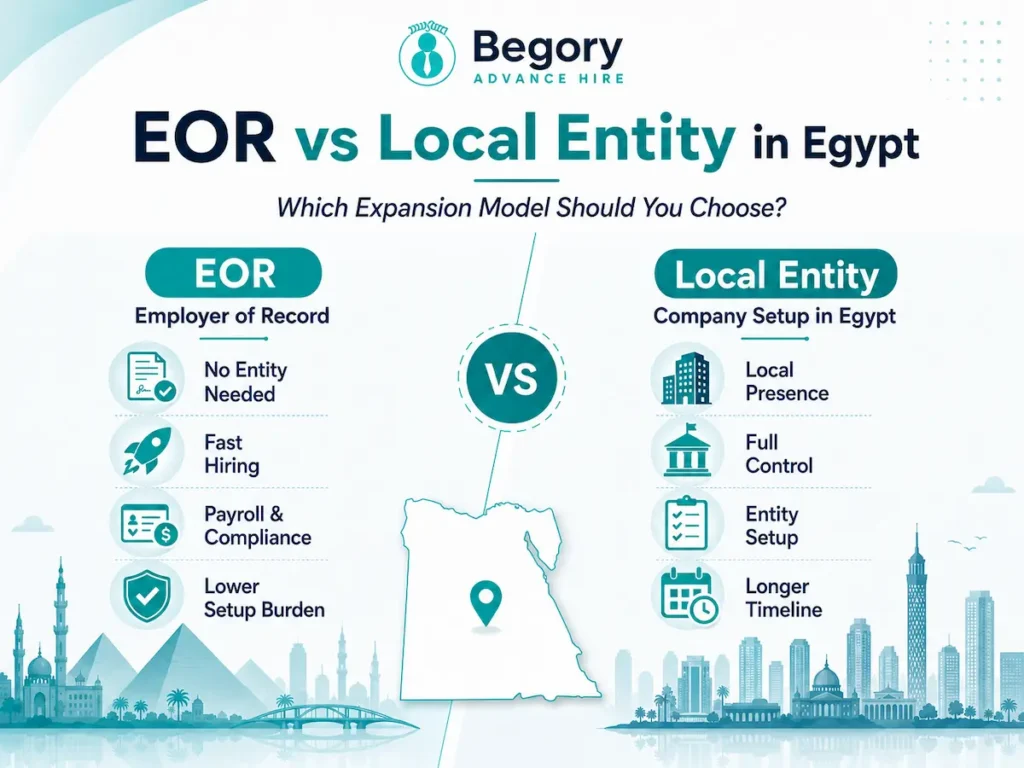
Short Answer: EOR vs Local Entity in Egypt
| Question | Direct Answer |
|---|---|
| What is an EOR in Egypt? | An Employer of Record in Egypt legally employs workers on behalf of a foreign company, handling payroll, contracts, HR administration, tax coordination, and compliance while the client manages daily work. |
| What is opening a local entity? | Opening a local entity means registering a company, branch, or other legal structure in Egypt so your business can directly employ staff and operate locally. |
| Which is faster? | EOR is usually faster because it avoids the need to complete full company setup before hiring. |
| Which gives more control? | A local entity gives more direct legal and operational control, but also brings more responsibility. |
| Which is better for market testing? | EOR is usually better for market testing, first hires, remote teams, and project-based hiring. |
| Which is better for permanent large-scale operations? | A local entity may be better for companies planning major investment, physical operations, large headcount, or long-term local presence. |
What Is an Employer of Record in Egypt?
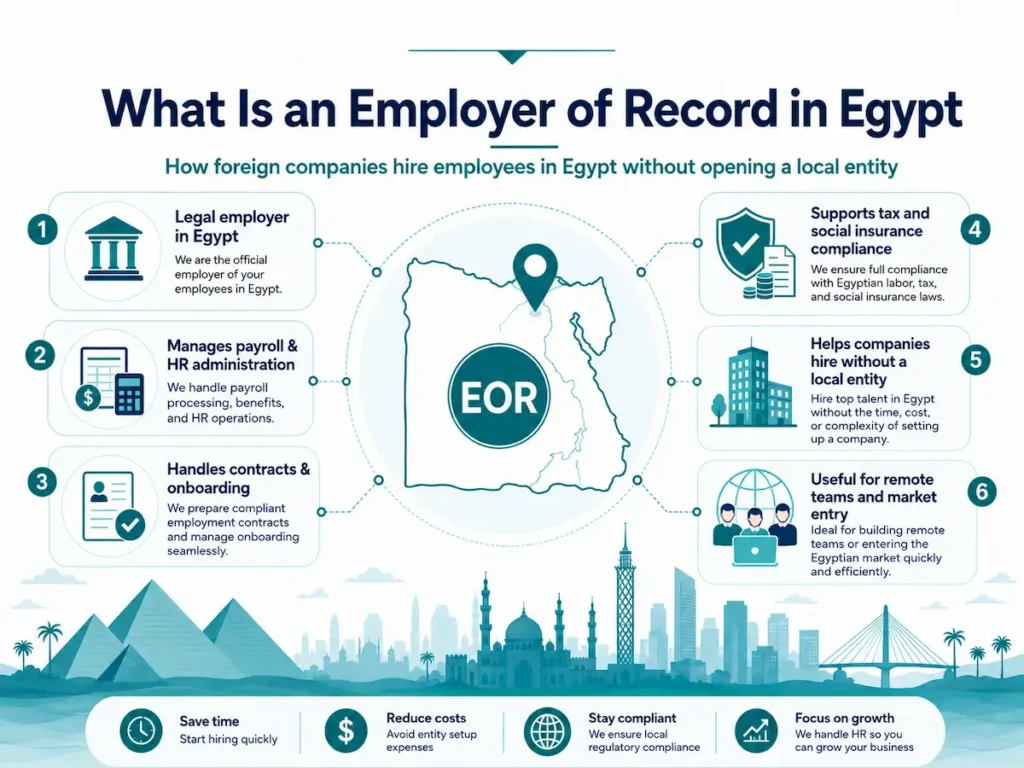
An Employer of Record, or EOR, is a third-party organization that becomes the legal employer of workers in a country on behalf of another company. In Egypt, this means the EOR can employ the worker locally while the foreign client company manages the employee’s daily work, performance, priorities, and business outcomes.
The EOR typically handles employment contracts, onboarding, payroll, salary payments, statutory deductions, social insurance administration, HR documentation, benefits coordination, leave records, and employment compliance support. The client company does not need to open an Egyptian company before hiring.
This model is especially useful for businesses that want to hire employees in Egypt quickly, test the market, build a remote team, support a regional project, or employ one or several strategic employees before committing to a local entity.
How EOR Works in Practice
Under an EOR arrangement, the client company signs a commercial agreement with the EOR provider. The EOR then signs the local employment agreement with the employee and manages employment administration in Egypt. The client company directs the employee’s work but does not become the local legal employer.
This structure separates operational management from employment administration. The foreign company manages the employee’s role, goals, tools, meetings, deliverables, and performance. The EOR manages payroll, contracts, statutory processes, and local HR compliance.
What an EOR Usually Handles
- Local employment contracts and onboarding documents
- Payroll processing and salary payment coordination
- Income tax withholding support and payroll reporting coordination
- Social insurance administration
- Leave, benefits, HR records, and employee files
- Employment compliance guidance
- Offboarding and termination administration
- Employee HR support during the employment lifecycle
An EOR does not normally replace the client’s role as the operational manager. The EOR supports employment administration so the client can focus on business outcomes.
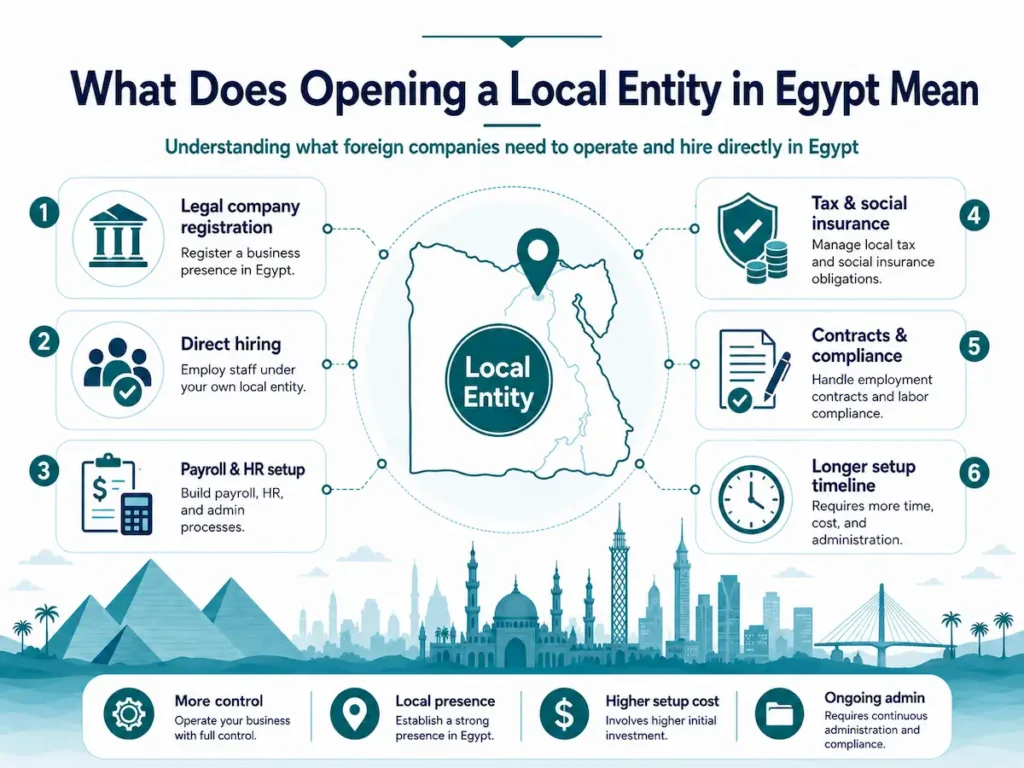
What Does Opening a Local Entity in Egypt Mean?
Opening a local entity in Egypt means creating a registered legal presence through the appropriate structure, such as a company, branch, or other approved business form. Once established, the entity can enter contracts, employ staff directly, register for tax, run payroll, maintain accounting records, and operate as a local employer.
Company setup in Egypt may involve decisions about legal structure, shareholders, documentation, capital requirements, tax registration, banking, accounting, employment registration, payroll systems, office needs, and ongoing governance. The General Authority for Investment and Free Zones is a key official body for investment and company establishment in Egypt, and companies should review official GAFI guidance before proceeding.
A local entity can be the right choice when a company is making a serious long-term commitment to Egypt. It is often more suitable for businesses planning a large team, physical operations, local revenue generation, commercial contracts, office presence, regulated activity, or long-term investment.
What a Local Entity Usually Requires
- Choosing the right legal structure
- Preparing incorporation documents
- Submitting company registration documents through the relevant channels
- Tax registration and accounting setup
- Banking and finance administration
- Payroll infrastructure
- Employment contracts and HR policies
- Social insurance processes
- Ongoing compliance, accounting, filings, and governance
The exact requirements depend on the legal structure, activity, ownership, industry, and current Egyptian regulations. Companies should verify details through official sources, legal counsel, tax advisors, and local compliance specialists before making a final decision.
EOR vs Opening a Local Entity in Egypt: The Core Difference
The core difference is legal responsibility. With an EOR, the EOR is the local legal employer. With a local entity, your company is the direct local employer and carries the full responsibility for employment, payroll, tax, accounting, and corporate compliance.
| Factor | Employer of Record in Egypt | Opening a Local Entity in Egypt |
|---|---|---|
| Local company required before hiring? | No. The EOR provides the local employment structure. | Yes. Your company must complete entity setup before directly employing staff. |
| Legal employer | The EOR. | Your Egyptian entity. |
| Best for | Fast hiring, first employees, remote teams, project roles, market testing. | Long-term operations, large teams, local contracts, office setup, direct control. |
| Setup complexity | Lower for the client. | Higher because incorporation, tax, payroll, accounting, and governance must be established. |
| Payroll | Managed by the EOR as part of the employment service. | Managed by the local entity internally or through a payroll/HR outsourcing partner. |
| Compliance responsibility | The EOR manages employment administration, with the client still responsible for operational decisions. | The company carries full employer and corporate compliance responsibility. |
| Control | Client controls daily work; EOR controls employment administration. | Company controls both employment and operations directly. |
| Long-term scalability | Good for lean teams and market entry; may later transition to entity. | Better for large, permanent, complex operations. |
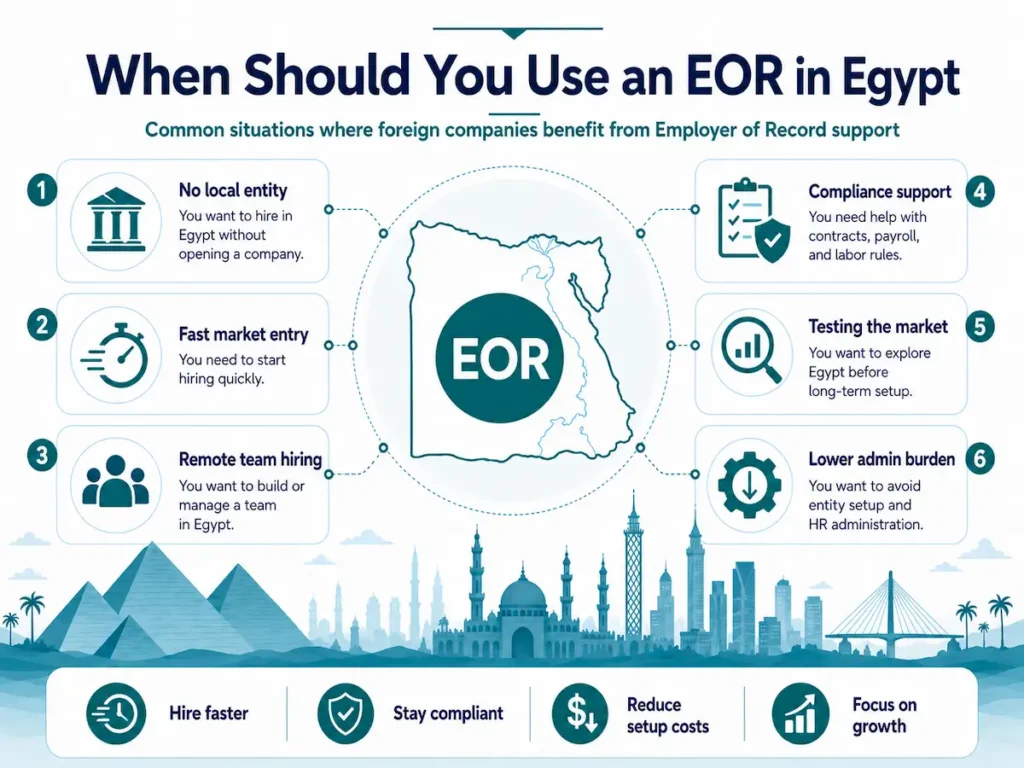
When Should You Use an EOR in Egypt?
You should consider EOR in Egypt when you need to hire before you are ready to open a company. This is the clearest use case. Many companies have a strong business reason to hire Egyptian talent but do not yet have the headcount, budget, legal certainty, or long-term market plan to justify entity setup.
Use EOR If You Need to Hire Quickly
If you have already found the right employee in Egypt, waiting for company setup can slow momentum. EOR can help you move from candidate selection to compliant employment faster because the local employment infrastructure already exists through the provider.
This is valuable when hiring senior technical talent, customer support teams, sales representatives, project coordinators, engineers, recruiters, or operations staff.
Use EOR If You Are Testing the Egyptian Market
Many companies want to validate demand before making a large investment. EOR allows a business to hire one or several employees, build relationships, test operations, and learn the local market before deciding whether to incorporate.
This is common for SaaS companies, construction firms, energy businesses, healthcare suppliers, BPO operations, recruitment projects, and regional service providers.
Use EOR If You Want Lower Initial Administrative Burden
Opening an entity requires local accounting, tax registration, employment policies, payroll systems, legal documents, banking, and governance. If your first goal is simply to employ a small team, EOR may reduce the initial workload.
Use EOR If You Are Hiring Remote Employees
Remote hiring has made it easier for companies to access Egyptian talent without a physical office. EOR supports this model by providing local employment administration while the employee works remotely for the client company.
Use EOR If You Want a Bridge Before Entity Setup
EOR can be a temporary bridge. A company may hire through EOR for 6, 12, or 18 months while deciding whether to open an Egyptian entity. If the business case becomes strong enough, employees may later transition to the company’s own local entity through a properly managed process.
When Should You Open a Local Entity in Egypt?
Opening a local entity may be the right move when Egypt is no longer just a hiring location but a strategic operating market. If the company expects long-term presence, larger headcount, local revenue, commercial operations, warehousing, manufacturing, regulated activities, or direct contracts, entity setup may become more appropriate.
Open a Local Entity If You Need Full Legal Presence
A local entity gives your business a direct legal identity in Egypt. This may be important for signing local contracts, leasing office space, opening local bank accounts, bidding for projects, issuing invoices, or managing commercial obligations directly.
Open a Local Entity If You Plan Large-Scale Hiring
For a company hiring a large permanent workforce, direct employment through a local entity may become more efficient over time. The entity can build its own HR department, payroll systems, leadership structure, and compliance processes.
Open a Local Entity If You Need Maximum Operational Control
A local entity gives the company direct control over employment agreements, HR policies, benefits design, payroll systems, local leadership, vendor contracts, and employment operations. This control can be valuable for mature operations.
Open a Local Entity If Egypt Is a Long-Term Revenue Market
If Egypt is part of your sales, distribution, manufacturing, or services strategy, entity setup may support broader business goals beyond hiring. Official resources such as Invest in Egypt can help companies explore investment context, though professional advice is still essential.
Entity Setup in Egypt: What Companies Should Expect
Opening a company in Egypt is a strategic legal and operational project. It is not only a paperwork task. A company must understand the correct structure, required documents, ownership model, activity approvals, tax setup, labor obligations, payroll systems, accounting responsibilities, and ongoing governance.
GAFI provides official company incorporation information, including GAFI company incorporation services. However, companies should work with qualified legal and tax advisors before relying on any general guide, because requirements can vary by structure and business activity.
Typical Entity Setup Workstreams
- Legal structure selection
- Shareholder and director documentation
- Company name and registration process
- Commercial registry and tax registration
- Banking and capital arrangements
- Accounting and bookkeeping setup
- Employment contract templates
- Payroll and HR systems
- Social insurance processes
- Internal policies and compliance workflows
These workstreams take planning. A company that wants only one or two employees may find the process disproportionate at the beginning. A company building a long-term operation may see it as necessary infrastructure.
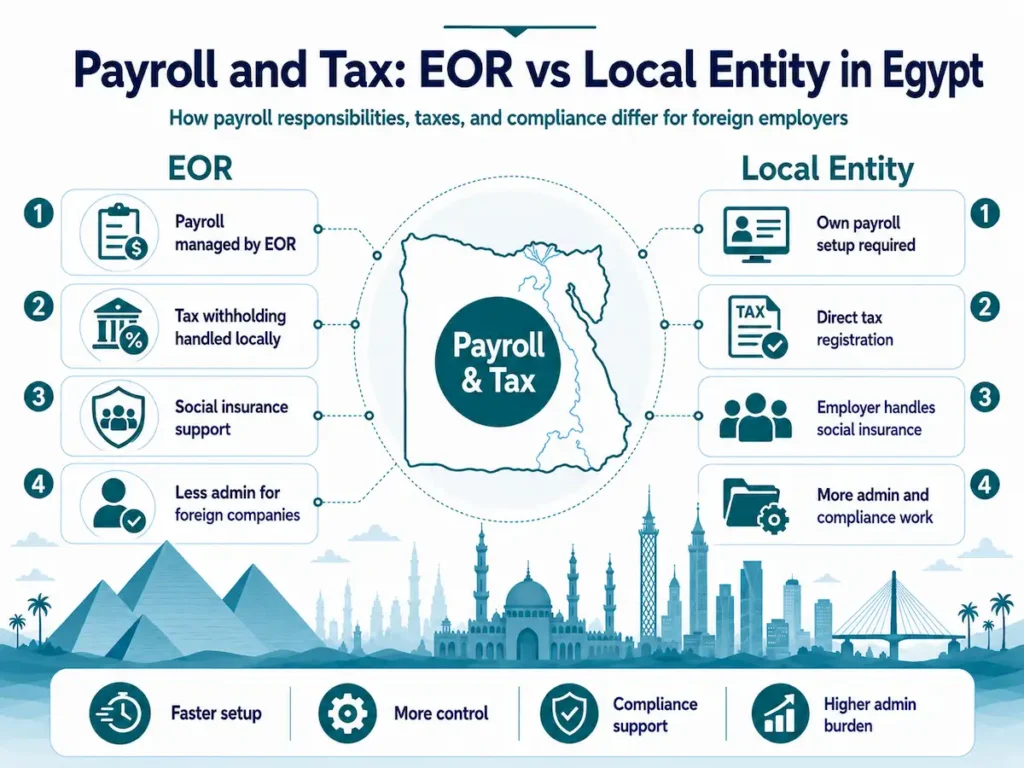
Payroll and Tax: EOR vs Local Entity in Egypt
Payroll is one of the biggest differences between EOR and opening a local entity. Under an EOR model, payroll is typically administered by the EOR as legal employer. Under a local entity model, the company must run payroll itself or outsource payroll administration while remaining legally responsible as employer.
Egypt payroll can involve salary calculations, tax withholding, employee records, statutory deductions, social insurance coordination, payslips, and reporting. Companies should consult official sources such as the Egyptian Tax Authority and qualified advisors before processing payroll or making tax decisions.
Payroll Under an EOR Model
In an EOR model, the provider typically manages payroll administration for the employee. The client company funds salary, employer costs, and service fees according to the commercial agreement. The EOR coordinates payroll processes locally and supports compliance with employment obligations.
This helps companies avoid building payroll infrastructure before they have a local entity.
Payroll Under a Local Entity Model
In a local entity model, your company must create or outsource payroll operations. That may include payroll software, accounting support, HR records, tax coordination, social insurance administration, salary payment processes, and internal approvals.
If the company does not want to manage all HR operations internally, it can use HR outsourcing Egypt support after entity setup. This model is different from EOR because the company remains the legal employer.
Labor Compliance: EOR vs Local Entity in Egypt
Labor compliance in Egypt involves written employment agreements, employee records, working arrangements, leave administration, payroll documentation, termination procedures, social insurance processes, and local HR practices. Companies should verify current requirements with the Egyptian Ministry of Labor, legal counsel, or Begory’s compliance team.
Under EOR, the provider helps manage local employment compliance because it is the legal employer. Under a local entity, the company must develop and maintain its own employment compliance system.
Compliance Under EOR
EOR can reduce compliance complexity for foreign companies because the provider already understands local employment administration. The EOR handles the employment contract, payroll workflow, HR files, and local processes within its role.
However, the client company must still act responsibly. Operational decisions such as performance management, role changes, compensation changes, disciplinary action, or termination should be coordinated with the EOR before action is taken.
Compliance Under a Local Entity
A local entity gives more control but also more obligation. The company must ensure employment contracts are properly drafted, payroll records are accurate, social insurance processes are handled, employee files are maintained, and labor decisions follow local requirements.
This can be manageable for companies with a strong HR and legal team. It can be risky for companies that open an entity without building the compliance infrastructure to support it.
Cost Comparison: EOR vs Opening a Local Entity in Egypt
The cost comparison depends on headcount, salary levels, legal structure, business activity, service scope, payroll complexity, office needs, accounting support, legal advisory, and long-term expansion plans. It would be inaccurate to give one universal cost for every company.
Still, the cost logic is clear.
EOR usually has lower upfront setup cost because you do not need to establish a company before hiring. You pay service fees and employment-related costs through the provider. This can be efficient for small teams, first hires, market testing, and remote employees.
Opening a local entity usually has higher upfront cost because it requires incorporation, legal support, tax registration, accounting, banking, payroll setup, HR infrastructure, and ongoing corporate administration. But it may become more efficient for larger, permanent operations.
| Cost Area | EOR | Local Entity |
|---|---|---|
| Initial setup | Lower for the client because the provider has the employment infrastructure. | Higher because incorporation, registration, legal, tax, and accounting setup are required. |
| Monthly costs | Service fee plus employment costs. | Payroll, HR, accounting, tax, legal, office, systems, and administration costs. |
| Best cost fit | Small teams, market entry, first hires, remote teams. | Large teams, long-term operations, direct local presence. |
| Hidden risk | Poor provider selection or unclear service scope. | Underestimating ongoing compliance and administration workload. |
Speed Comparison: EOR vs Local Entity
EOR is generally faster for hiring because the company does not need to complete entity setup first. The provider can support onboarding through its existing local employment structure.
Opening a local entity takes longer because it requires legal setup and operational readiness. The company must be prepared to employ staff, run payroll, maintain records, and comply with local rules once employees are hired.
If the company needs to hire immediately, EOR is usually the more practical starting point. If the company has a long planning horizon and wants full local operations, entity setup may be worth the wait.
Control Comparison: EOR vs Local Entity
Opening a local entity gives the company more direct control. The company can design its own employment structure, HR policies, compensation systems, payroll processes, local leadership model, office operations, and commercial activities.
EOR provides operational control over the employee’s day-to-day work, but employment administration is managed by the EOR. This is enough for many companies hiring remote workers or small teams. It may be less suitable for companies that need deep local integration, complex labor structures, or direct regulatory licenses.
| Control Area | EOR | Local Entity |
|---|---|---|
| Daily work management | Client company controls daily work. | Company controls daily work. |
| Employment contract | EOR signs as employer. | Local entity signs as employer. |
| Payroll system | Managed by EOR. | Managed or outsourced by company. |
| HR policies | Coordinated through EOR framework. | Designed and owned by company. |
| Local commercial presence | Limited; EOR is for employment support. | Fuller legal and commercial presence. |
Risk Comparison: EOR vs Local Entity
Every expansion model carries risk. EOR can reduce the risk of entering Egypt without local employment infrastructure, but companies must choose a reliable provider and keep responsibilities clear. Local entity setup gives control but creates direct compliance obligations.
Risks of EOR
- Choosing an inexperienced provider
- Unclear service scope
- Weak communication between client, EOR, and employee
- Assuming the EOR handles operational decisions without client involvement
- Not planning for transition if the company later opens an entity
Risks of Opening a Local Entity
- Underestimating setup complexity
- Delaying hiring while incorporation is still in progress
- Creating payroll and tax errors
- Failing to maintain proper employee records
- Lacking local HR expertise
- Taking on corporate compliance obligations before the business case is proven
The lower-risk option depends on your situation. For a first hire, EOR often reduces risk. For a mature local operation, a properly managed entity may reduce strategic dependency and increase control.
Can You Start With EOR and Open a Local Entity Later?
Yes. Many companies use EOR as a bridge into Egypt. This approach lets the company hire first, learn the market, validate talent quality, build operations, and decide later whether entity setup is justified.
A staged approach may look like this:
- Hire first employees in Egypt through EOR.
- Build the team and validate the business case.
- Assess long-term headcount, cost, and operational needs.
- Begin entity setup if Egypt becomes a strategic market.
- Plan employee transition carefully with legal, payroll, and HR support.
- Move from EOR to direct employment when the local entity is ready.
- Use payroll services Egypt or HR outsourcing if internal HR capacity is limited.
This path gives companies flexibility. It avoids overcommitting too early while preserving the option to build a permanent local structure later.
Which Model Fits Your Situation?
| Business Situation | Best-Fit Model | Why |
|---|---|---|
| You want to hire one employee in Egypt. | EOR | Entity setup may be too heavy for a single hire. |
| You want to test Egypt as a new market. | EOR | EOR supports market validation with lower upfront commitment. |
| You need a full Egyptian office and local contracts. | Local entity | A local company gives direct legal and commercial presence. |
| You plan to hire a large permanent team. | Local entity, possibly after EOR bridge | Entity setup may become more efficient at scale. |
| You need remote Egyptian talent quickly. | EOR | EOR supports compliant hiring without waiting for incorporation. |
| You already have an Egyptian entity but need HR support. | HR outsourcing | Your entity remains employer while a partner supports payroll and HR. |
| You are unsure about long-term Egypt headcount. | EOR | EOR keeps the model flexible while you evaluate demand. |
Decision Framework: EOR or Local Entity?
Ask these questions before choosing:
- Do we already have a legal entity in Egypt?
- How many employees do we need in the first 12 months?
- Do we need to hire immediately?
- Are we testing the market or committing long term?
- Do we need local contracts, invoicing, banking, or office operations?
- Do we have local HR, payroll, accounting, and legal support?
- Can we manage direct employer obligations?
- Will entity setup create value beyond employment?
- Do we expect to transition from EOR to entity later?
If your answers point to speed, flexibility, and first hires, EOR is usually the stronger starting point. If your answers point to permanent operations, local revenue, direct control, and larger headcount, opening a local entity may be the better long-term structure.
Why Begory Advance Hire Helps Companies Choose the Right Egypt Hiring Model
Begory Advance Hire supports companies hiring and managing talent in Egypt through EOR, HR outsourcing, payroll support, and recruitment expertise. For companies without an Egyptian entity, Begory can help simplify compliant employment through an Employer of Record model. For companies with a local presence, Begory can support HR administration, payroll, compliance workflows, and employee management.
The value is not only administrative. Egypt hiring requires local understanding: candidate expectations, employment documentation, payroll practices, labor compliance, social insurance processes, and communication between international management and local employees.
Choosing between EOR and local entity setup is ultimately a business strategy decision. Begory helps companies match the model to their stage of growth, risk tolerance, hiring timeline, and long-term Egypt plan.
Conclusion: EOR vs Opening a Local Entity in Egypt
EOR vs opening a local entity in Egypt is a choice between flexible market entry and full local infrastructure.
An Employer of Record is usually the better option when your company wants to hire employees in Egypt quickly, avoid immediate entity setup, test the market, build a remote team, or employ a small number of strategic hires. The EOR becomes the legal employer and manages employment administration while your company directs the employee’s daily work.
Opening a local entity is usually better when Egypt is a long-term strategic market, your company needs direct commercial presence, you plan to hire at scale, or you want full control over local employment and operations.
The smartest path for many companies is phased: start with EOR, validate the market, then open a local entity when the business case is strong enough. Before acting, verify all legal, tax, payroll, social insurance, and company registration requirements with official Egyptian sources, qualified advisors, or Begory’s compliance team.
-
Previous Post
EOR vs PEO in Egypt
-
Next Post
Egypt Employment Compliance
Related Posts
Egypt Labor Law for Foreign Companies
Egypt Labor Law for Foreign Companies: Complete 2026 Employer Guide Egypt Labor Law for Foreign…
Hiring Remote Employees in Egypt
Hiring Remote Employees in Egypt: Complete Guide for Global Companies Hiring remote employees in Egypt…
Employee Contracts in Egypt
Employee Contracts in Egypt: Complete Employer Guide for 2026 Employee contracts in Egypt should be…
Egypt Employment Compliance
Egypt Employment Compliance: Complete Guide for Employers in 2026 Egypt employment compliance means hiring, paying,…
