

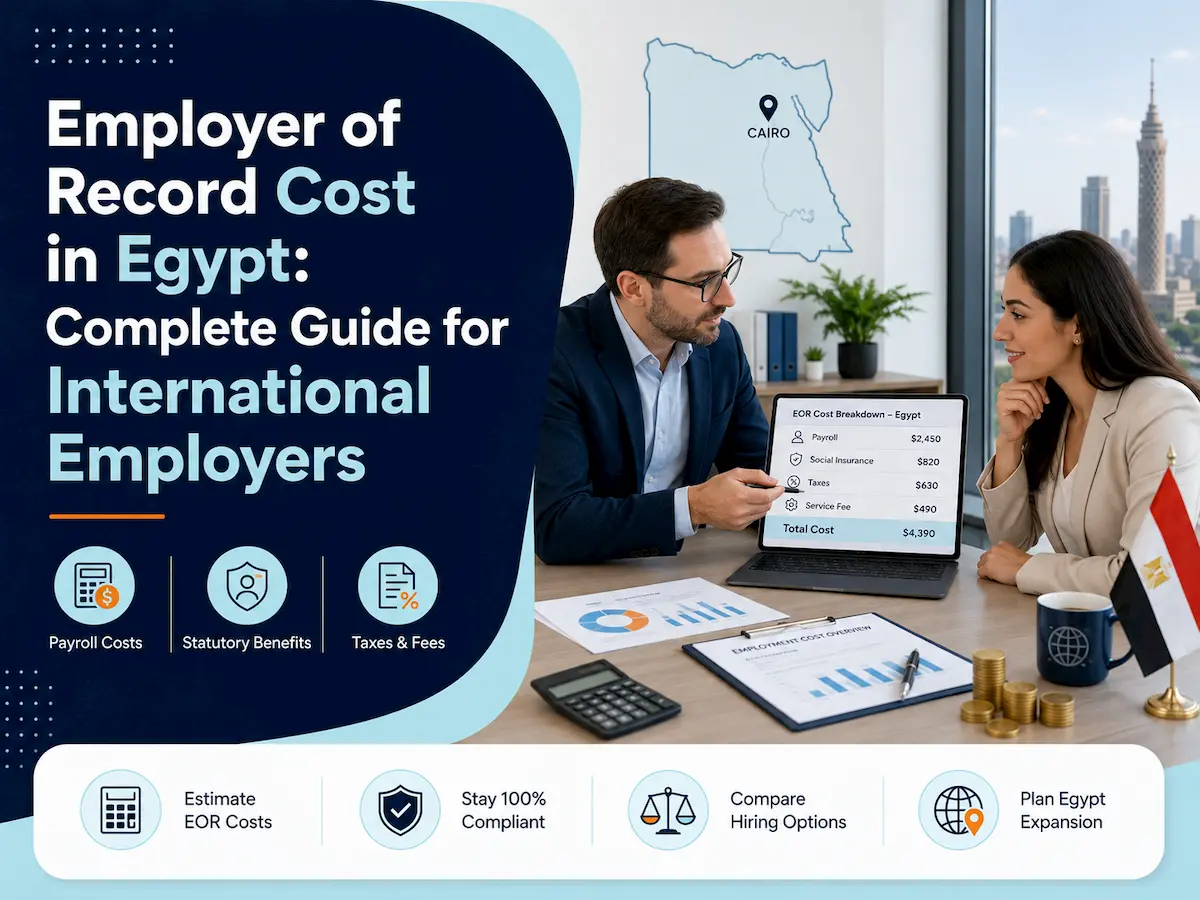
Employer of Record Cost in Egypt: Complete Guide for International Employers
Employer of Record cost in Egypt depends on the employee’s salary, statutory employer obligations, payroll administration, onboarding work, benefits, HR support, and the EOR provider’s service fee. For international companies, the main value of an Egypt EOR is not only price. It is the ability to hire legally, run payroll, manage social insurance, and employ workers in Egypt without opening a local company.
If your company wants to hire in Egypt, the cost question usually comes before the compliance question. Finance wants predictability. HR wants a smooth employee experience. Legal wants reduced risk. Founders and operators want to move quickly. An Employer of Record helps connect those priorities by giving your company a compliant local employment structure while you continue to manage the employee’s day-to-day work.
For most international companies, Employer of Record cost in Egypt should be reviewed as a total employment cost, not only as a monthly provider fee. The real calculation includes salary, employer-side obligations, payroll administration, employee onboarding, HR support, and compliance management.
Begory Advance Hire provides an Employer of Record service in Egypt for companies that want to hire employees, manage payroll, and stay compliant without establishing a local entity. This guide explains what affects EOR pricing in Egypt, what should be included in a reliable quote, and how to compare EOR cost against entity setup, payroll outsourcing, and independent contractor arrangements.
Short Answer: How Much Does an Employer of Record Cost in Egypt?
An Employer of Record in Egypt usually costs more than simple payroll processing but far less than opening and maintaining a local legal entity for a small team. The total cost normally includes the employee’s gross salary, employer statutory contributions, payroll and HR administration, onboarding, contract preparation, employee support, and the EOR provider’s management fee.
The exact fee should be quoted by the provider because Egypt EOR pricing can vary by employee salary, contract type, benefits, risk level, headcount, seniority, payment currency, and scope of service. A transparent EOR quote should separate statutory employment costs from the provider’s service fee so your finance team can see the true monthly employment cost.
What Is an Employer of Record in Egypt?
An Employer of Record, often shortened to EOR, is a third-party organization that legally employs workers on behalf of another company. In Egypt, the EOR becomes the local legal employer for employment contracts, payroll, tax withholding, social insurance registration, statutory administration, and HR compliance. The client company continues to direct the employee’s daily work, performance, role expectations, tools, and team integration.
This model is useful when an international company wants to hire Egyptian employees but does not want to create an Egyptian company immediately. Begory Advance Hire’s EOR page explains that the EOR model lets companies hire and manage employees legally without opening a local entity while the provider handles payroll, compliance, social insurance, contracts, and HR operations.
For cost planning, that distinction matters. You are not simply buying payroll software. You are paying for a local employment structure, compliance administration, employee support, statutory payroll work, and risk management. That is why EOR cost should be evaluated against the cost of entity setup, not only against the cost of a payroll vendor.

Why Companies Ask About Egypt EOR Cost
Egypt is an attractive hiring market for international employers because it offers a large talent pool, competitive labor costs, multilingual professionals, and a strong location for serving Middle East, African, and European markets. World Bank country data for Egypt provides useful macroeconomic context for companies evaluating the market, including GDP and development indicators through the World Bank Egypt data portal.
But hiring cost is not only salary. When a company employs someone in Egypt, it must consider employment contracts, payroll processing, tax withholding, social insurance, leave, onboarding documents, termination rules, HR support, and record keeping. These obligations can be difficult to manage from outside Egypt without local expertise.
That is why EOR pricing matters. The right EOR model should make the total employment cost easier to understand, forecast, and defend internally. It should also reduce the hidden costs that often appear when companies try to manage foreign employment without the right local setup.
What Is Included in Employer of Record Cost in Egypt?
A complete Egypt EOR quote should make the cost structure clear. At a minimum, it should show what the employee receives, what the employer must pay under local rules, what the EOR provider charges, and which additional services are included or excluded.
| Cost Component | What It Means | Why It Matters |
|---|---|---|
| Gross salary | The employee’s agreed monthly salary before employee deductions. | This is usually the largest part of total employment cost. |
| Employer statutory contributions | Mandatory employer-side costs such as social insurance obligations where applicable. | These affect the real cost above gross salary. |
| Employee deductions | Amounts deducted from employee pay, such as employee-side social insurance and income tax withholding where applicable. | These affect net pay and payroll calculations. |
| Payroll administration | Monthly payroll processing, payslips, calculations, and reporting support. | Accuracy matters for compliance and employee trust. |
| Employment contract setup | Preparation of compliant employment documentation. | Contracts reduce ambiguity and support lawful employment. |
| Onboarding | Collection of employee data, registration support, setup, and HR coordination. | Good onboarding speeds up hiring and reduces errors. |
| Benefits administration | Management of statutory or optional benefits, if included. | Benefits can affect employee retention and total cost. |
| EOR service fee | The provider’s fee for legal employment, HR operations, payroll, and compliance management. | This is the commercial fee that should be separated from statutory costs. |
Employer of Record Cost in Egypt vs Gross Salary
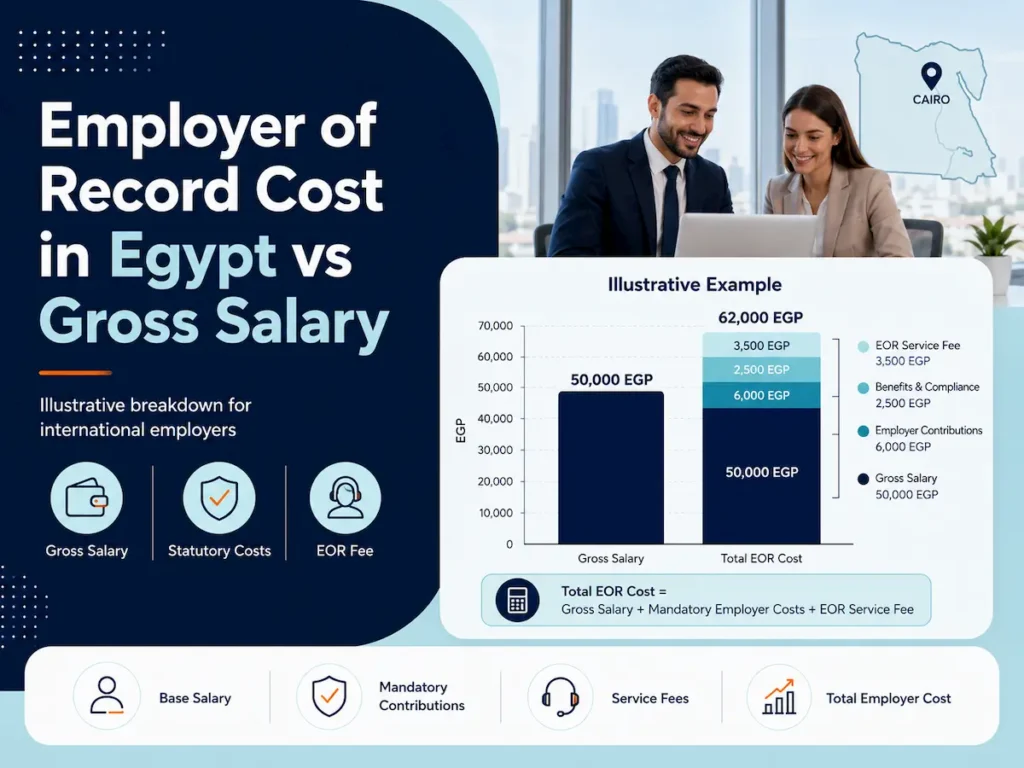
One common mistake is assuming that the employee’s gross salary equals the employer’s full monthly cost. In reality, gross salary is only the starting point. The employer must also account for statutory obligations, payroll administration, employment documentation, local HR support, and the EOR provider’s fee.
For example, if a company hires a software developer, finance manager, customer support lead, or operations coordinator in Egypt, the gross salary may be easy to benchmark. The harder part is understanding what sits around that salary. Who prepares the compliant contract? Who registers the worker where required? Who calculates deductions? Who manages payslips? Who answers employee HR questions? Who keeps records ready if there is a compliance review?
An EOR fee covers that operational layer. A low quote that does not clearly explain statutory handling, payroll support, contract support, and employee service may not be cheaper in practice. It may simply be incomplete.
Statutory Employment Costs in Egypt
Employment costs in Egypt can include payroll tax withholding, employee and employer social insurance contributions, and other employment-related obligations depending on the worker, contract, salary, and current law. External references such as PwC’s Egypt individual tax and social insurance overview and the ILO Egypt social protection profile are useful starting points for understanding social insurance context and changing wage thresholds.
Because tax and social insurance rules can change, employers should not rely on outdated assumptions. Any live quote should be checked against the latest official guidance, current payroll practice, and Begory’s compliance team before publishing exact figures or making employment decisions.
Why Social Insurance Affects EOR Cost
Social insurance can affect total employer cost because it may create employer-side obligations in addition to gross salary. The calculation can depend on insurable salary thresholds and current contribution rules. A responsible EOR provider should explain which amounts are statutory, which are employee deductions, which are employer-side costs, and how they appear in monthly payroll.
For international companies, this is especially important because salary negotiations often focus on net pay. If an employee asks for a target net salary, the employer needs to understand the gross-up effect, deductions, employer costs, and EOR service fee. Without that breakdown, a salary offer can become more expensive than expected.
Why Tax Withholding Affects Payroll Administration
Payroll tax withholding is another reason EOR services cost more than simple payment transfer. A compliant payroll process needs accurate employee records, salary data, tax treatment, monthly calculations, reporting support, and payslip production. The Egyptian Tax Authority is the official reference point for tax administration, but employers still need local payroll execution to apply current rules correctly.
For a company hiring one employee, building this knowledge internally can be inefficient. For a company hiring several employees, the risk of manual errors increases. EOR providers reduce that burden by managing payroll administration locally.

How EOR Providers Usually Price Their Service
Employer of Record providers commonly use one of several pricing models. Begory’s own EOR service page notes that Egypt EOR costs are typically based on a percentage of the employee’s monthly salary or a flat monthly fee, and that companies should request a custom quote based on requirements.
| Pricing Model | How It Works | Best For | Watch Out For |
|---|---|---|---|
| Flat monthly fee per employee | The provider charges a fixed fee for each employee each month. | Budget predictability and small teams. | Check whether onboarding, benefits, offboarding, and support are included. |
| Percentage of salary | The provider fee is calculated as a percentage of the employee’s gross salary. | Roles with different salary levels or scalable pricing. | Higher salaries increase the fee. |
| Tiered pricing | Pricing changes by headcount, seniority, or service level. | Growing teams and phased expansion. | Understand which tier applies as your team grows. |
| Custom quote | The provider prices based on role, risk, benefits, payroll needs, and complexity. | Specialized roles, mixed workforces, or multi-country hiring. | Ask for a line-item breakdown. |
The most useful quote is not always the lowest number. It is the quote that clearly separates employee compensation, statutory employer costs, pass-through costs, optional benefits, one-time setup fees, and monthly EOR management fees.
What Drives Employer of Record Cost in Egypt?
1. Employee Salary
Salary is the foundation of the total cost. Senior employees, technical specialists, bilingual professionals, finance leaders, and managers will usually create a higher monthly employment cost than junior or administrative employees. If the EOR provider charges a percentage-based fee, salary also affects the provider fee.
2. Role Type and Risk Level
Some roles are administratively simple. Others carry more compliance complexity. A remote software developer, local sales representative, country manager, construction supervisor, healthcare professional, or oil and gas specialist may require different contract terms, benefits, working arrangements, and risk review.
If your company also needs recruitment support, Begory can help you hire Egyptian workers through a locally informed hiring process before moving the selected candidate into EOR employment.
3. Headcount
Hiring one employee through an EOR is often very different from hiring 20 employees. Larger headcounts may require more onboarding coordination, employee support, payroll review, reporting, benefits administration, and HR documentation. Some providers offer volume-based pricing, while others keep a fixed fee per employee.
4. Benefits Package
Optional benefits can increase cost but improve retention. Depending on the role and seniority, companies may offer private medical insurance, allowances, performance bonuses, equipment support, or other benefits. The EOR quote should clarify whether benefits are included, optional, or billed separately.
5. Payroll Complexity
Payroll is simple only when every employee has the same salary, same benefit structure, same location, and no changes. In reality, payroll may include bonuses, unpaid leave, expense reimbursements, allowances, overtime considerations, deductions, and off-cycle adjustments.
Companies that already have a local entity but need payroll administration may not need a full EOR. In that case, payroll services in Egypt may be the better fit. Companies without a local entity typically need EOR because payroll alone does not solve legal employment.
6. Contract and Compliance Support
A reliable EOR quote should include employment contract preparation and compliance support. This matters because employment terms affect probation, working hours, leave, confidentiality, intellectual property, termination, notice, and employee rights. The more specialized the role, the more important contract quality becomes.
7. Onboarding Speed
Fast hiring can increase coordination needs. If your company wants to onboard an employee quickly, the EOR provider must collect documents, prepare contracts, set up payroll, explain employee obligations, and coordinate start dates. Speed has value, especially when the alternative is a delayed market entry.
8. Remote Work Setup
Many companies use Egypt as a remote hiring market for technology, operations, sales support, customer service, finance, and back-office roles. Remote work may require equipment policies, expense rules, data security coordination, and local HR support. Begory’s remote hiring in Egypt service page is a useful supporting resource for companies building distributed teams.
9. HR Support Level
Some companies only need employment and payroll administration. Others need employee relations support, HR advisory, policy guidance, performance documentation, and ongoing workforce administration. If your company already has a local entity, HR outsourcing in Egypt may be relevant. If your company does not have a local entity, EOR is usually the more complete structure.

EOR Cost in Egypt vs Opening a Local Entity
The best way to evaluate EOR cost is to compare it with the cost of opening and maintaining a local entity. Entity setup can make sense when a company has a long-term Egypt strategy, larger local headcount, physical operations, local revenue, and dedicated management capacity. But for early hiring, market testing, remote teams, or small teams, an EOR is often more practical.
| Cost Area | Employer of Record | Local Entity |
|---|---|---|
| Setup time | Usually faster because the EOR already has the local employment structure. | Can take longer because the company must complete registration and setup steps. |
| Upfront cost | Usually lower for small teams. | Usually higher due to legal, accounting, registration, and administrative setup. |
| Payroll | Managed by the EOR. | Managed internally or through a payroll vendor. |
| Compliance ownership | EOR handles local employment administration. | Company must manage compliance directly. |
| Best use case | Hiring quickly without an entity, testing the market, remote teams, small teams. | Large local operation, long-term presence, local contracting, physical operations. |
| Scalability | Flexible for early and mid-stage hiring. | Better when Egypt becomes a major operating base. |
If you only need to hire one to ten employees in Egypt, an EOR may be easier to justify than a full entity. If you plan to build a large operation, hold local assets, sign many local commercial contracts, or employ a large workforce, entity setup may become more attractive over time.
EOR Cost in Egypt vs Contractors
Some companies compare EOR cost with contractor payments. Contractors may look cheaper at first because there are fewer visible employment costs. But contractor arrangements can create misclassification risk if the person works like an employee, follows company hours, uses company systems, reports to a manager, and depends economically on one client.
An EOR is designed for employment. It gives the worker a formal employment relationship, payroll processing, local HR administration, and statutory treatment where applicable. If the role is long-term, full-time, integrated into the company, and managed like an employee, the EOR model may be safer than trying to force a contractor structure.

What Should an Egypt EOR Quote Include?
Before comparing providers, ask each EOR to provide a structured quote. Without structure, it is easy to compare the wrong numbers.
| Quote Item | Question to Ask |
|---|---|
| Gross salary | Is the quote based on gross salary or net salary? |
| Employer statutory costs | Which employer-side costs are included and how are they calculated? |
| Employee deductions | How will employee-side tax and social insurance deductions be shown? |
| EOR service fee | Is the provider fee flat, percentage-based, tiered, or custom? |
| Setup fee | Is there a one-time onboarding or contract setup fee? |
| Benefits | Are benefits included, optional, or separately billed? |
| Offboarding | Are termination support and final payroll included? |
| Currency | Which currency is used for invoicing and salary funding? |
| Payment timing | When must funds be received to run payroll on time? |
| Compliance support | Who answers labor law, payroll, and HR administration questions? |
Hidden Costs to Watch For
A low headline EOR fee may not include every cost your company will actually pay. When reviewing EOR pricing in Egypt, ask about hidden or variable charges before signing.
- Onboarding fees: Some providers charge a one-time setup fee per employee.
- Offboarding fees: Final payroll, termination documents, or settlement support may be billed separately.
- Benefits administration: Private benefits may carry separate premiums or admin fees.
- Expense processing: Reimbursements and allowances may require additional payroll handling.
- Currency conversion: Cross-border funding can create exchange-rate differences and bank fees.
- Urgent hiring: Accelerated onboarding may require extra coordination.
- Legal review: Highly customized contracts may require additional advisory work.
- Role-specific compliance: Regulated or high-risk roles may need deeper review.
The solution is not to avoid EOR providers. The solution is to ask for a transparent quote. A good EOR partner should be comfortable explaining what is included, what is optional, and what may change over time.
Sample Monthly Cost Structure for an Egypt EOR
The table below is not a price quote. It is a structure you can use to understand how EOR cost is usually built. Exact amounts should be confirmed by Begory Advance Hire based on the employee’s salary, role, benefits, and current legal requirements.
| Line Item | Example Description | Fixed or Variable? |
|---|---|---|
| Gross monthly salary | Agreed compensation before employee deductions. | Variable by role |
| Employer statutory contribution | Employer-side obligations calculated according to current rules. | Variable by salary and law |
| Benefits | Optional or statutory benefits depending on package. | Variable |
| EOR monthly fee | Provider’s fee for legal employment, payroll, HR, and compliance administration. | Flat, percentage, or custom |
| One-time setup fee | Contract, onboarding, and initial registration support if applicable. | One-time |
| Other pass-through costs | Bank fees, special benefits, equipment, or exceptional services. | Variable |
When Is an Employer of Record Worth the Cost?
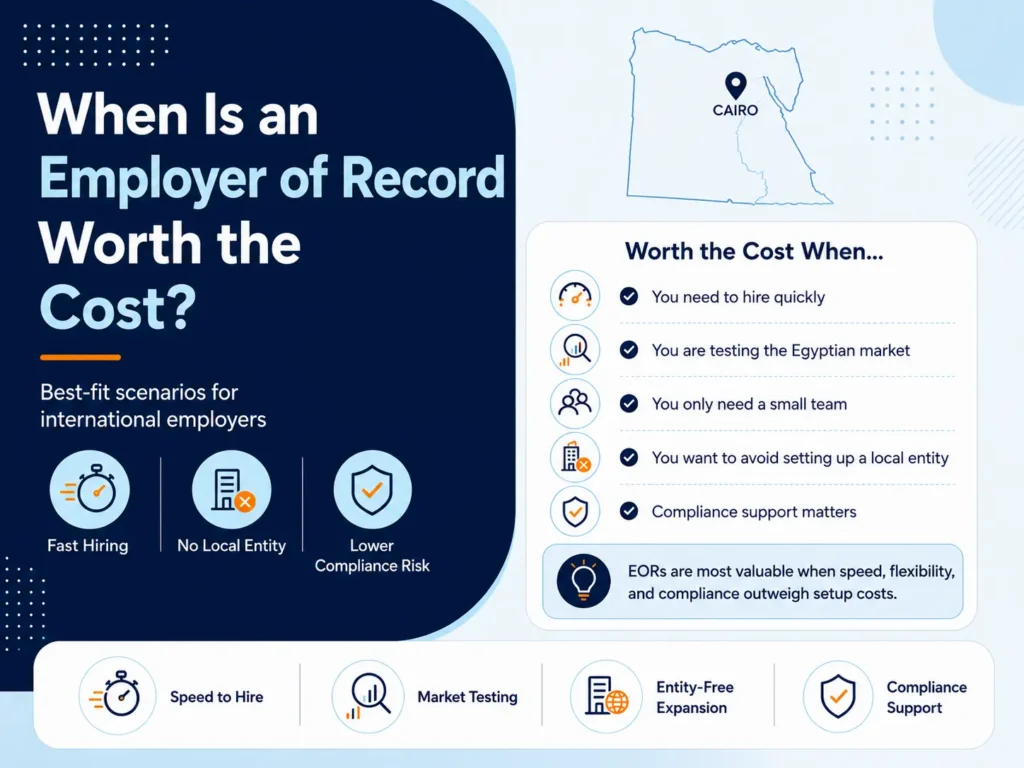
An Employer of Record is usually worth the cost when your company needs legal employment in Egypt but does not want to open a local entity yet. It is especially useful when speed, compliance, and flexibility matter more than building a full local infrastructure.
An EOR is often a strong fit when:
- You want to hire employees in Egypt without creating a local company.
- You need to onboard a candidate quickly.
- You are testing Egypt as a hiring or expansion market.
- You are building a remote team in Egypt.
- You have fewer employees than would justify entity setup.
- You need local payroll, social insurance, and employment support.
- You want one local partner to manage employment administration.
An EOR may not be the best long-term fit when:
- You plan to employ a very large Egypt workforce.
- You need to sign local contracts directly through an Egyptian entity.
- You have a permanent physical operation in Egypt.
- You need local licensing, assets, or regulated operating presence.
- You already have a local entity and only need payroll or HR support.
In those cases, Begory can still support adjacent needs through payroll, HR outsourcing, and recruitment services. The right model depends on whether your company needs legal employment, payroll administration, recruitment, HR support, or full market entry support.
How to Reduce Employer of Record Cost in Egypt Without Increasing Risk
Companies often ask how to reduce EOR cost. The answer is not to cut compliance. The better approach is to remove ambiguity, plan headcount clearly, and choose the right service scope.
1. Define the Role Before Requesting a Quote
A clear job title, salary range, seniority level, location, work arrangement, and expected start date will help the EOR provider quote accurately. Vague role descriptions create pricing uncertainty.
2. Decide Whether You Need Recruitment Support
If you already have a candidate, the EOR quote can focus on employment and onboarding. If you need to source candidates, include recruitment support early so costs and timelines are realistic.
3. Clarify Gross vs Net Salary
Net salary promises can create unexpected employer cost. Before making an offer, ask the EOR provider to calculate the gross salary, employee deductions, employer costs, and total invoice estimate.
4. Keep Benefits Practical
Benefits matter, but they should match the role, market expectations, and retention strategy. Overly complex benefits can increase administration. Underpowered benefits can hurt hiring. A local partner can help find the right balance.
5. Use One Provider for Employment, Payroll, and HR
Fragmented vendors can create hidden coordination costs. When one provider manages EOR, payroll, and HR administration, the workflow is usually cleaner and easier to audit.
6. Plan Headcount Growth
If you expect to grow from one employee to ten employees in Egypt, tell the provider early. Headcount plans may affect pricing tiers, onboarding workflows, reporting, and long-term recommendations.
How to Compare Egypt EOR Providers
Price matters, but it should not be the only decision factor. A weak EOR partner can create payroll delays, employee frustration, legal exposure, and operational drag. A strong EOR partner should give your company clarity and confidence.
| Evaluation Area | What to Look For |
|---|---|
| Local expertise | Deep knowledge of Egyptian employment, payroll, and HR administration. |
| Transparent pricing | Clear separation of salary, statutory costs, service fee, and extras. |
| Payroll accuracy | Reliable calculations, payslips, deductions, and reporting support. |
| Employee experience | Responsive HR support for employees in Egypt. |
| Contract quality | Compliant employment documentation and clear employment terms. |
| Scalability | Ability to support more employees as your Egypt team grows. |
| Advisory support | Ability to explain risks, options, and practical next steps. |
Employer of Record Cost in Egypt for Remote Teams
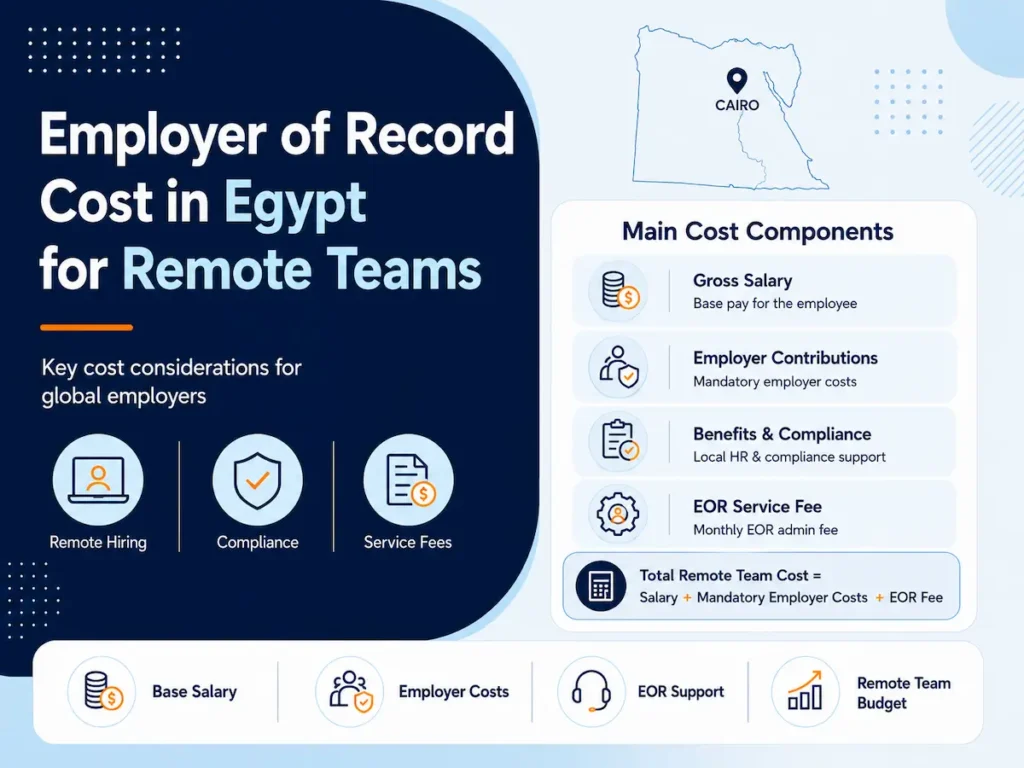
Remote hiring is one of the most common reasons international companies use EOR services in Egypt. A company may want to hire Egyptian software engineers, designers, customer support agents, sales development representatives, accountants, recruiters, or operations specialists without creating an Egyptian branch.
For remote teams, the EOR cost should be compared with the cost of building internal infrastructure. That includes legal setup, payroll registration, social insurance administration, HR support, local employment contracts, and employee support. An EOR can make the first hires much easier because the provider already has the local systems to employ and pay workers.
Remote teams also need clear policies. Equipment, data security, expenses, working hours, leave, performance management, and confidentiality should be handled from the start. These are not just HR details. They affect cost, employee satisfaction, and compliance.
Employer of Record Cost in Egypt for Market Entry
For market entry, an EOR can function as a practical bridge. Instead of waiting months to create an entity before hiring a local employee, a company can hire through an EOR while testing the market. This is useful for companies exploring sales, partnerships, customer support, local operations, or technical hiring in Egypt.
If the Egypt strategy grows, the company can later evaluate whether to keep using EOR, transition to a local entity, or use a hybrid model. The cost of the EOR should be viewed as part of an expansion strategy, not only a monthly HR expense.
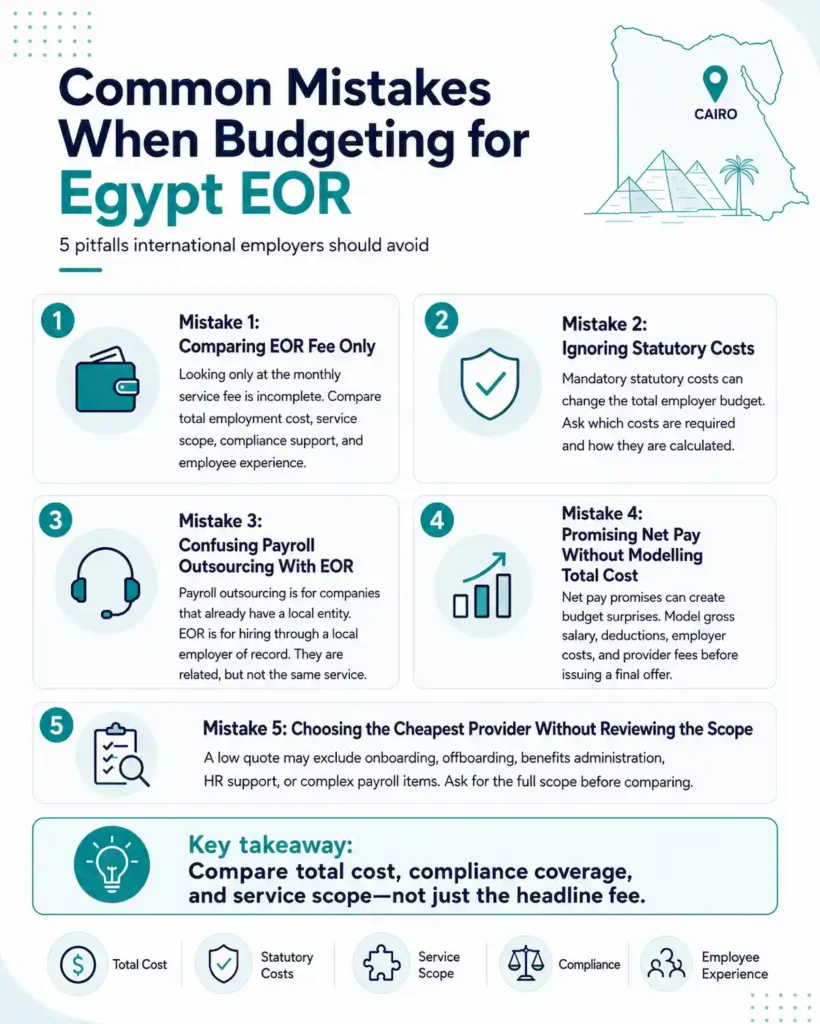
Common Mistakes When Budgeting for Egypt EOR
Mistake 1: Comparing EOR Fee Only
Some buyers compare only the provider’s monthly service fee. That is incomplete. You need to compare total employment cost, service scope, compliance support, and employee experience.
Mistake 2: Ignoring Statutory Costs
Statutory costs can affect the total employer budget. Ask the provider to explain which costs are mandatory and how they are calculated.
Mistake 3: Confusing Payroll Outsourcing With EOR
Payroll outsourcing helps when your company already has a local employer entity. EOR helps when you need a local employer of record. They are related, but they are not the same service.
Mistake 4: Promising Net Pay Without Modelling Total Cost
Net pay promises can create budget surprises. Always model gross salary, deductions, employer costs, and provider fees before issuing the final offer.
Mistake 5: Choosing the Cheapest Provider Without Reviewing the Scope
A cheap quote may exclude onboarding, offboarding, benefits administration, HR support, or complex payroll items. Ask for the full scope before comparing.
Questions to Ask Before Choosing an Egypt EOR Provider
- What is included in the monthly EOR fee?
- Is pricing flat, percentage-based, tiered, or custom?
- Are statutory employer costs shown separately?
- How are social insurance and payroll tax handled?
- Who prepares the employment contract?
- What documents are required for onboarding?
- How long does onboarding usually take?
- Are benefits included or optional?
- How are expenses, bonuses, and allowances processed?
- What happens if the employee leaves?
- Can the provider support future headcount growth?
- Can the provider help with recruitment before EOR employment?
How Begory Advance Hire Supports EOR Cost Clarity
Begory Advance Hire helps international companies hire, employ, and manage workers in Egypt without opening a local entity. The goal is to make the employment process clearer: compliant contracts, payroll, social insurance administration, HR support, and ongoing employee management through one local partner.
For companies comparing Egypt EOR cost, Begory can help clarify:
- Estimated monthly employment cost per employee.
- Gross salary versus net salary implications.
- Employer-side statutory cost considerations.
- Payroll and social insurance administration.
- One-time onboarding requirements.
- Optional benefits and employee support.
- Whether EOR, payroll outsourcing, HR outsourcing, or recruitment is the right fit.
Because every role is different, the best next step is to request a tailored quote based on your candidate, salary, role, start date, and required support level.
Request an Egypt EOR Cost Quote →
FAQs About Employer of Record Cost in Egypt
How much does an Employer of Record cost in Egypt?
Employer of Record cost in Egypt depends on the employee’s salary, statutory employer obligations, benefits, payroll complexity, onboarding needs, and the provider’s service fee. Most companies need a custom quote because the total cost changes by role, salary, and service scope.
Is EOR cheaper than opening a company in Egypt?
For one employee or a small team, an EOR is usually more cost-effective than opening and maintaining a local entity. A local entity may become more suitable if your company plans a large permanent operation in Egypt.
What is included in Egypt EOR pricing?
Egypt EOR pricing typically includes employment contract support, payroll administration, social insurance handling, HR administration, compliance support, employee onboarding, and the provider’s monthly service fee. Benefits and special services may be billed separately.
Does EOR cost include employee salary?
A full EOR invoice usually includes the employee salary funding plus employer costs and the provider’s service fee. However, quotes should separate gross salary, statutory costs, benefits, and EOR fees so the employer can understand the full breakdown.
Can I hire employees in Egypt without a local entity?
Yes. An Employer of Record can legally employ workers in Egypt on behalf of a foreign company while the client company manages the employee’s daily work. This allows international employers to hire without setting up a local company first.
Is payroll outsourcing the same as Employer of Record?
No. Payroll outsourcing supports companies that already have a legal employer entity in Egypt. An Employer of Record acts as the legal employer for companies that do not have a local entity.
What affects the total EOR cost the most?
The biggest cost drivers are employee salary, employer statutory obligations, benefits, headcount, payroll complexity, role risk, contract requirements, onboarding support, and the provider’s pricing model.
How can I get an accurate Egypt EOR quote?
To get an accurate quote, provide the employee’s role, salary expectation, location, start date, benefits requirements, contract type, and whether recruitment support is needed. Begory Advance Hire can then prepare a tailored EOR cost estimate.
Conclusion: Is Employer of Record Cost in Egypt Worth It?
Employer of Record cost in Egypt is usually worth it when your company wants to hire employees legally, move quickly, and avoid the time and overhead of creating a local entity. The cost includes more than a provider fee. It includes employment structure, payroll administration, compliance support, onboarding, employee documentation, and ongoing HR management.
The right way to evaluate EOR pricing is to compare the full cost of employment against the cost, time, and risk of entity setup or informal hiring. For small teams, remote hiring, market testing, and fast expansion, an EOR can be the most practical path into Egypt.
If your company is planning to hire in Egypt, Begory Advance Hire can help you understand the total monthly cost, choose the right hiring model, and employ your workers with confidence.
-
Previous Post
Hire Employees in Egypt Without Entity
-
Next Post
EOR vs PEO in Egypt
Related Posts
Egypt Labor Law for Foreign Companies
Egypt Labor Law for Foreign Companies: Complete 2026 Employer Guide Egypt Labor Law for Foreign…
Hiring Remote Employees in Egypt
Hiring Remote Employees in Egypt: Complete Guide for Global Companies Hiring remote employees in Egypt…
Employee Contracts in Egypt
Employee Contracts in Egypt: Complete Employer Guide for 2026 Employee contracts in Egypt should be…
Egypt Employment Compliance
Egypt Employment Compliance: Complete Guide for Employers in 2026 Egypt employment compliance means hiring, paying,…
