

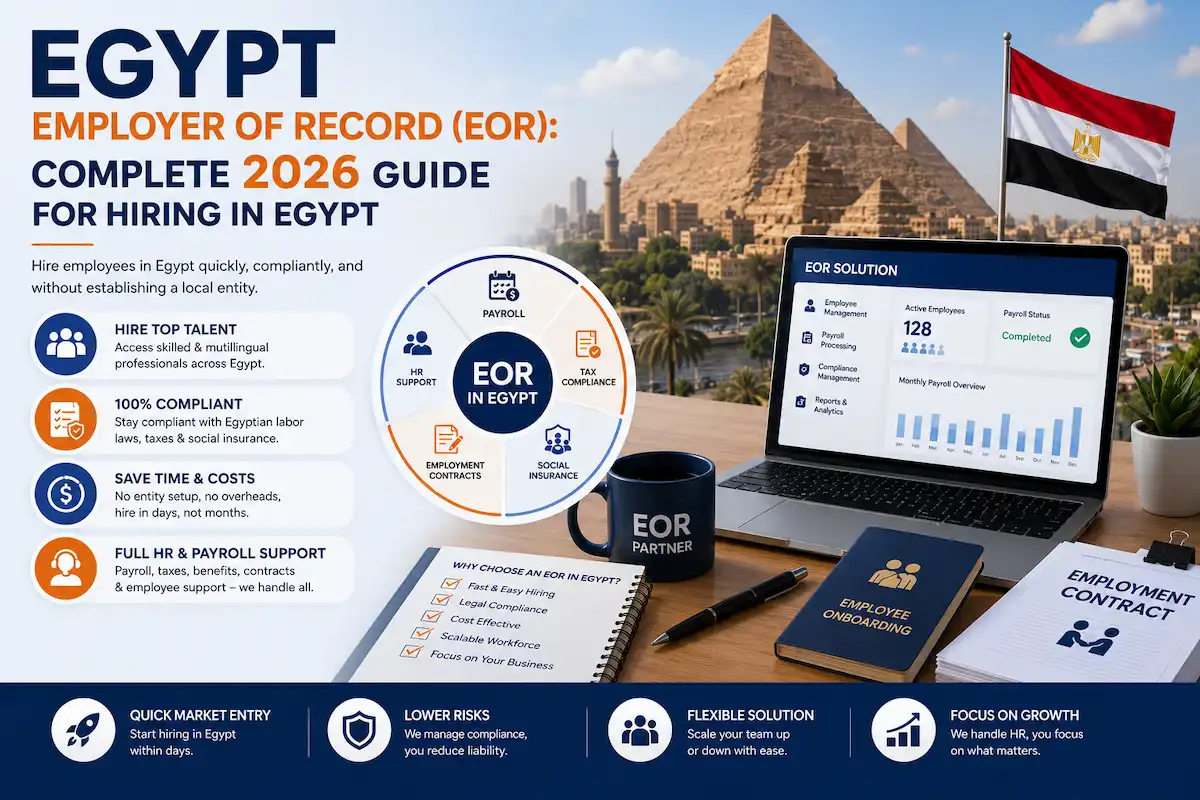
Egypt Employer of Record: Employer Guide
Introduction
Egypt has become one of the fastest-growing destinations for global hiring and workforce expansion in the MENA region. Many international companies now use an Egypt employer of record solution to hire talent quickly and legally without opening a local entity. With a skilled workforce, competitive labor costs, and strong access to GCC, African, and European markets, Egypt offers excellent opportunities for global businesses.
Need to hire employees in Egypt without opening a local entity? Visit our Employer of Record Egypt service page to learn how Begory Advance Hire manages compliant hiring, payroll, employment contracts, onboarding, social insurance, and HR administration for international companies.
The growth of remote work and international expansion has also increased demand for EOR services in Egypt. Companies can now hire employees in Egypt across industries such as construction, IT, healthcare, engineering, and customer support without the complexity of establishing a local company. An Employer of Record manages essential tasks, including payroll, onboarding, HR administration, labor law compliance, taxes, and employment contracts.
However, hiring in Egypt can involve legal and administrative challenges. Egyptian labor laws, payroll regulations, social insurance requirements, and tax compliance can be difficult for foreign employers to manage alone. By working with an experienced Egypt employer of record provider, businesses can simplify hiring, reduce compliance risks, and expand into the Egyptian market faster and more efficiently.
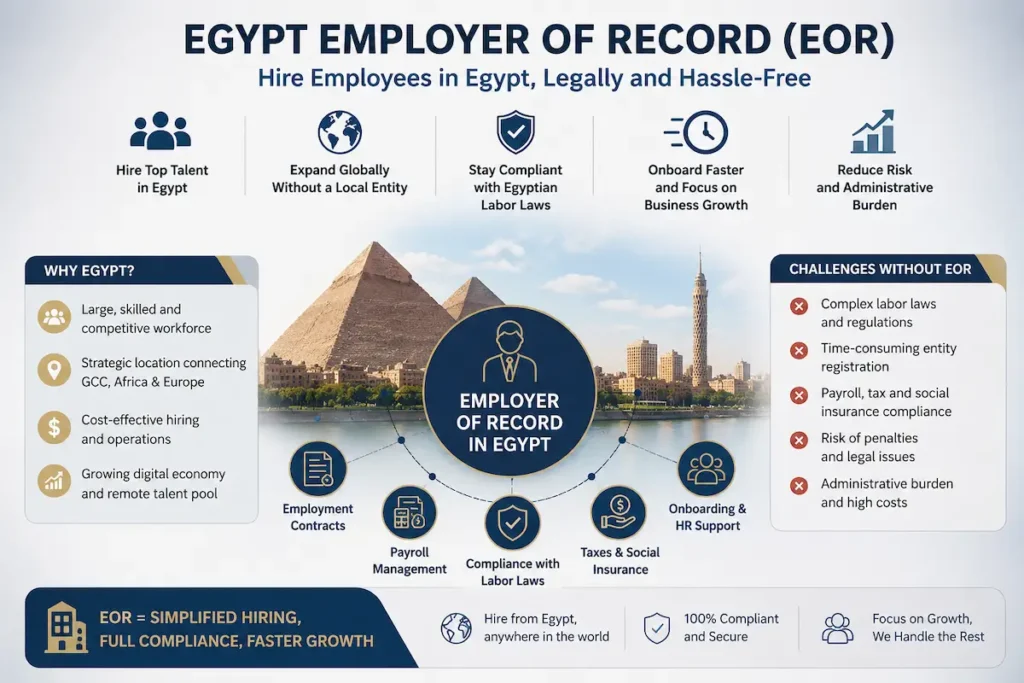
Quick Answer: What Is an Employer of Record in Egypt?
An Employer of Record in Egypt is a third-party employment partner that legally hires employees on behalf of a foreign company. The EOR manages employment contracts, payroll, tax withholding, social insurance registration, onboarding, leave administration, and labor law compliance, while the client company manages the employee’s daily work.
For international companies, an Egypt EOR is useful when they want to hire employees in Egypt without opening a local entity. It allows companies to enter the Egyptian market faster, reduce compliance risk, and manage local employment obligations through a local partner.
Best for: foreign companies hiring remote employees, project teams, sales staff, customer support teams, IT professionals, engineers, or operational workers in Egypt.
Not ideal for: companies planning a large permanent physical operation in Egypt that requires a full local entity, licenses, offices, and long-term direct infrastructure.
What Is an Employer of Record (EOR) in Egypt?
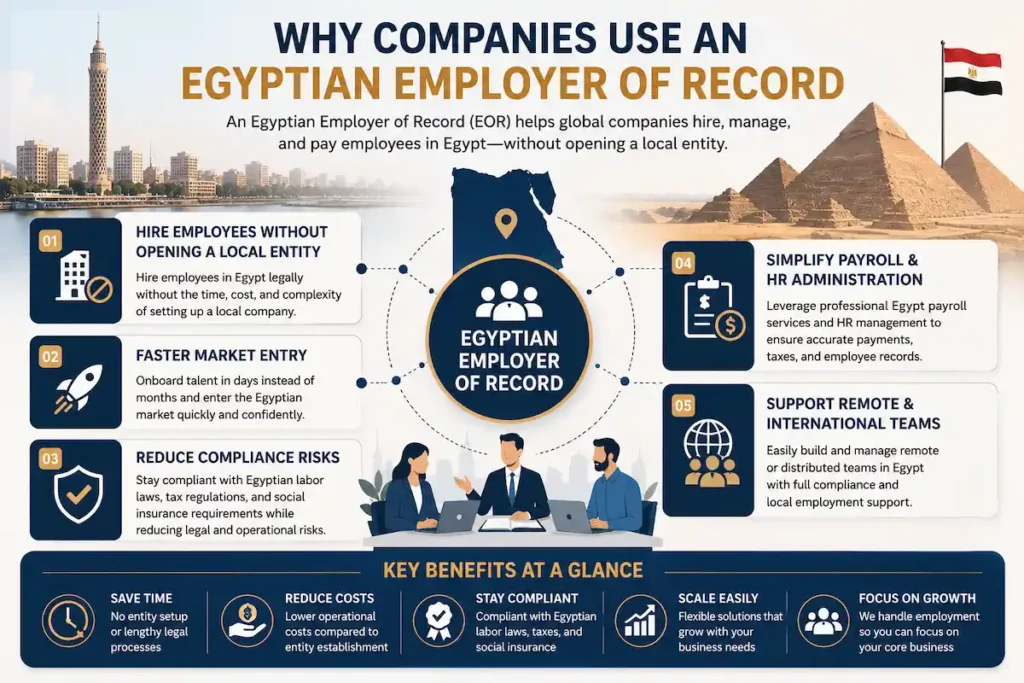
An Employer of Record Egypt solution allows international companies to legally hire and manage employees in Egypt without establishing a local legal entity. Through professional Egypt EOR services, the EOR provider becomes the official legal employer on paper while the client company manages the employee’s daily work, responsibilities, and performance.
Businesses use an Employer of Record Egypt model to simplify international expansion, reduce compliance risks, and accelerate hiring in the Egyptian market. This approach is especially useful for companies looking for flexible and scalable Egypt hiring solutions.
Definition of an EOR
An Employer of Record (EOR) is a third-party organization that legally employs workers on behalf of another company. The EOR handles critical employment responsibilities such as payroll processing, employment contracts, onboarding, tax management, social insurance registration, labor law compliance, and employee benefits administration.
With reliable Egypt EOR services, foreign businesses can hire local talent quickly while remaining compliant with Egyptian employment regulations.
How an EOR Works in Egypt
Under an Employer of Record Egypt arrangement, the EOR provider becomes the legal employer responsible for managing HR and compliance obligations. Meanwhile, the client company retains full control over the employee’s day-to-day tasks, projects, and operational management.
The EOR typically manages:
- Employment contracts
- Payroll and salary payments
- Taxes and social insurance
- Employee onboarding
- Labor law compliance
- HR administration
- Benefits and leave management
This structure allows businesses to enter the Egyptian market faster while reducing administrative burdens and legal risks through professional Egypt hiring solutions.
EOR vs Traditional Employment
In a traditional employment setup, foreign companies usually need to establish a local legal entity before hiring employees in Egypt. This process can involve company registration, tax setup, legal documentation, payroll compliance, and ongoing administrative management.
By contrast, an Employer of Record Egypt provider enables businesses to hire employees immediately without creating a local company. This makes Egypt EOR services a faster, more cost-effective, and lower-risk solution for international expansion, remote hiring, and workforce management in Egypt.
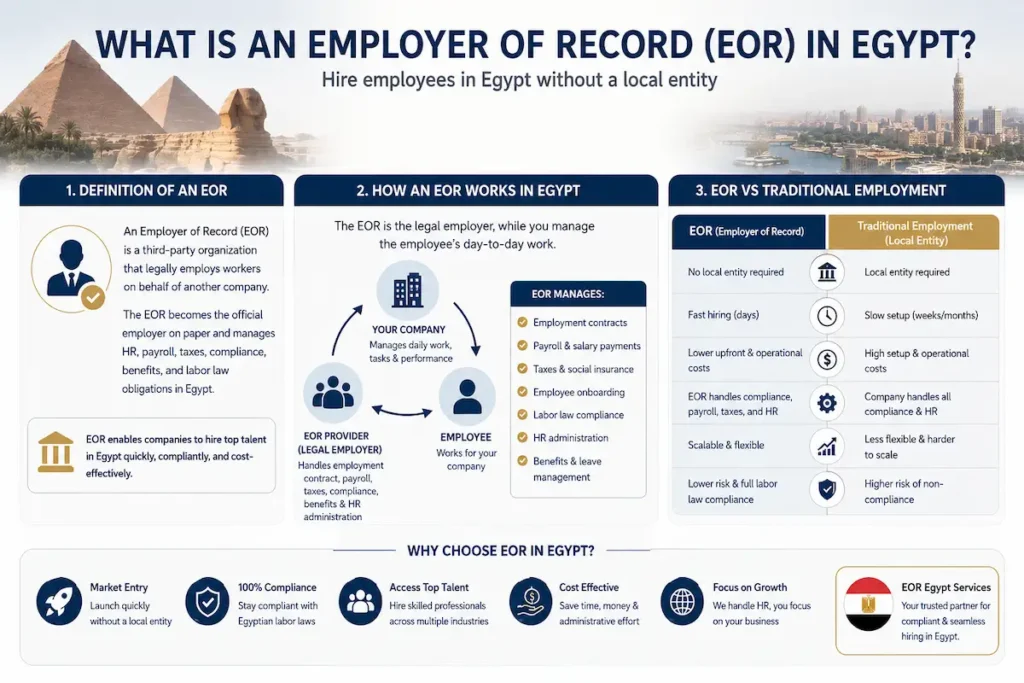
Why Companies Use an Egyptian Employer of Record
As global hiring continues to grow, many international businesses are turning to an Egyptian Employer of Record (EOR) to simplify expansion and workforce management. An EOR allows companies to hire employees in Egypt quickly and legally without establishing a local company while ensuring full compliance with local labor laws and payroll regulations.
From startups to multinational corporations, businesses use Egypt employment outsourcing solutions to reduce operational complexity, lower expansion costs, and access skilled Egyptian talent across industries such as construction, engineering, IT, healthcare, and customer support.
Hire Employees Without Opening a Local Entity
One of the biggest advantages of using an Employer of Record is the ability to hire employees in Egypt without setting up a local legal entity. Establishing a company in Egypt can involve lengthy registration procedures, legal documentation, tax setup, and ongoing compliance obligations.
An EOR removes these barriers by acting as the legal employer on behalf of the client company, allowing businesses to expand faster and more efficiently.
Faster Market Entry
An Egyptian EOR helps companies enter the local market much faster than traditional entity setup. Instead of waiting months for business registration and administrative approvals, companies can onboard employees within days or weeks.
This flexibility is especially valuable for businesses testing new markets, launching short-term projects, or building remote teams in Egypt.
Reduce Compliance Risks
Egyptian labor laws, tax regulations, and social insurance requirements can be challenging for foreign companies unfamiliar with local employment rules. An Employer of Record helps reduce legal and operational risks by managing compliance responsibilities such as employment contracts, payroll taxes, employee benefits, and labor law requirements.
This allows companies to focus on growth while avoiding costly penalties or administrative issues.
Simplify Payroll & HR Administration
Managing payroll, taxes, onboarding, leave policies, and HR administration across borders can become complex and time-consuming. Professional Egypt payroll services provided through an EOR simplify these responsibilities by handling salary payments, payroll calculations, tax deductions, social insurance contributions, and employee records.
This creates a smoother hiring and employee management process for international employers.
Support Remote & International Teams
The rise of remote work has increased demand for flexible hiring solutions worldwide. Through Egypt employment outsourcing and EOR services, companies can legally hire remote employees, contractors, and distributed teams in Egypt without managing local HR infrastructure internally.
This helps businesses scale internationally while maintaining compliance, operational flexibility, and access to highly skilled Egyptian professionals.
Who Should Use an EOR in Egypt?
Who Should Use an Employer of Record in Egypt?
An Employer of Record in Egypt is a strong option for international companies that want to hire local employees quickly without building a full legal, payroll, and HR infrastructure in the country. It is especially useful for companies testing the Egyptian market, hiring remote employees, launching short-term projects, or expanding teams before deciding whether to open a local entity.
Companies commonly use an Egypt EOR when they need to hire one or several employees, manage payroll in Egyptian Pounds, issue compliant employment contracts, register workers for social insurance, and follow Egyptian labor law without handling every local requirement internally.
An EOR may not be the best long-term option for companies planning to hire a very large workforce, lease offices, obtain local business licenses, or operate as a fully established Egyptian company. In those cases, opening a local entity may become more suitable over time.
Benefits of Using an EOR in Egypt
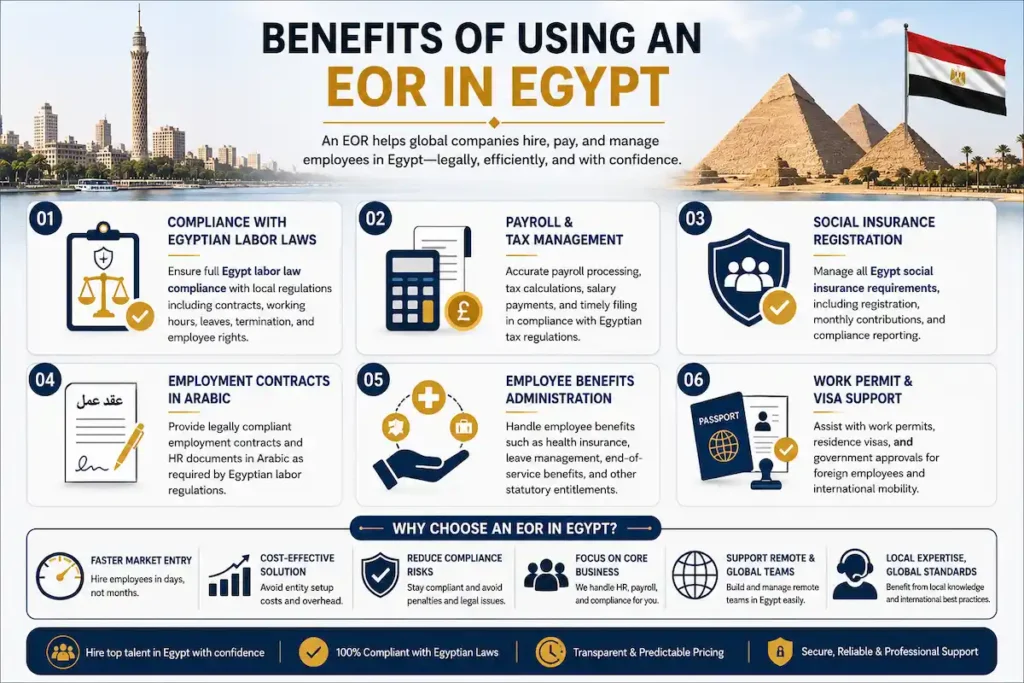
Using an Employer of Record (EOR) in Egypt provides international companies with a faster, safer, and more efficient way to hire and manage employees. From payroll processing to legal compliance, an EOR helps businesses navigate local employment regulations while reducing operational risks and administrative burdens.
Professional EOR providers also offer reliable Egypt onboarding services, helping companies streamline hiring, employee management, and workforce expansion in the Egyptian market.
Compliance With Egyptian Labor Laws
One of the biggest advantages of using an EOR is ensuring full Egypt labor law compliance. Egyptian employment regulations include specific rules related to contracts, working hours, probation periods, employee termination, leave policies, and workplace rights.
An EOR helps companies remain compliant with these legal requirements while minimizing the risk of penalties, disputes, or administrative issues.
Payroll & Tax Management
Managing payroll and taxes in Egypt can be complex for foreign employers. An EOR simplifies salary processing, tax deductions, payroll reporting, and employee payments while ensuring compliance with local tax regulations.
This allows businesses to focus on operations and growth without worrying about payroll administration or compliance challenges.
Social Insurance Registration
Employers in Egypt must comply with mandatory social insurance obligations for local employees. Understanding Egypt social insurance requirements can be difficult for companies unfamiliar with local regulations and contribution systems.
An EOR manages employee registration, monthly contributions, and compliance with Egypt’s social insurance laws to ensure all employment obligations are properly handled.
Employment Contracts in Arabic
Egyptian labor regulations often require employment contracts and legal employment documentation to be prepared in Arabic. An EOR helps businesses create legally compliant employment agreements that align with local labor laws and protect both employers and employees.
This reduces legal risks and ensures proper employment documentation from the beginning of the hiring process.
Employee Benefits Administration
An EOR also manages employee benefits administration, including paid leave, sick leave, social benefits, insurance coordination, and HR support. This improves employee experience while helping companies maintain compliant and competitive employment packages in Egypt.
Work Permit & Visa Support
For foreign employees and international workforce mobility, EOR providers can assist with work permits, visa coordination, and employment documentation. Combined with professional Egypt onboarding services, this helps companies hire and relocate talent more efficiently while remaining compliant with Egyptian immigration and labor regulations.
Risks and Limitations of Using an EOR in Egypt
An Employer of Record can simplify hiring in Egypt, but companies should also understand its limitations. An EOR is usually best for fast market entry, remote hiring, project-based employment, and smaller or medium-sized teams. It may not replace the need for a local entity if a company plans to operate a licensed business, open a physical office, sign local commercial contracts, or build a large permanent workforce in Egypt.
Companies should also choose their EOR provider carefully. A weak provider may create risks around contract accuracy, payroll mistakes, delayed onboarding, poor employee support, unclear pricing, or incomplete compliance handling. For this reason, businesses should review the provider’s local experience, payroll process, legal documentation standards, social insurance handling, and communication model before hiring.
Using an EOR works best when the client company and provider clearly define responsibilities from the beginning, including salary approvals, employee management, onboarding steps, termination procedures, and ongoing HR support.
How Hiring in Egypt Works in 2026
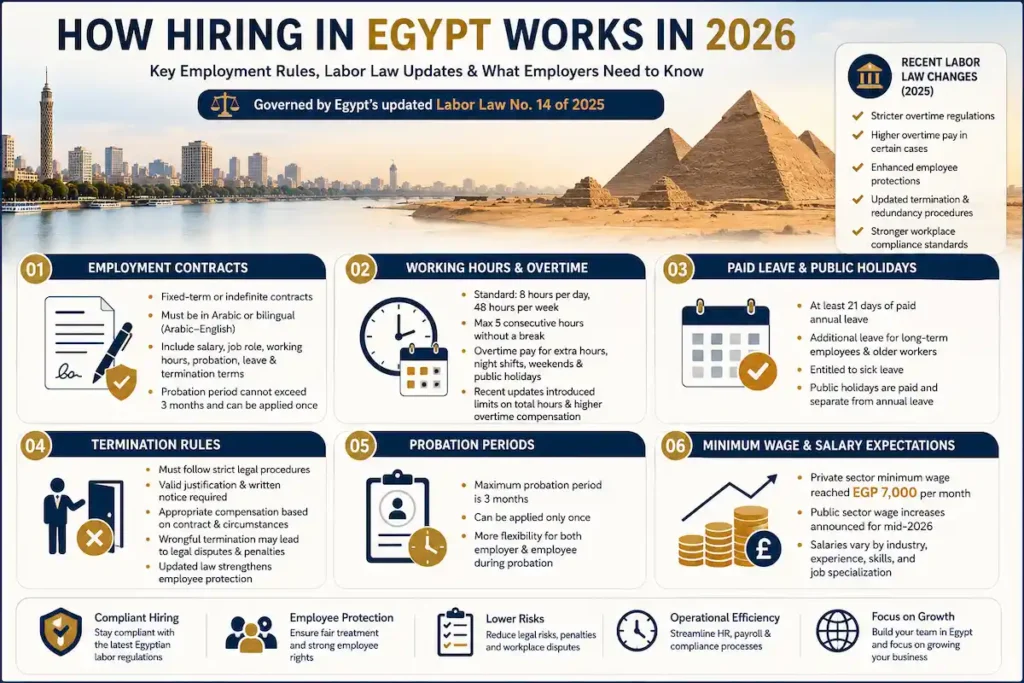
Hiring employees in Egypt in 2026 is mainly governed by Egypt’s updated Labor Law No. 14 of 2025. It introduced key changes to contracts, work hours, wages, employee rights, and compliance steps. Companies hiring in Egypt must follow local labor laws, payroll rules, and social insurance duties. This helps avoid legal and administrative risks.
Employment Contracts
Employment contracts in Egypt can be fixed-term or indefinite. They must be in Arabic or bilingual Arabic-English to be legally enforceable. Contracts usually include salary details, job responsibilities, working hours, probation terms, leave entitlements, and termination conditions. Under the updated labor law, probation periods cannot exceed three months and may only be applied once per employee.
Working Hours & Overtime
Standard work hours in Egypt are usually 8 hours a day and 48 hours a week. Meal and rest breaks are not included. Employees cannot typically work more than five consecutive hours without a break. Overtime work is regulated under Egyptian labor law. Employers must pay extra for overtime hours, night shifts, weekends, and public holidays.
Recent labor law updates added stricter overtime rules and more worker protections. These include limits on total work hours and higher overtime pay in some cases.
Paid Leave & Public Holidays
Employees in Egypt are entitled to paid annual leave, official public holidays, and sick leave benefits. Under Egyptian labor rules, employees usually get at least 21 days of paid annual leave. More leave is given to long-term workers and older workers. Public holidays are recognized separately and should not be deducted from annual leave balances.
Termination Rules
Employee termination in Egypt must follow strict legal procedures. Employers are typically required to provide valid legal justification, written notice, and appropriate compensation depending on the employment agreement and circumstances. Wrongful termination can expose employers to legal disputes, financial penalties, and compensation claims under Egyptian labor law.
The new 2025 labor law also introduced updated termination and redundancy procedures aimed at strengthening employee protections and improving workplace compliance standards.
Probation Periods
The probation period in Egypt is limited to a maximum of three months under the updated labor law framework. Employers may only place employees on probation once during the employment relationship. During this period, both employers and employees have more flexibility regarding contract termination and resignation procedures.
Minimum Wage & Salary Expectations
Egypt’s minimum wage framework continued evolving in 2026 as part of broader labor and economic reforms. The private sector minimum wage reached approximately EGP 7,000 per month, while additional public-sector wage increases were announced for mid-2026. Salary expectations in Egypt vary significantly depending on industry, experience level, language skills, and job specialization.
2026 Egypt Employment Compliance Notes
Foreign companies hiring in Egypt should pay close attention to labor law, payroll, social insurance, minimum wage, contract language, and termination rules. Egypt’s Labor Law No. 14 of 2025 became effective on September 1, 2025, replacing the previous Labor Law No. 12 of 2003.
In 2026, companies should make sure employment contracts, probation terms, working hours, overtime, leave policies, termination procedures, and employee records are aligned with the updated legal framework. This is especially important for foreign employers that do not have local HR or legal teams in Egypt.
Employers should also account for minimum wage and salary compliance. Egypt’s National Wages Council raised the private-sector minimum wage to EGP 7,000 per month, effective March 1, 2025.
An Employer of Record can help companies manage these obligations by preparing compliant employment documentation, processing payroll correctly, registering employees for social insurance, and helping reduce the risk of administrative or legal errors.
EOR Responsibilities vs Client Responsibilities
| Area | EOR Provider Handles | Client Company Handles |
|---|---|---|
| Legal employment | Acts as the legal employer in Egypt | Manages business direction |
| Employment contract | Prepares compliant local contracts | Defines role, salary, and job duties |
| Payroll | Processes salary payments and deductions | Approves compensation and payroll changes |
| Tax and social insurance | Manages required registrations and contributions | Provides employee and salary information |
| HR administration | Supports onboarding, leave, records, and documentation | Manages daily performance |
| Compliance | Helps follow Egyptian labor, tax, and employment rules | Follows agreed employment policies |
| Work output | Not usually responsible for daily work delivery | Supervises tasks, KPIs, and performance |
Egypt Employer of Record vs Opening a Local Entity
When expanding into Egypt, international companies often choose between using an Employer of Record (EOR) or establishing a local legal entity. Understanding the differences between these two models is essential for evaluating compliance obligations, operational flexibility, setup costs, and long-term business goals.
For many businesses entering the Egyptian market for the first time, the debate around employer of record vs entity setup Egypt depends on hiring speed, budget, scalability, and administrative complexity.
| Factor | Employer of Record (EOR) | Opening a Local Entity |
|---|---|---|
| Setup Time | Employees can often be hired within days or weeks | Company registration may take several months |
| Legal Complexity | EOR manages labor law compliance, contracts, payroll, and HR obligations | Company handles all legal, tax, payroll, and employment responsibilities internally |
| Cost | Lower upfront investment with predictable monthly service fees | Higher setup costs including legal registration, accounting, office setup, and administration |
| Payroll Management | Managed entirely through the EOR provider | Requires internal payroll systems and local compliance management |
| Compliance | EOR handles employment regulations, taxes, and social insurance obligations | Company is directly responsible for all compliance requirements |
| Scalability | Easy to scale teams up or down quickly | Expansion and workforce changes may require additional administrative processes |
| Market Entry | Fast entry into the Egyptian market | Slower expansion due to registration and licensing procedures |
| Operational Control | Shared HR and compliance responsibilities with the EOR | Full operational and legal control over local operations |
Which Option Is Better for International Companies?
An Employer of Record is often the preferred option for companies seeking rapid expansion, remote hiring, project-based staffing, or market testing in Egypt. Businesses can hire employees without establishing a local company while reducing compliance risks and administrative burdens.
Opening a local entity may be more suitable for companies planning long-term operations, large-scale investments, or permanent physical offices in Egypt. However, this option usually involves greater legal complexity, higher operational costs, and ongoing compliance management.
Cost of Employer of Record in Egypt
The cost of employer of record in Egypt typically depends on factors such as employee headcount, payroll complexity, HR support requirements, and additional services like visa processing or benefits administration. Most EOR providers charge either a fixed monthly fee per employee or a percentage of payroll.
Compared to the expenses associated with establishing a legal entity, many businesses find EOR solutions to be a more cost-effective and flexible approach for international hiring experts and workforce expansion in Egypt.
Payroll, Taxes & Social Insurance in Egypt
Managing payroll, taxes, and employee benefits is one of the most important aspects of hiring in Egypt. International companies must comply with local employment regulations, tax obligations, and social insurance requirements to avoid penalties and legal risks. Many businesses rely on professional Egypt payroll services to simplify payroll administration, ensure accurate salary processing, and maintain full compliance with Egyptian labor laws.
Understanding payroll and tax compliance Egypt requirements is essential for companies hiring local employees, remote workers, or international teams in the Egyptian market.
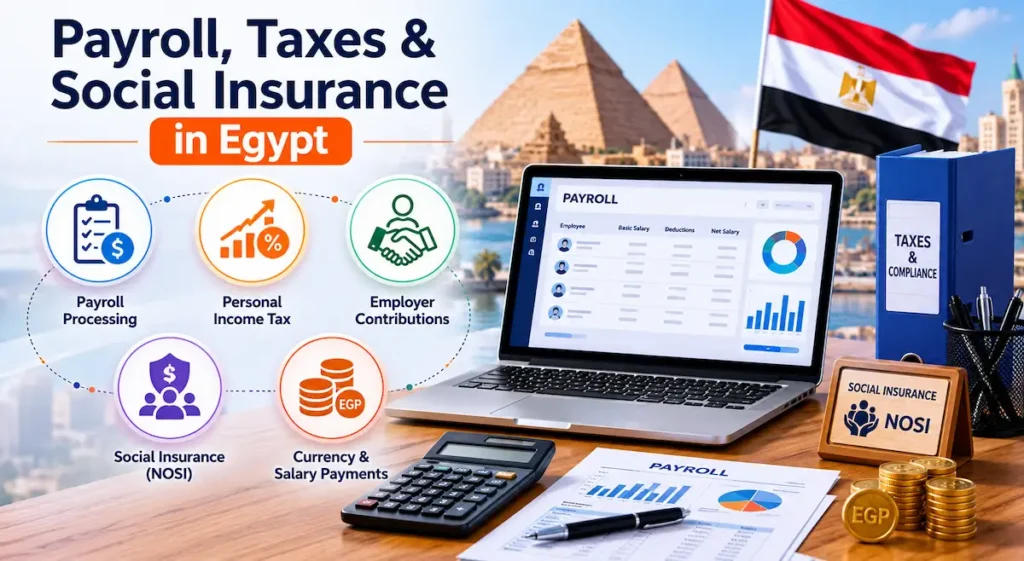
Payroll Processing
Payroll processing in Egypt includes salary calculations, overtime payments, tax deductions, social insurance contributions, bonuses, and employee benefits management. Employers are responsible for ensuring that employees receive salaries accurately and on time while maintaining proper payroll records and compliance documentation.
Professional Egypt compliance payroll solutions help companies manage payroll operations efficiently while reducing administrative burdens and compliance risks.
Personal Income Tax
Egypt uses a progressive personal income tax system where tax rates increase based on employee income levels. Employers are generally responsible for withholding income taxes directly from employee salaries and submitting payments to the Egyptian Tax Authority.
Tax compliance requires accurate payroll calculations, monthly filings, and proper reporting procedures to ensure legal compliance and avoid financial penalties.
Employer Contributions
Employers in Egypt are required to make mandatory contributions related to employee social insurance and employment benefits. These contributions are calculated based on employee salaries and regulated under Egyptian labor and social insurance laws.
Failure to meet employer contribution obligations can result in legal liabilities, fines, and compliance issues for foreign companies operating in Egypt.
Social Insurance (NOSI)
Egypt’s National Organization for Social Insurance (NOSI) manages the country’s social insurance system for employees. Employers must register eligible employees and make monthly social insurance contributions covering pensions, workplace injuries, and other social protection programs.
Understanding local social insurance regulations is a critical part of payroll and tax compliance Egypt, especially for international businesses unfamiliar with Egyptian employment laws.
Currency & Salary Payments
Employee salaries in Egypt are typically paid in Egyptian Pounds (EGP), although some international companies may offer partial foreign currency payments depending on employment agreements and regulatory requirements. Employers must ensure that salary payments comply with local banking, payroll, and tax regulations.
Reliable Egypt payroll services help businesses manage salary payments securely while ensuring full compliance with local financial and employment regulations.
How to Choose the Best Employer of Record in Egypt
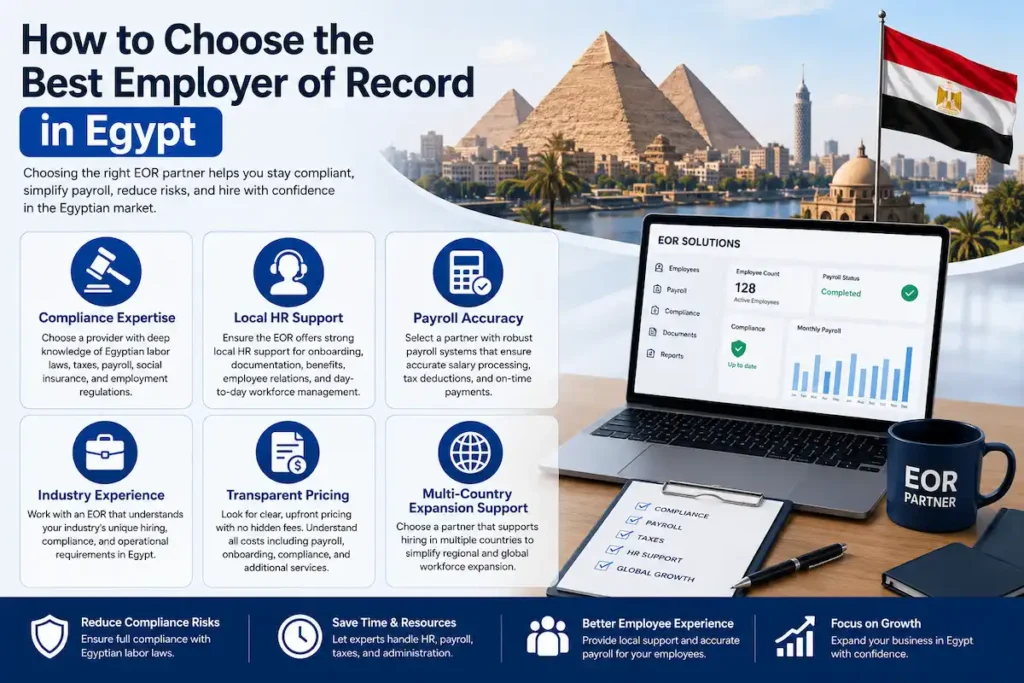
Choosing the best employer of record Egypt solution is an important decision for companies planning to hire employees, expand operations, or manage remote teams in the Egyptian market. A reliable Egypt EOR provider can help businesses remain compliant with local labor laws, simplify payroll management, reduce administrative risks, and accelerate international hiring.
Since Employer of Record services directly impact compliance, payroll, employee experience, and operational efficiency, companies should carefully evaluate potential providers before making a decision.
Compliance Expertise
One of the most important factors when selecting the best employer of record Egypt service is local compliance expertise. Egyptian labor laws, payroll regulations, tax obligations, and social insurance requirements can be complex for international employers.
An experienced Egypt EOR provider should have strong knowledge of:
- Egyptian labor law
- Employment contracts
- Payroll regulations
- Tax compliance
- Employee termination procedures
- Social insurance requirements
This helps businesses avoid legal risks, penalties, and compliance issues.
Local HR Support
Strong local HR support is essential for managing employee onboarding, documentation, leave policies, benefits administration, and workforce management. A professional Egypt EOR provider should offer responsive HR assistance for both employers and employees throughout the employment lifecycle.
Local expertise also improves employee experience and helps companies navigate cultural and operational differences more effectively.
Payroll Accuracy
Payroll errors can create serious compliance and employee satisfaction problems. The best employer of record Egypt solutions should provide accurate payroll processing, timely salary payments, tax deductions, and social insurance management.
Reliable payroll systems help ensure employees are paid correctly while maintaining full compliance with Egyptian payroll regulations.
Industry Experience
Different industries often have unique hiring, compliance, and workforce management requirements. Companies should choose an Egypt EOR provider with experience in their specific sector, whether it involves construction, engineering, healthcare, IT, customer support, oil & gas, or manufacturing.
Industry expertise allows the provider to better understand operational needs, workforce challenges, and local employment requirements.
Transparent Pricing
Transparent pricing is another important factor when selecting the best employer of record Egypt provider. Businesses should clearly understand:
- Monthly service fees
- Payroll management costs
- Onboarding charges
- Compliance fees
- Additional HR or visa support costs
Clear pricing structures help companies avoid unexpected expenses and manage expansion budgets more effectively.
Multi-Country Expansion Support
For businesses planning regional or global growth, choosing an Egypt EOR provider with international expansion capabilities can provide additional flexibility. Some EOR providers support hiring across multiple countries, allowing companies to centralize payroll, HR administration, and compliance management through a single partner.
This can simplify workforce expansion for companies operating across the Middle East, Africa, Europe, or other international markets.
Industries Hiring Through EOR Services in Egypt
Many international companies use Employer of Record (EOR) services in Egypt to access skilled talent, simplify hiring, and remain compliant with local employment regulations. Egypt’s growing workforce and strategic location make it an attractive destination for multiple industries seeking flexible hiring solutions and workforce expansion.
Construction
The construction sector is one of the largest industries using EOR services in Egypt. International contractors and infrastructure companies hire engineers, project managers, technicians, and skilled labor for large-scale construction and development projects across the region.
Oil & Gas
Egypt’s oil and gas industry continues to attract foreign investment and international energy companies. EOR solutions help businesses hire specialized professionals, field engineers, technicians, and operational staff while managing compliance and workforce administration efficiently.
IT & Tech
The IT and technology sector in Egypt has experienced rapid growth in recent years. Global companies increasingly hire Egyptian software developers, cybersecurity specialists, IT support teams, and remote tech professionals through EOR services to support digital transformation and remote operations.
Healthcare
Healthcare organizations and medical service providers use EOR solutions to recruit qualified doctors, nurses, healthcare administrators, and medical support staff. EOR services help simplify licensing, onboarding, payroll, and employment compliance in the healthcare sector.
Customer Support & BPO
Egypt has become a leading hub for customer support and business process outsourcing (BPO) services due to its multilingual workforce and competitive labor costs. Companies use EOR providers to quickly build call center teams, customer service departments, and remote support operations.
Engineering
Engineering companies across industries such as manufacturing, energy, infrastructure, and industrial services rely on EOR solutions to hire skilled engineers, technical specialists, and project teams in Egypt while reducing administrative and compliance challenges.
Challenges of Hiring Employees in Egypt
While Egypt offers strong opportunities for international hiring and workforce expansion, companies may also face several legal, administrative, and operational challenges when employing local talent. Understanding these challenges is important for maintaining compliance, reducing risk, and managing employees effectively in the Egyptian market.
Labor Law Complexity
Egyptian labor laws include detailed regulations related to employment contracts, working hours, overtime, employee benefits, probation periods, leave policies, and termination procedures. Foreign companies unfamiliar with local employment laws may struggle to navigate these legal requirements without local HR or legal support.
Arabic Documentation Requirements
Many official employment documents in Egypt, including employment contracts and government-related paperwork, are often required in Arabic or bilingual formats. This can create challenges for international employers managing hiring, compliance, and legal documentation without local expertise.
Employee Classification Risks
Incorrectly classifying employees as independent contractors or freelancers can expose companies to legal and financial risks. Businesses must ensure workers are classified correctly under Egyptian labor law to avoid disputes, tax issues, and compliance penalties.
Tax & Compliance Issues
Managing payroll taxes, social insurance contributions, employee benefits, and government reporting obligations can become complex for foreign employers. Failure to comply with local tax and payroll regulations may result in fines, administrative penalties, or legal complications.
Termination Procedures
Employee termination in Egypt is regulated by strict labor laws designed to protect employee rights. Employers are generally required to follow formal notice procedures, provide valid legal reasons for termination, and comply with compensation requirements when applicable. Improper termination processes can lead to legal disputes and financial liabilities.
Documents Needed to Hire Employees in Egypt Through an EOR
To hire employees in Egypt through an Employer of Record, companies usually need to provide basic employee, role, and compensation details before onboarding can begin. The exact documentation may vary depending on the employee’s nationality, job type, contract structure, and whether work permit or visa support is required.
Common documents and information may include:
| Requirement | Purpose |
|---|---|
| Employee full name and contact details | For onboarding and employment records |
| National ID or passport copy | For identity verification and employment documentation |
| Job title and job description | To prepare the employment contract |
| Salary and benefits details | To structure payroll and compensation |
| Start date and working schedule | To define employment terms |
| Work location or remote-work arrangement | To confirm employment setup |
| Bank details | For salary payments |
| Social insurance information | For local compliance registration |
| Work permit or visa documents, if applicable | For foreign employees working in Egypt |
Step-by-Step Process to Hire Employees in Egypt Through an EOR
Understanding how EOR works in Egypt helps international companies simplify hiring, reduce compliance risks, and onboard employees faster. An Employer of Record (EOR) manages legal employment responsibilities while allowing businesses to focus on operations and workforce growth. This process is a key part of any effective Egypt remote hiring guide.
Choose Your Candidate
The first step is identifying and selecting the right employee for your business needs. Companies can recruit local Egyptian talent or remote workers across industries such as IT, engineering, healthcare, customer support, and construction.
Draft Employment Contract
The EOR prepares legally compliant employment contracts that align with Egyptian labor laws, payroll regulations, and local employment requirements. Contracts are typically provided in Arabic or bilingual formats.
Payroll & Compliance Setup
The EOR manages payroll registration, tax setup, social insurance enrollment, and compliance procedures. This ensures employees are paid correctly while meeting all legal employment obligations in Egypt.
Employee Onboarding
Professional onboarding helps employees integrate smoothly into the company. The EOR handles employment documentation, HR setup, benefits administration, and onboarding support to simplify the hiring process.
Ongoing HR Management
After onboarding, the EOR continues managing payroll, leave policies, tax compliance, HR administration, and employee support. This allows companies to maintain compliant operations while focusing on business growth and team management.
Employer of Record Egypt Cost
Understanding Employer of Record (EOR) pricing is important for companies planning to hire employees in Egypt without establishing a local legal entity. The total cost of an EOR solution usually depends on employee headcount, payroll complexity, compliance requirements, and additional HR services.
For many international businesses, EOR services provide a more flexible and cost-effective alternative compared to opening a local company in Egypt.
Typical Pricing Models
Most EOR providers use one of two pricing structures:
- Fixed monthly fee per employee
- Percentage-based fee calculated from employee salary
The fixed-fee model is the most common because it offers predictable monthly costs and easier budgeting for international hiring operations.
Monthly EOR Fees
The average monthly EOR fee in Egypt typically ranges between $300 and $700 per employee per month, depending on the provider, service level, and included HR support. Some budget-focused providers may offer lower pricing, while enterprise-level solutions can charge higher fees for advanced compliance, payroll, and international workforce management services.
In addition to the service fee, employers should also account for:
- Employee salary
- Social insurance contributions
- Payroll taxes
- Benefits administration
- Optional visa or relocation support
Hidden Costs to Watch For
When comparing EOR providers, businesses should carefully review potential hidden fees and additional charges. Some providers may charge extra for:
- Employee onboarding
- Contract termination
- Currency exchange fees
- Payroll deposits
- Immigration or visa support
- Equipment procurement
- Benefits upgrades
Some providers may also require minimum contract commitments or refundable payroll security deposits.
EOR vs Entity Setup Costs
For companies hiring small or mid-sized teams, using an EOR is often significantly cheaper than establishing a local entity in Egypt. Setting up a company may involve:
- Legal registration fees
- Accounting and tax setup
- Office and administrative costs
- Ongoing compliance management
- Payroll infrastructure
- HR staffing
Entity setup costs in Egypt can range from approximately $5,000 to $15,000+, excluding ongoing operational expenses. By comparison, an EOR allows businesses to begin hiring within days or weeks while avoiding major upfront investments and administrative complexity.
Why Egypt Is a Strategic Hiring Market in 2026
Egypt continues to strengthen its position as one of the most attractive hiring and outsourcing destinations in the Middle East and North Africa. In 2026, international companies are increasingly turning to Egypt for workforce expansion, remote hiring, and regional business operations due to its large talent pool, strategic location, and competitive employment costs.
Skilled Workforce
Egypt has a large and growing workforce with strong capabilities across industries such as engineering, IT, construction, healthcare, customer support, finance, and manufacturing. Universities and technical institutions continue producing qualified graduates with skills that support both local and international business needs.
Multilingual Talent
One of Egypt’s major advantages is its multilingual workforce. Many Egyptian professionals speak English fluently, while others also have proficiency in Arabic, French, German, or additional European languages. This makes Egypt an attractive destination for international customer support, outsourcing, and global business operations.
GCC Proximity
Egypt’s strategic geographic location provides easy access to GCC markets, Africa, and Europe. Companies operating in Saudi Arabia, the UAE, Qatar, Kuwait, and other Gulf countries often use Egypt as a regional hiring and outsourcing hub due to cultural alignment, time zone compatibility, and operational convenience.
Competitive Salaries
Compared to many international markets, Egypt offers highly competitive labor costs while maintaining access to skilled professionals. Businesses can build efficient teams and reduce operational expenses without compromising workforce quality, making Egypt attractive for startups, outsourcing firms, and multinational companies alike.
Outsourcing Growth
Egypt’s outsourcing and business process outsourcing (BPO) sectors continue to grow rapidly. Global companies increasingly establish customer service centers, technical support operations, shared service teams, and back-office functions in Egypt to benefit from cost efficiency and workforce scalability.
Remote Hiring Demand
The continued rise of remote work has increased international demand for Egyptian talent. Companies worldwide now hire remote employees in Egypt across sectors such as software development, digital marketing, engineering, customer support, and administrative services. This trend has made Egypt a key market for global remote hiring and distributed workforce expansion in 2026.
Need Help Hiring Employees in Egypt?
If your company wants to hire employees in Egypt without opening a local entity, Begory Advance Hire can support the process through Employer of Record services, payroll administration, employment contracts, onboarding, social insurance, and HR compliance.
Explore our Employer of Record Egypt service to learn how we help international companies hire legally, quickly, and efficiently in Egypt.
FAQ Section
What is an Employer of Record in Egypt?
An Employer of Record (EOR) in Egypt is a third-party organization that legally employs workers on behalf of another company. The EOR manages payroll, taxes, employment contracts, compliance, and HR administration while the client company manages the employee’s daily work and responsibilities.
Can foreign companies hire employees in Egypt without opening a company?
Yes. Foreign companies can hire employees in Egypt without establishing a local legal entity by using an Employer of Record service. The EOR becomes the legal employer while handling payroll, compliance, onboarding, and employment administration.
Is EOR legal in Egypt?
Yes. Employer of Record services are legal in Egypt when operated in compliance with Egyptian labor laws, tax regulations, and social insurance requirements. Many international companies use EOR solutions to hire employees legally and efficiently in the Egyptian market.
How much does an Egypt EOR cost?
The cost of an Egypt EOR typically ranges from approximately $300 to $700 per employee per month, depending on the provider, service scope, payroll complexity, and additional HR or compliance support services.
What taxes do employers pay in Egypt?
Employers in Egypt are generally responsible for payroll tax withholding, social insurance contributions, and other employment-related obligations required under Egyptian labor and tax laws. Tax rates and contribution amounts may vary depending on employee salary levels and employment structures.
How long does onboarding take?
Employee onboarding through an EOR in Egypt can often be completed within a few days to a few weeks, depending on contract preparation, compliance checks, payroll registration, and documentation requirements.
What is the difference between EOR and PEO?
An EOR becomes the legal employer of the employee and manages compliance, payroll, and employment responsibilities. A PEO (Professional Employer Organization) typically works through a co-employment model, where the client company usually needs to have its own legal entity in the country.
Can an EOR help with visas and work permits?
Yes. Many EOR providers assist with work permits, visa processing, relocation support, and employment documentation for foreign employees working in Egypt.
Does Egypt require Arabic employment contracts?
Yes. Employment contracts in Egypt are commonly required in Arabic or bilingual Arabic-English formats to ensure compliance with local labor laws and legal enforceability.
Can I hire one employee in Egypt through an EOR?
Yes. Companies can usually hire one employee in Egypt through an Employer of Record. This is useful for businesses testing the Egyptian market, hiring a remote employee, or adding a local representative before opening a full legal entity.
Who is the legal employer under an EOR in Egypt?
The EOR provider is the legal employer in Egypt. The client company manages the employee’s daily work, tasks, performance, and business goals, while the EOR manages employment contracts, payroll, tax compliance, social insurance, and HR administration.
Do I need a local entity to hire employees in Egypt?
No. A foreign company can hire employees in Egypt without opening a local entity by using an Employer of Record. The EOR legally employs the worker on behalf of the foreign company and manages local employment compliance.
What is the fastest way to hire employees in Egypt?
The fastest way to hire employees in Egypt is usually through an Employer of Record because the company does not need to complete local entity setup before onboarding workers. The EOR manages contracts, payroll, onboarding, and compliance requirements.
Is an EOR suitable for remote employees in Egypt?
Yes. An EOR is suitable for hiring remote employees in Egypt because it allows foreign companies to employ Egyptian talent legally while outsourcing payroll, HR administration, social insurance, and labor law compliance.
-
Previous Post
Why Should Business Payroll Outsourcing?
-
Next Post
Hire Employees in Egypt Without Entity
Related Posts
Egypt Labor Law for Foreign Companies
Egypt Labor Law for Foreign Companies: Complete 2026 Employer Guide Egypt Labor Law for Foreign…
Hiring Remote Employees in Egypt
Hiring Remote Employees in Egypt: Complete Guide for Global Companies Hiring remote employees in Egypt…
Employee Contracts in Egypt
Employee Contracts in Egypt: Complete Employer Guide for 2026 Employee contracts in Egypt should be…
Egypt Employment Compliance
Egypt Employment Compliance: Complete Guide for Employers in 2026 Egypt employment compliance means hiring, paying,…
