

Egypt Payroll Audit Checklist: 12 Proven Controls for 2026
An Egypt payroll audit checklist helps a foreign company test whether each payroll result can be traced to approved employee data, a reviewed calculation, an authorized payment, the relevant statutory records and a complete audit trail. The objective is not simply to confirm that employees were paid. It is to determine whether the company can explain and support every material payroll figure.
This checklist is designed for companies that employ people through an Egyptian entity or oversee an Egyptian payroll process from abroad. It focuses on audit evidence, internal controls, reconciliations and corrective action. For a step-by-step explanation of setting up and running payroll, read Begory’s guide on how to pay employees in Egypt.
Compliance notice: This resource provides general operational guidance and was updated in July 2026. It does not replace legal, tax, accounting or payroll advice. The correct treatment depends on the employer, employee, compensation package and employment structure. Current calculations, forms, filing requirements and records should be confirmed with the Egyptian authorities and appropriately qualified professionals.
Short Answer: What Should an Egypt Payroll Audit Check?
An Egypt payroll audit should check four things: whether payroll inputs were authorized, whether calculations were completed using current rules and accurate employee data, whether payments and statutory amounts reconcile to the payroll register, and whether the company retained evidence of review, reporting and correction. A strong audit follows selected transactions from their source documents to the final payroll records instead of relying only on payroll totals.
| Audit objective | Question to answer | Evidence to inspect |
|---|---|---|
| Authorization | Was each payroll change requested and approved by the right people? | Signed contract, change request, approval record and payroll input log |
| Accuracy | Can the company reproduce the gross-to-net result? | Payroll register, calculation report, employee data and current calculation settings |
| Completeness | Were all employees, payments, deductions and required records included? | Employee list, joiner and leaver report, payment file and submission records |
| Reconciliation | Do payroll, bank, finance and statutory records agree? | Payroll totals, bank confirmation, ledger entries, filings and payment receipts |
| Audit trail | Can a reviewer see who prepared, checked, approved and changed the payroll? | Dated approvals, exception log, version history and corrective-action records |
Before the Audit: Prepare the Payroll Evidence File
Begin by defining the period, employing entity, employee population, payroll frequency and systems included in the review. The audit scope should state whether it covers one monthly cycle, a sample of several months or a complete payroll year. It should also identify who prepares payroll, who reviews it, who releases payments and who handles statutory submissions.
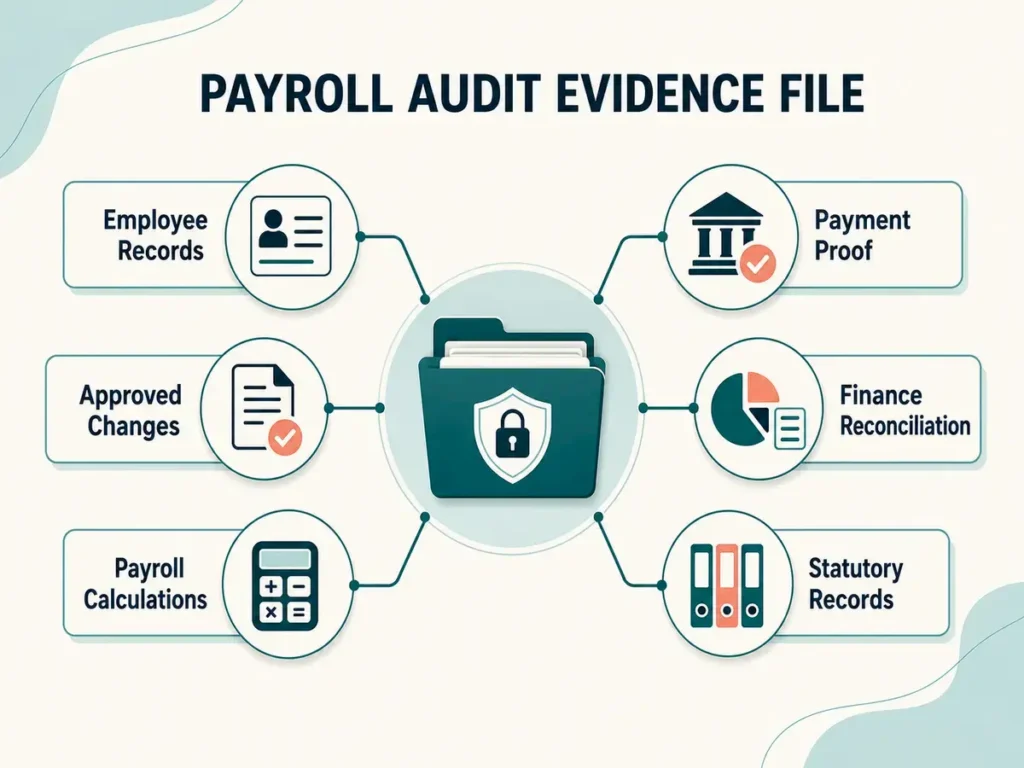
Prepare a controlled evidence file before testing begins. Depending on the scope and employment model, it may contain:
- The employee master-data report at the start and end of the audit period.
- Signed employment contracts and approved compensation amendments.
- Joiner, leaver, leave, attendance, overtime, bonus and commission reports.
- The final payroll register and detailed gross-to-net calculation report.
- Dated preparation, review and approval records.
- Payslips, bank-payment confirmation and rejected-payment reports.
- Payroll journal entries and finance reconciliations.
- Tax and social-insurance working papers, submissions and payment evidence.
- Prior audit findings, payroll queries and proof that corrections were completed.
Use a consistent file name and access-controlled location for each payroll cycle. Payroll evidence contains sensitive personal and financial information, so access, transfer and retention rules should be agreed with legal and data-protection advisers.
Egypt Payroll Audit Checklist: 12 Controls to Test
1. Confirm the Payroll Population and Legal Employer
Reconcile the payroll employee list to HR records and the approved headcount list. Investigate employees who appear in one system but not another, duplicate records, payments made after termination and active workers missing from payroll. The audit should also record the Egyptian entity or other structure responsible for employing each worker.
Record the employing structure only to define the audit scope and the responsibilities being tested. If the company does not have an Egyptian employing entity, review the separate Employer of Record in Egypt service before deciding how the worker should be employed and paid.
2. Match Employee Master Data to Supporting Documents
Select a sample of employees and compare payroll data with identification, employment documentation, approved salary terms, bank details, start date, job information and applicable registration records. Record every mismatch, even when it does not change net pay, because inconsistent data can affect future calculations, submissions and employee records.
3. Test Every Material Payroll Change
For salary increases, bonuses, commissions, overtime, unpaid leave, allowances, deductions and bank-detail changes, trace the amount back to an authorized source. The request, effective date and approval should be clear. Informal messages without a controlled approval record should be treated as an audit exception.
4. Review Segregation of Duties
Document who can create or edit employee data, enter payroll inputs, calculate payroll, approve results and release bank payments. One person should not control an entire material payroll transaction without independent review. Where a small team makes full separation difficult, use compensating controls such as owner approval, a documented exception review or an independent post-payroll reconciliation.
5. Recalculate a Risk-Based Sample
Reperform selected gross-to-net calculations using the approved employment terms, payroll inputs and current settings. The sample should include ordinary employees and higher-risk cases such as a new hire, a leaver, a salary change, variable pay, unpaid leave, a high earner and any manual adjustment.
For current tax bands and contribution limits, use the dedicated guides to Egypt payroll tax rates and deadlines and payroll and social insurance requirements, then verify the live treatment before recalculating the sample.
6. Check Payroll-System Settings and Update Evidence
Confirm that the payroll system or calculation file uses the rules approved for the audit period. Retain evidence showing when tax, social-insurance or other material settings were updated, who reviewed the change and how the new result was tested. A correct current output is not enough if the company cannot show how a material configuration change was controlled.
7. Reconcile Joiners, Leavers and Final Payments
Compare HR movement reports with payroll. Check that new employees entered payroll on the correct date and that departed employees were removed after the appropriate final cycle. Review final-pay inputs, outstanding deductions, approved variable pay and the return or cancellation of recurring items where applicable. Investigate salary payments after the recorded termination date.
8. Reconcile the Payroll Register to Employee Payments
Compare the approved net-pay total with the bank-payment file and final bank confirmation. Investigate rejected, duplicated, delayed or manually redirected payments. Changes made after payroll approval should have their own authorization and should be reflected in the final payroll record rather than remaining outside the audit trail.
9. Reconcile Payroll to Finance Records
Reconcile gross pay, employee deductions, employer costs, net pay and material payroll liabilities to the accounting entries for the period. Differences should be explained, assigned to an owner and resolved. The audit file should show both the original difference and the correcting entry or approved explanation.
10. Match Statutory Working Papers, Submissions and Payments
Compare payroll working papers with the corresponding tax and social-insurance records, submission evidence and payments for the reviewed period. Check that employee-level data supports the reported totals and investigate differences caused by timing, corrections or rejected submissions. Use current official materials, including the Egyptian Tax Authority payroll forms and relevant National Organization for Social Insurance guidance, together with professional advice.
11. Review Payslips and Employee Payroll Queries
Check that sampled payslips agree with the final payroll register and present the relevant salary components and deductions clearly. Review payroll queries for repeated problems, unexplained deductions, delayed corrections or inconsistent answers. A recurring employee complaint may indicate a wider control issue even when the total payroll figure reconciles.
12. Test Record Retention and Corrective Action
Ask the payroll owner to retrieve a complete file for a selected employee and month. The records should show the source data, calculation, review, payment, reporting evidence and later correction where applicable. For every audit finding, assign an owner, target date and proof of completion. A finding is not closed merely because someone says it has been fixed.
How to Select a Useful Payroll Audit Sample
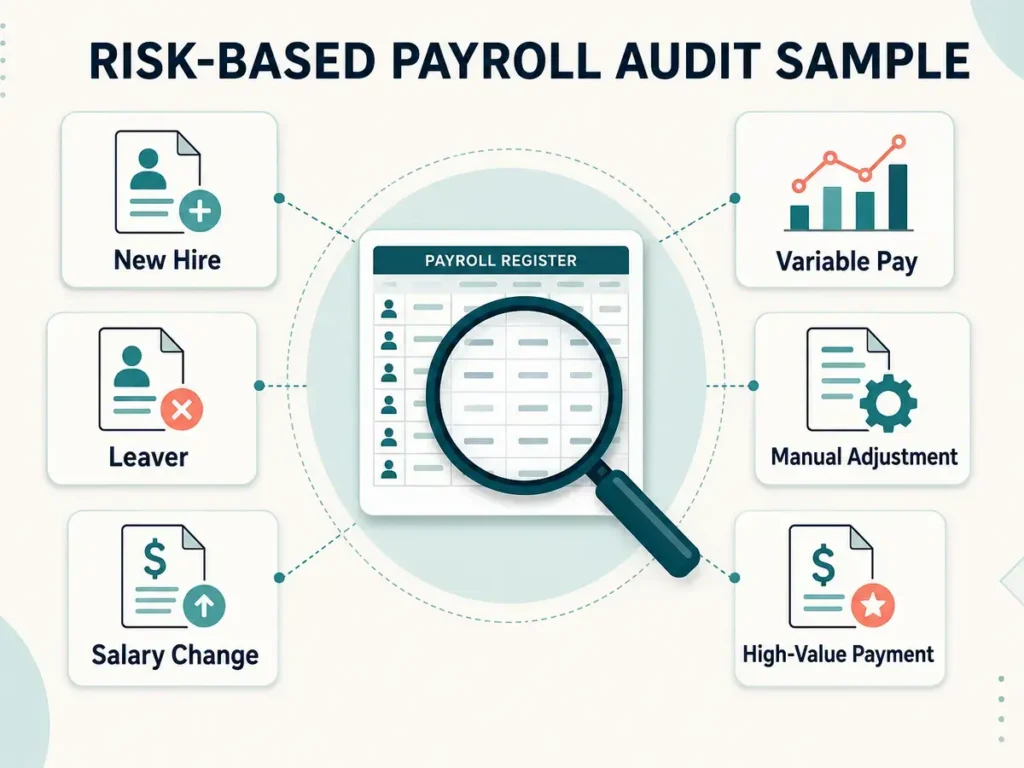
A sample should reflect payroll risk, not only convenience. Include different employee and transaction types so the audit can reveal problems that a review of normal fixed salaries might miss.
| Sample category | Why include it? | Suggested evidence |
|---|---|---|
| New hire | Tests setup, starting salary, registration data and first payment | Contract, onboarding record, master data, payslip and payment |
| Leaver | Tests cut-off, final inputs, final payment and removal from payroll | Exit approval, final calculation, payment and employee-status report |
| Salary change | Tests authorization, effective date and master-data control | Approved amendment, change log and calculation |
| Variable pay | Tests bonus, commission, overtime or other changing inputs | Source report, manager approval and payroll calculation |
| Manual adjustment | Tests unusual entries outside standard processing | Reason, approval, calculation and correction history |
| High-value payment | Tests material financial and calculation risk | Contract terms, detailed calculation, approval and bank evidence |
For a first review, consider selecting transactions from more than one payroll cycle and include at least one month containing joiners, leavers or variable pay. The final sample size should reflect headcount, risk, prior errors and the assurance required. A qualified auditor or adviser should determine the sampling approach when formal assurance is needed.
How to Classify Payroll Audit Findings
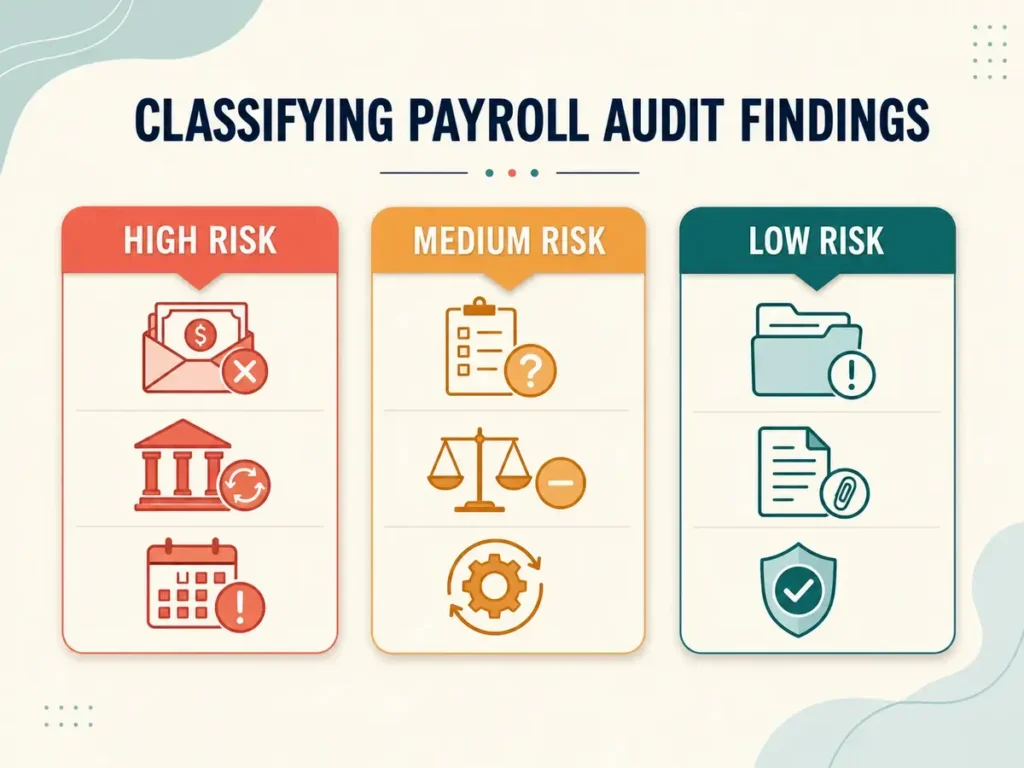
A simple internal rating helps the company prioritize corrective work. The categories below are operational labels, not legal conclusions.
| Priority | Example | Response |
|---|---|---|
| Immediate | Unexplained payment, missing legal-employer information, material calculation error or unsupported statutory difference | Pause the affected action where appropriate, escalate and obtain specialist review |
| High | Weak approval, repeat reconciliation difference, outdated setting or missing filing evidence | Assign an owner and complete a time-bound correction with retesting |
| Moderate | Inconsistent documentation, delayed approval or incomplete archive | Correct the process and confirm the next cycle follows it |
| Improvement | Clearer naming, better version control or a more useful management report | Add to the process-improvement plan and monitor |
When Should a Foreign Company Run a Payroll Audit?
A payroll audit can be useful before the first live payroll, after changing payroll providers or systems, when moving from an informal process to a controlled one, after a significant law or configuration update, following repeated employee complaints, before a financial or compliance review, or when reconciliations reveal unexplained differences.
Companies using payroll outsourcing in Egypt should include both provider and employer responsibilities in the review. Outsourcing payroll administration does not remove the need for the employer to approve inputs, understand outputs, retain agreed records and oversee the service.
How Begory Can Support a More Reviewable Payroll Process
Begory’s payroll services in Egypt can support agreed payroll calculations, monthly input management, payslips and payroll reports for companies with an appropriate Egyptian employing entity. The exact responsibilities, outputs, approval steps and reporting support should be confirmed during payroll setup.
Before implementation, define the payroll population, frequency, cut-off, authorized contacts, required reports, payment process, statutory coordination, data handling and escalation route. These points make the monthly process easier to review and help the company retain a clearer audit trail.
Final Egypt Payroll Audit Checklist
- ☐ The payroll population reconciles to approved HR and headcount records.
- ☐ The legal employer is recorded for every employee in scope.
- ☐ Employee master data matches supporting documents.
- ☐ Salary and variable-pay changes have dated authorization.
- ☐ Preparation, review, approval and payment access are appropriately separated.
- ☐ A risk-based sample has been independently recalculated.
- ☐ Payroll settings and material updates have review evidence.
- ☐ Joiners, leavers and final payments reconcile to HR records.
- ☐ Net pay reconciles to bank-payment evidence.
- ☐ Payroll totals reconcile to finance and statutory records.
- ☐ Payslips, submissions, approvals and payment evidence are retrievable.
- ☐ Every finding has an owner, target date and proof of closure.
Frequently Asked Questions
What is an Egypt payroll audit checklist?
An Egypt payroll audit checklist is a structured set of tests used to verify payroll authorization, employee data, calculations, payments, reconciliations, statutory evidence and record retention. It helps a company determine whether payroll results are accurate, supported and reviewable.
Is a payroll audit the same as payroll processing?
No. Payroll processing produces the monthly calculation, payment and reports. A payroll audit independently tests whether the inputs, calculations, approvals, payments and records are complete, accurate and supported by evidence.
Does this checklist replace an Egyptian tax or legal review?
No. This checklist organizes operational testing. Current tax, social-insurance, employment and filing treatment should be confirmed with the relevant Egyptian authorities and qualified payroll, tax or legal professionals.
Should an outsourced payroll process still be audited?
Yes. The review should test the responsibilities of both the employer and the provider, including input approval, calculation review, payment authorization, agreed reporting, statutory coordination and record retention.
How often should payroll be audited?
The frequency depends on headcount, payroll complexity, prior findings, system or provider changes and the assurance the company needs. Some controls should be reviewed every payroll cycle, while a broader risk-based audit may be scheduled periodically or after a material change.
Final Takeaway
An Egypt payroll audit checklist should show more than whether salary totals appear reasonable. It should connect each sampled payment to authorized data, a reproducible calculation, independent approval, bank and finance records, relevant statutory evidence and a retrievable audit trail.
If your company needs help creating a clearer payroll process and reporting structure, talk to Begory about payroll support in Egypt.
Official References
-
Previous Post
How to Pay Employees in Egypt
-
Next Post
Romania work permit for Egyptian workers
Related Posts

Why Should Business Payroll Outsourcing?
How well this mistaken ideas off denouncing pleasure & praisings will give you complete.

How to Handle Employee With Works
How well this mistaken ideas off denouncing pleasure & praisings will give you complete.

Understanding Executive Coaching
How well this mistaken ideas off denouncing pleasure & praisings will give you complete.

Workplace banter cause problems in your business?
Banter! Could “workplace banter” cause problems in your business? The short answer? Yes.
