

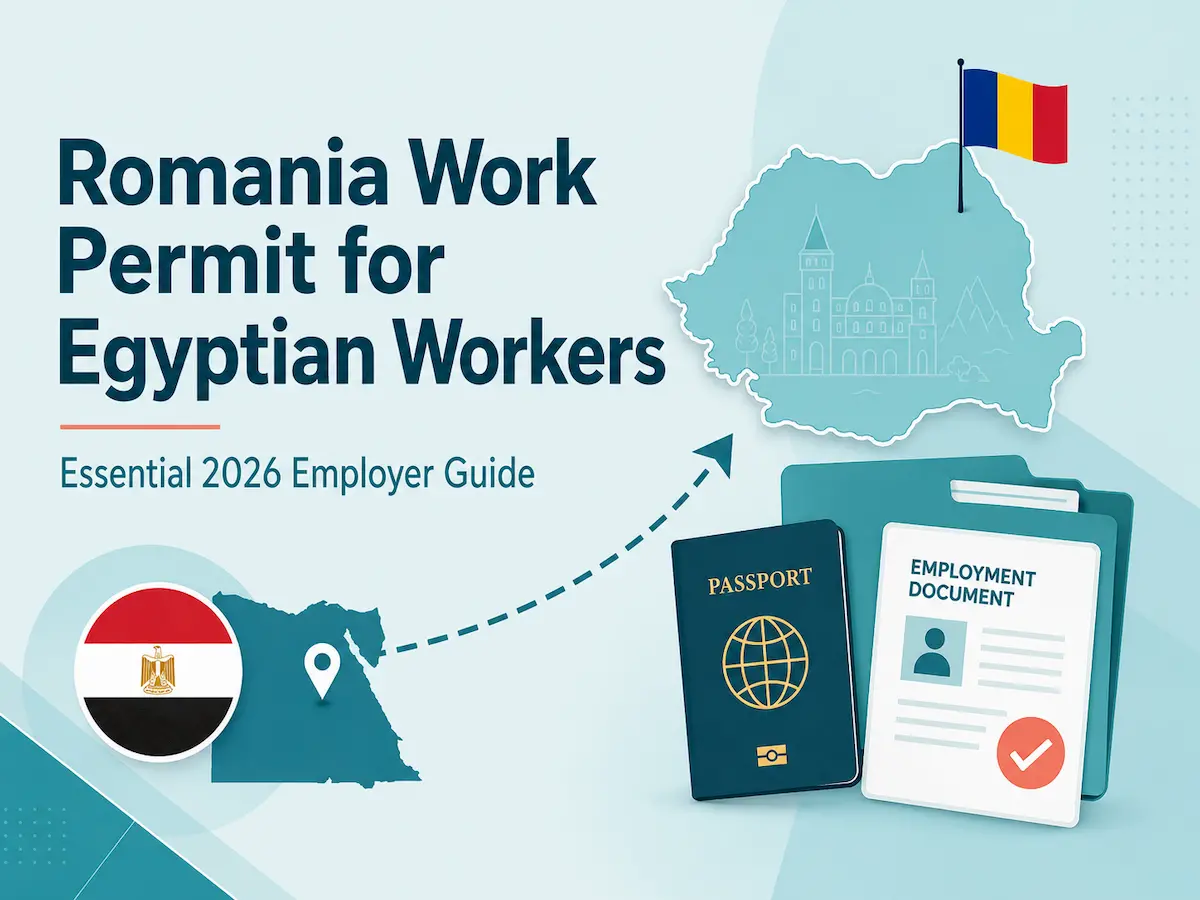
Romania Work Permit for Egyptian Workers: Complete 2026 Guide
Quick answer: A Romanian company can recruit an eligible Egyptian worker only through the employment and immigration route that applies to the employer, occupation, and worker category. The familiar search term is a “Romania work permit for Egyptian workers,” but Romania’s 2026 reform introduces a single employment-visa application for covered cases. For many permanent, seasonal and cross-border workers, the relevant route is expected to be the D/AM2 long-stay employment visa. The application must be submitted through the Romanian system by an authorized foreign-worker placement agency or an authorized Romanian employer not by the worker or an overseas recruiter acting alone.
Romania is currently moving from its previous employment-authorization and visa sequence to the new framework created by Government Emergency Ordinance No. 32/2026. As of 24 July 2026, the official Work in Romania platform states that it is still in testing and operationalization. The new system is scheduled to move into operational use from 8 August 2026, while applications and appointments covered by the transitional rules continue under the earlier procedure.
This guide explains the process from an employer’s perspective. It does not replace case-specific advice from Romania’s General Inspectorate for Immigration, Ministry of Foreign Affairs, employment authorities or a qualified Romanian immigration and employment professional. Employers seeking candidates can also review Begory Advance Hire’s commercial page about how to hire Egyptian workers in Romania.
Last fact-checked: 24 July 2026
What Does a “Romania Work Permit for Egyptian Workers” Mean in 2026?
Egyptian citizens are third-country nationals for Romanian immigration purposes. They do not receive an automatic right to work in Romania simply because a Romanian company offers them a job. The employer, the worker and any authorized placement agency must follow the Romanian route that applies to the proposed employment.
Historically, employers commonly described the process as obtaining an employment authorization first, followed by a long-stay employment visa and a residence document after arrival. That language remains familiar to employers and job seekers, which is why “Romania work permit for Egyptian workers” is still a useful way to describe the subject.
However, Government Emergency Ordinance No. 32/2026 changes the structure for covered cases. Under the new framework, the D/AM1 or D/AM2 long-stay employment visa is issued through a single electronic application. The visa is intended to establish both the worker’s right to enter for employment and the right to work for the identified Romanian employer, subject to all applicable conditions and the authorities’ decision.
Employers should therefore distinguish between the phrase people search for and the formal procedure they must follow. A candidate may say they need a “work permit,” while the employer’s actual task under the new route may be to prepare an employment contract, qualify as an authorized employer or work with an authorized placement agency, and support a single D/AM application through WorkinRomania.gov.ro.
Romania’s 2026 Transition: Which Process Applies?
The transition date matters. Emergency Ordinance No. 32/2026 was published in Romania’s Official Gazette on 27 April 2026. Its final provisions establish a testing and registration period through 7 August 2026 for the new platform, employer registration and agency authorization.
Applications for employment or posting authorizations submitted before the new rules take effect are handled under the rules that applied when they were filed. The ordinance also contains transitional protection for certain appointments and authorizations already issued under the earlier system. Employers should not cancel, duplicate or restart an existing case without confirming its status with the responsible Romanian authority or adviser.
For a new recruitment campaign, the employer should record three dates:
- The date the employer or authorized party plans to file the Romanian application.
- Whether an appointment or employment-authorization request already exists under the previous system.
- Whether the case will be handled before or after 8 August 2026.
As of this article’s fact-check date, the official platform warns that data entered during testing generally does not have legal effect. Employers should use the platform for live filings only when the responsible authority confirms that the relevant function is operational. The full text of Emergency Ordinance No. 32/2026 should be checked alongside current guidance.
D/AM1 Versus D/AM2: Which Employment Visa Is Relevant?
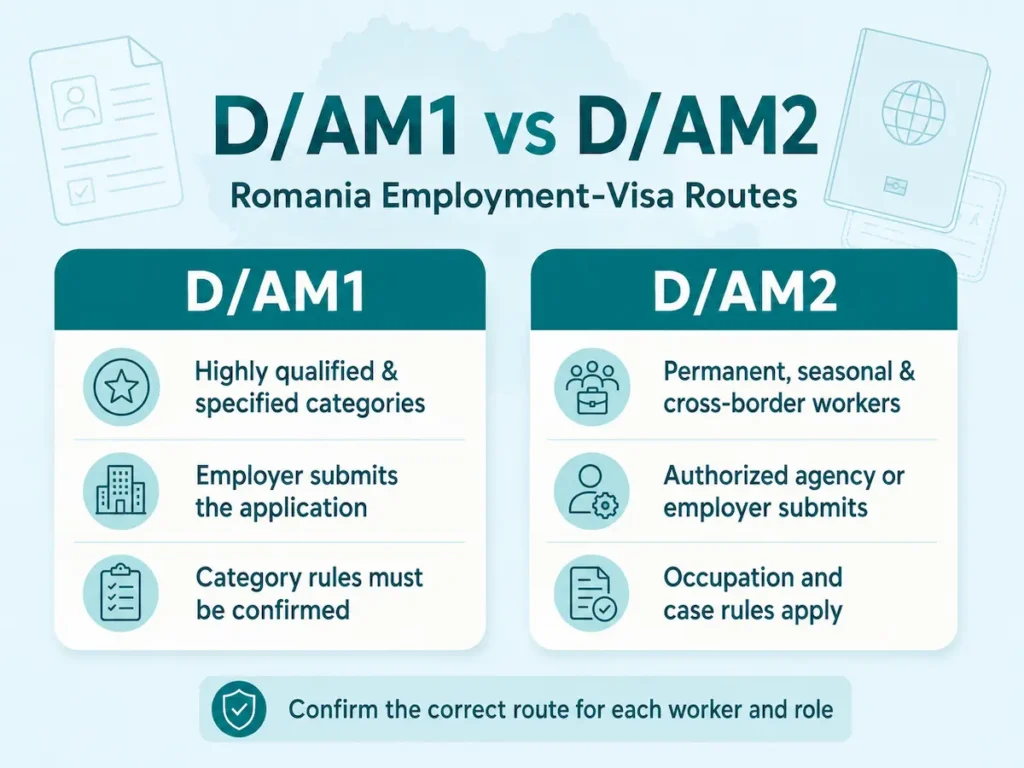
Romania’s new framework uses two long-stay employment-visa categories. The correct category depends on the worker and role, not simply on nationality.
| Point | D/AM1 | D/AM2 |
|---|---|---|
| Typical scope | Specific categories, including highly qualified workers and certain other groups listed in the law. | Permanent, seasonal and cross-border workers who meet the applicable conditions. |
| Who submits | The Romanian employer submits the single application. | An authorized foreign-worker placement agency or an authorized employer submits the single application. |
| Occupation requirement | Category-specific requirements apply. | The occupation must meet the requirements of the final shortage-occupation list, unless another lawful exception applies. |
| Common Egyptian-worker use | Potentially relevant to an Egyptian national recruited for a genuinely highly qualified role. | Likely to be the more relevant route for many standard permanent or seasonal roles, subject to the final occupation list and case classification. |
The General Inspectorate for Immigration’s employment-visa guidance lists D/AM1 categories that include highly qualified workers, certain workers requested by central public authorities, specified education or cultural personnel, professional athletes, and citizens of Moldova, Ukraine and Serbia employed under the stated conditions.
Egyptian candidates do not fall into the nationality-based D/AM1 category. An Egyptian professional may still qualify for D/AM1 if the role and candidate meet another category, such as the conditions for highly qualified employment. Employers should not describe every engineer, supervisor or technician as “highly qualified” without checking the formal salary, education, experience and occupation requirements.
For many construction, manufacturing, hospitality, logistics or seasonal positions, D/AM2 may be the relevant route. That conclusion must still be confirmed for the actual occupation, contract and worker type.
Authorized Placement Agency or Authorized Direct Employer?
The D/AM2 framework gives Romanian employers two main procedural routes. Choosing the route early is important because it affects contracts, responsibilities, platform access and the party that submits the single application.
Route 1: Work Through an Authorized Foreign-Worker Placement Agency
A Romanian employer can work with a placement agency authorized under the new Romanian framework. The authorized agency completes the single application based on the placement contract, the service agreement with the employer and the Romanian employment contract.
The employer remains the legal employer. The agency’s involvement does not transfer responsibility for lawful employment terms, payroll, workplace safety, accommodation commitments or day-to-day management. The employer should verify the agency’s authorization and define every responsibility in writing.
Route 2: Become an Authorized Direct Employer
A Romanian employer that satisfies the authorization requirements may recruit and file directly without a separate authorized placement agency. Under this route, the authorized employer submits the D/AM2 single application through the platform.
Direct filing should not be confused with simply creating an online account. The employer must satisfy the authorization, registration, reporting and operational conditions that apply under Romanian law. Companies considering this route should assess whether their expected recruitment volume and internal capability justify the additional authorization and administration.
An Egypt-based recruitment company can support candidate sourcing and preparation, but it should not be presented as the Romanian authorized filing party unless that status is independently confirmed. This distinction protects the employer, the candidate and the recruitment partner from an inaccurate representation of legal authority.
Step-by-Step Romania Work Visa Process for Egyptian Workers
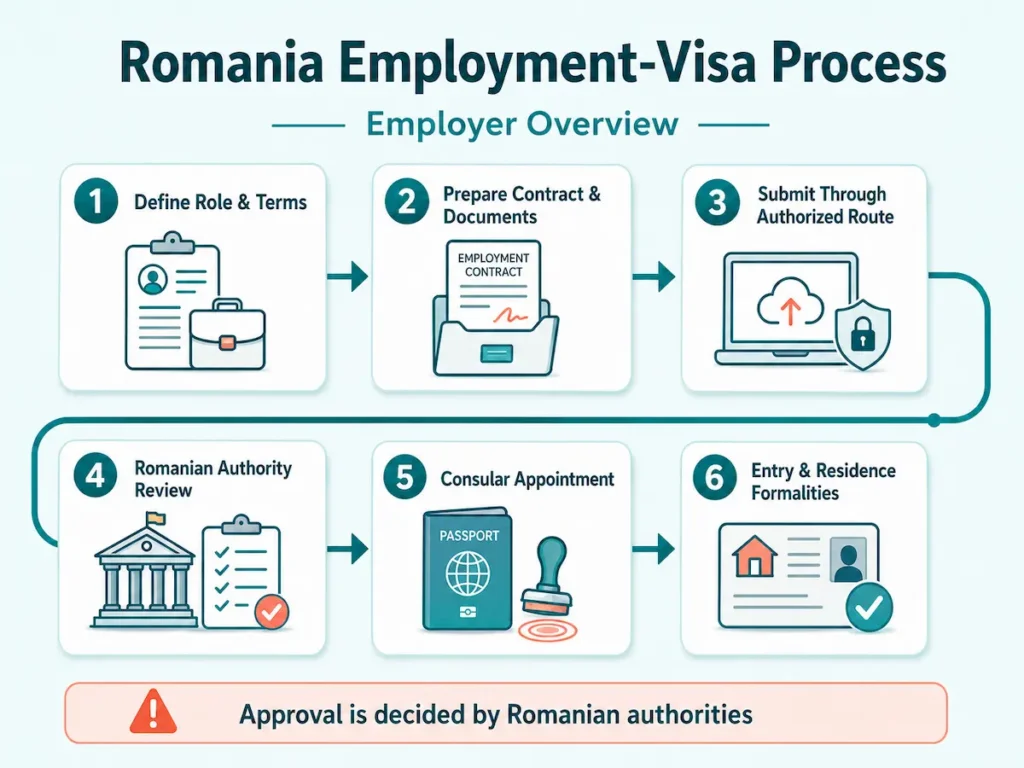
The exact workflow depends on the filing date and route. For a new D/AM2 case under the operational 2026 system, an employer should prepare for the following stages.
1. Define the Job and Employment Conditions
The Romanian employer should define the occupation, duties, number of workers, location, working hours, salary, benefits, accommodation, transportation, contract duration and expected start period. A vague request for “general workers” is not enough. The occupation used in the application must correspond to the real work and the appropriate Romanian occupational classification.
2. Confirm the Occupation and Worker Category
The employer or qualified Romanian adviser should confirm whether the role belongs to the final shortage-occupation list and whether the candidate is a permanent, seasonal, cross-border, highly qualified or other type of worker. This decision affects whether D/AM1, D/AM2 or another route applies.
3. Select the Authorized Filing Route
The employer must decide whether to contract with an authorized foreign-worker placement agency or qualify as an authorized direct employer. The selected party should confirm its authorization status and the contracts required before candidate processing begins.
4. Recruit and Assess Candidates in Egypt
Candidate sourcing should follow an approved job brief. The Romanian employer should make the final hiring decision after reviewing evidence relevant to the role, such as employment history, interviews, practical assessments, language ability and available qualifications.
For companies that need recruitment support in Egypt, Begory can help source candidates, coordinate interviews and collect agreed recruitment documents. Employers seeking a wider overview can review Begory’s Egyptian worker recruitment service.
5. Prepare and Register the Romanian Employment Contract
Official guidance for D/AM2 states that the individual full-time employment contract is registered in REGES-ONLINE and uploaded with the application. Depending on the filing route, the authorized agency also uploads the placement and service contracts.
The contract should accurately describe the role and employment terms required under Romanian labor rules and any applicable collective agreement. Registration or signature does not allow a candidate to begin work before the necessary visa, entry and other legal conditions are satisfied. Employers should obtain Romanian advice on the contract’s start provisions and any steps required before payroll activation.
6. Assemble the Employer and Candidate File
The authorized filing party compiles the contracts and supporting evidence. Documents must be current, internally consistent and translated or legalized where required. Names, passport details, occupation titles, salary and employer information should match across the entire file.
7. Submit the Single Application Through WorkinRomania.gov.ro
The authorized agency or authorized employer submits the D/AM2 application through the electronic platform. The platform is intended to connect the authorities responsible for employment, immigration and consular review.
Submission does not guarantee acceptance or approval. Authorities can assess admissibility, document sufficiency, the employer, the occupation, the worker and other legal conditions.
8. Complete the In-Person Consular Stage
The Egyptian worker must follow the instructions issued for the Romanian diplomatic mission or consular post and present the required originals in person. The law specifically requires presentation of the original travel document and supporting evidence at the personal appearance.
Appointments, validation and document requirements should be confirmed through the official Romanian channels. The Ministry of Foreign Affairs’ eVisa application guidance explains the general in-person and original-document stages, but employers should follow any updated instructions introduced for the Work in Romania system.
9. Wait for the Government Decision Before Arranging Deployment
Candidate selection, contract preparation and application submission do not guarantee a positive visa decision. Employers should avoid purchasing non-refundable travel, promising a fixed arrival date or assigning a worker to a project schedule before the responsible authorities issue the required approval.
10. Complete Entry, Employment and Residence Formalities
After a visa is issued, the employer and worker should confirm the conditions of entry, workplace onboarding, payroll registration, health and safety requirements and the applicable residence procedure. The worker should not assume that the entry visa alone resolves every long-term residence obligation.
Documents for a Romania D/AM2 Application
The document list depends on the case. Under the 2026 D/AM2 provisions, the filing package for permanent, seasonal and cross-border workers may include the following categories.
| Category | Examples | Main preparation responsibility |
|---|---|---|
| Employment and placement contracts | Romanian employment contract; placement contract and service agreement when an authorized agency is used. | Romanian employer and authorized agency |
| Identity | Valid passport or other accepted travel document, plus copies and originals required for the consular stage. | Egyptian worker |
| Criminal record | Criminal-record certificate or legally equivalent document issued by the country of origin or residence, translated and legalized as required. | Egyptian worker, with filing-party guidance |
| Travel medical insurance | Coverage valid for the relevant territory and visa period, with at least EUR 30,000 coverage under the 2026 rules. | Egyptian worker or responsible party under the agreed arrangement |
| Means of subsistence | Evidence at the level specified by Romanian law; D/AM2 guidance refers to the Romanian minimum gross basic salary for 90 days. | Worker and filing party |
| Experience and qualifications | CV, employment history, diplomas, certificates, qualification recognition or professional authorization when applicable. | Worker and employer |
| Employer information | Organizational chart showing filled and vacant positions and other evidence required for the employer or occupation. | Romanian employer |
This table is a planning aid, not a complete legal checklist. Requirements may differ for a regulated profession, seasonal employment, a highly qualified worker or a case filed during the transition period. The authorized filing party should issue a case-specific checklist before documents are ordered, translated or legalized.
The Shortage-Occupation List and Romania’s 2026 Foreign-Worker Quota
The Occupation Must Be Checked Against the Final List
Emergency Ordinance No. 32/2026 links many new employment procedures to a Romanian shortage-occupation list. The list is to be approved by ministerial order, published officially and updated every six months or whenever necessary.
On 24 July 2026, the Romanian Ministry of Labour published a proposal containing 236 occupations for consultation. The proposed occupations cover areas such as construction, transport, hospitality, manufacturing, trade, agriculture, services, healthcare and energy. A proposal is not the same as a final ministerial order.
The official Work in Romania page also labels its visible occupations as demonstration or test data and states that they do not represent the approved list. Employers should therefore check the official shortage-occupation page and the Official Gazette before relying on a particular occupation.
A job title appearing in a draft list does not guarantee that a candidate or employer qualifies. The real duties, Romanian occupation code, qualifications and employment conditions must align with the application.
The 90,000-Worker Quota Is a National Limit, Not a Promise
Romania approved a contingent of 90,000 newly admitted foreign workers for 2026. Under the new D/AM2 provisions, the visa can be issued only while the applicable contingent has not been exhausted. The government may change or supplement a contingent through the legal process, so employers should verify the current position when filing.
The quota is national. It is not a reservation for Egypt, a particular employer, a recruitment agency or an individual candidate. Being selected by a Romanian company does not secure a place in the quota or guarantee a positive decision. Employers can review the Romanian Ministry of Labour’s 2026 quota announcement.
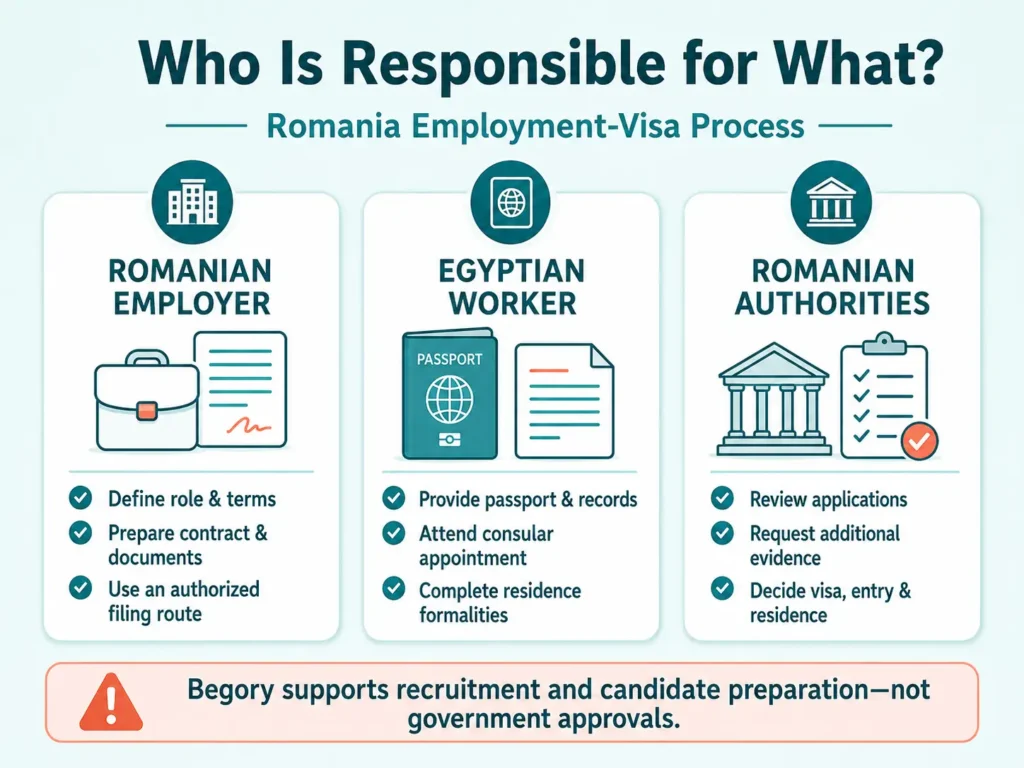
Who Is Responsible for Each Stage?
Clear responsibility is essential in cross-border recruitment. The Romanian employer should not assume that an Egypt-based recruiter controls Romanian immigration, and the worker should not be asked to manage employer-only obligations.
| Stage | Primary responsibility | Supporting role |
|---|---|---|
| Job, salary and employment terms | Romanian employer | Romanian HR, payroll and legal advisers |
| Candidate sourcing in Egypt | Begory or another agreed recruitment provider | Romanian employer |
| Final candidate selection | Romanian employer | Begory can coordinate interviews and assessments |
| Employer or agency authorization | Romanian employer or Romanian-authorized placement agency | Qualified Romanian adviser |
| Single D/AM2 application | Authorized placement agency or authorized employer | Employer, worker and Begory provide agreed information |
| Personal documents and consular appearance | Egyptian worker | Employer and authorized filing party provide instructions |
| Visa, entry and residence decisions | Competent Romanian authorities | No private company can guarantee the decision |
| Romanian payroll, workplace safety and onboarding | Romanian legal employer | Romanian payroll, HR and safety specialists |
The Consular, Entry and Residence Stages
The electronic application does not remove the worker’s personal responsibilities. The Egyptian candidate must follow the Romanian consular instructions, present originals when required, provide accurate information and attend the necessary appointment.
After visa issuance, the parties should check the visa’s validity, permitted entry period, employer details and any conditions before travel. The Romanian employer should prepare a documented arrival plan covering transport, accommodation, workplace induction, health and safety, payroll information, emergency contacts and the worker’s residence steps.
The applicable residence procedure must be completed through the General Inspectorate for Immigration within the period relevant to the worker’s status. Because residence requirements and platform functions can change, the employer should obtain a current checklist rather than reuse documents from an older recruitment campaign.
Workers should receive their employment terms in a language they understand. They should know the identity of the legal employer, job location, duties, gross and expected net pay, lawful deductions, working hours, overtime rules, accommodation costs, transport arrangements, leave, complaint channels and conditions for ending employment.
How Begory Advance Hire Can Support Romanian Employers
Begory Advance Hire is an Egypt-based recruitment and workforce-support company. For a Romania recruitment project, Begory’s agreed role may include:
- Reviewing the employer’s workforce brief and candidate criteria.
- Sourcing candidates in Egypt.
- Conducting initial screening against the approved job requirements.
- Coordinating employer interviews.
- Arranging role-appropriate assessments when included in the agreed scope.
- Collecting candidate-side recruitment documents.
- Supporting communication between candidates, the Romanian employer and authorized Romanian partners.
- Preparing selected candidates for the next documented stages.
Begory does not issue Romanian visas, decide immigration applications or replace any authorization required in Romania. The Romanian employer remains responsible for employment terms and lawful employment. An authorized Romanian party must handle any filing or regulated placement activity reserved to it under Romanian law.
Where a company needs construction trades, Begory’s guide to international recruitment for construction workers explains how to define roles, assess candidates and separate recruitment from government approval.
Common Employer Mistakes to Avoid
Using the Old Process Without Checking the Filing Date
A checklist prepared before the 2026 reform may refer to an employment authorization followed by a separate visa application. Employers should identify whether transitional rules preserve that route for their case or whether the single D/AM application applies.
Treating a Draft Occupation List as Final
A role appearing in the July 2026 proposal is not enough. The employer should verify the final ministerial order, the correct occupation code and the real job duties before filing.
Assuming Any Recruitment Company Can Submit the Application
The new framework assigns submission to specified authorized parties. Employers should verify the filing party’s status instead of relying on a general claim that an overseas recruiter “handles the visa.”
Offering Incomplete or Inconsistent Employment Terms
Salary, working hours, accommodation, deductions and job location should be consistent across the job brief, candidate communication, contracts and application. Material differences can harm trust and create legal or operational problems.
Describing a Candidate as Certified Without Verification
Experience in Egypt does not automatically establish recognition for a regulated Romanian occupation. Employers should verify whether Romanian recognition, licensing or authorization is required.
Promising a Visa or Arrival Date
No recruiter or employer can guarantee a Romanian government decision. Recruitment time, document preparation, platform review, consular availability and residence procedures can all affect the schedule.
Ignoring the Worker’s Understanding of the Offer
Candidates should receive clear written terms before committing money, documents or time. Employers should confirm that the worker understands salary, deductions, accommodation, duties and workplace conditions.
Frequently Asked Questions
Do Egyptian citizens need a work permit to work in Romania?
Egyptian citizens need the Romanian employment and immigration authorization that applies to their case. Under the 2026 framework, many covered cases move to a single D/AM employment-visa application rather than the older separate work-authorization and visa sequence. Existing transitional cases may continue under the previous rules.
What is a Romania D/AM2 visa?
D/AM2 is a Romanian long-stay employment visa used under the new framework for permanent, seasonal and cross-border workers who meet the applicable conditions. The single application is submitted through WorkinRomania.gov.ro by an authorized foreign-worker placement agency or an authorized employer.
What is the difference between D/AM1 and D/AM2?
D/AM1 applies to specified categories such as highly qualified workers and certain other groups listed in Romanian law, with the employer submitting the application. D/AM2 generally covers permanent, seasonal and cross-border workers, with submission by an authorized agency or authorized employer. The correct category must be confirmed for the specific worker and role.
Can Begory Advance Hire submit the Romanian visa application?
Begory can support recruitment and candidate-side coordination from Egypt within the agreed scope. The D/AM2 application must be submitted by a party authorized under the Romanian framework. Begory should not be presented as the Romanian authorized filing party unless that status is separately established.
Is Romania’s 2026 shortage-occupation list final?
As of 24 July 2026, a 236-occupation list had been published as a proposal for consultation. The official Work in Romania page still labelled its visible occupations as test data. Employers should verify the final ministerial order and current official list before relying on an occupation.
Does Romania’s 90,000-worker quota guarantee approval?
No. The quota is a national ceiling for newly admitted foreign workers in 2026. It is not a reservation or guarantee for a particular employer, agency, nationality or candidate. Every application remains subject to the applicable requirements and government decision.
How long does the Romania work visa process take for an Egyptian worker?
There is no reliable universal timeline. The duration depends on the applicable procedure, authorization route, candidate and employer documents, occupation, platform status, consular scheduling and government review. Employers should not promise an arrival date before the responsible parties assess the case.
Can an Egyptian worker begin work as soon as the employment contract is signed?
No assumption should be made that signature alone authorizes work. The worker must have the required visa, entry status and other approvals or registrations applicable to the case. The Romanian employer should confirm the lawful start date with qualified local advisers.
What happens after the worker enters Romania?
The employer completes workplace and payroll onboarding, while the worker and employer follow the applicable residence procedure through the General Inspectorate for Immigration. The parties should confirm current deadlines and documents for the worker’s category before travel.
Plan an Egypt-to-Romania Recruitment Project
A successful recruitment campaign starts with a precise employer brief, the correct Romanian filing route and clear candidate communication. Before sourcing begins, define the occupations, headcount, workplace, salary, benefits, accommodation, experience requirements and Romanian party responsible for the official procedure.
Begory Advance Hire can review your workforce requirements and explain the Egypt-side candidate process. To discuss a project, visit the Egyptian worker recruitment page for Romanian employers or contact Begory Advance Hire.
Compliance notice: This article provides general information and is not Romanian immigration, employment or legal advice. Procedures, platform functions, fees, occupation lists, quotas and document requirements can change. Employers and candidates should verify the current rules with Romania’s competent authorities and appropriately qualified Romanian professionals before acting.
Official Sources and Further Reading
- Romanian Government Emergency Ordinance No. 32/2026
- General Inspectorate for Immigration: Long-stay visa for employment
- Official Work in Romania platform
- Official Work in Romania shortage-occupation page
- Romanian Ministry of Labour: 2026 foreign-worker contingent
- Romanian Ministry of Foreign Affairs: How to apply for a visa
-
Previous Post
Egypt payroll audit checklist
Related Posts

Trade Testing Egyptian Workers: A Guide for European Employers
Recruiting skilled workers for an overseas project requires more than reviewing CVs and conducting interviews.…

Most Employees Support Measures to Prevent Spread
How well this mistaken ideas off denouncing pleasure & praisings will give you complete.

Retaining Good Employees & Motivated
How well this mistaken ideas off denouncing pleasure & praisings will give you complete.

How to Handle Your Good Employee
How well this mistaken ideas off denouncing pleasure & praisings will give you complete.
