

Reviewed by: Selvana Abdelnour, Business Development & Operations Manager
Last reviewed: July 2026
To pay employees in Egypt legally, an employer needs a compliant employment structure, an Egyptian payroll setup, accurate gross-to-net calculations, income tax withholding, social insurance administration, payslips, salary payments, and the required statutory filings. A company with a registered Egyptian entity can run payroll directly or outsource payroll administration. A foreign company without a local entity will usually need an Employer of Record to employ and pay the worker locally.
Understanding how to pay employees in Egypt is important for international companies hiring local or remote Egyptian talent. Salary payment is not simply a monthly bank transfer. It connects the employment contract, employee records, approved payroll inputs, statutory deductions, payslips, banking instructions, and proof of payment.
This employer guide explains the complete payment process, the difference between direct payroll and Employer of Record payroll, what employers must prepare before the first salary run, and the payment mistakes that most often cause delays.
Compliance notice: This guide provides general information and was last reviewed in July 2026. Payroll treatment can vary according to the employer, employee, compensation package, and employment structure. Verify operational decisions with current Egyptian government guidance and qualified payroll, tax, or legal professionals.
Short Answer: How to Pay Employees in Egypt Correctly
The correct way to pay employees in Egypt is to identify the legal employer, issue a compliant employment contract, register the employee where required, place the employee on an Egyptian payroll, calculate gross salary and statutory deductions, approve the payment instruction, transfer the resulting net salary, issue a payslip, and complete the necessary tax and social-insurance reporting.
For a foreign company, the first decision is whether it has an Egyptian legal entity:
- With an Egyptian entity: The entity can employ the worker and run payroll internally or use managed payroll services in Egypt.
- Without an Egyptian entity: The company can use an Employer of Record in Egypt to become the local legal employer and administer payroll.
- For genuinely independent work: A contractor arrangement may be possible, but it should not be used to disguise an employee-like relationship.
What Do Employers Need Before Paying an Employee in Egypt?
Before the first payroll run, the employer should confirm the employment structure, contract, employee data, compensation terms, bank instructions, and required registrations. Starting work before these points are clear can lead to delayed payments, incorrect deductions, and difficult payroll corrections.
| Requirement | What the employer should confirm |
|---|---|
| Legal employer | The Egyptian entity or Employer of Record that signs the contract and carries the local employment obligations. |
| Employment contract | Role, salary, allowances, benefits, working pattern, start date, leave, probation, and termination provisions. |
| Employee information | Legal name, identification, address, verified bank details, job details, tax information, and social-insurance records. |
| Salary structure | Gross or net salary, insurable salary, allowances, bonuses, overtime, commissions, and benefits. |
| Payroll calendar | Input cut-off, approval date, funding date, salary payment date, and filing responsibilities. |
| Payment controls | Authorized approver, bank-file owner, funding currency, payment reference, and evidence-retention process. |
Can a Foreign Company Pay Employees in Egypt Directly?
A foreign company generally needs a registered Egyptian legal entity to employ workers and run direct local payroll in its own name. Paying someone from a foreign bank account does not, by itself, create a compliant Egyptian employment and payroll structure.
A company researching how to pay employees in Egypt normally has three possible models:
| Employment model | Best suited to | Who manages payroll? |
|---|---|---|
| Own Egyptian entity | Established companies planning long-term operations or larger local teams. | The Egyptian entity, either internally or through a payroll outsourcing provider. |
| Employer of Record | Foreign companies hiring in Egypt without creating a local entity. | The EOR employs the worker locally and administers payroll, tax, social insurance, and employment records. |
| Independent contractor | Genuine independent suppliers delivering defined services under their own control. | The contractor generally manages their own invoicing and tax position, subject to the applicable arrangement. |
Contractor classification should be reviewed carefully when the person works fixed hours, reports to company managers, depends economically on one company, or operates like a normal member of the workforce. Companies that need to hire employees in Egypt without establishing an entity can consider an EOR rather than stretching a contractor arrangement beyond its proper purpose.
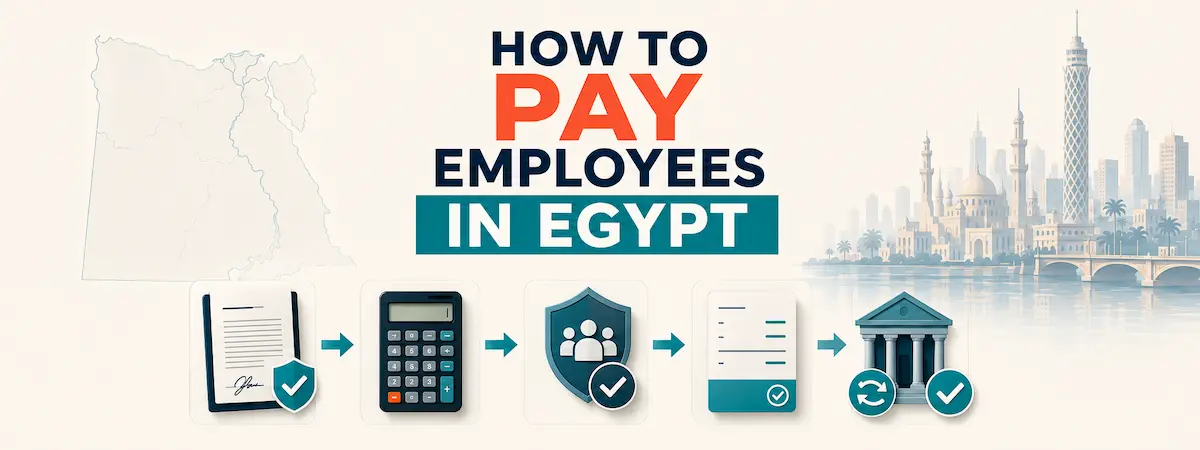
How to Pay Employees in Egypt: 10-Step Payroll Process
1. Choose the Correct Employment Structure
Identify the legal employer before issuing an offer or promising a start date. If your company has an Egyptian entity, that entity can employ the worker. If you do not have an entity, an EOR can act as the local employer while your company manages the employee’s daily work, goals, and performance.
This choice determines who signs the contract, registers the employee, calculates payroll, withholds tax, remits social insurance, issues payslips, and maintains the official employment file.
2. Prepare a Compliant Employment Contract
The employment contract should accurately document the role, compensation, benefits, working pattern, place of work, leave, probation, confidentiality, and termination terms. Egypt’s Labour Law No. 14 of 2025 became effective on 1 September 2025 and replaced the previous Labour Law No. 12 of 2003. The legislative record is available through the International Labour Organization’s NATLEX database.
For payroll purposes, the contract should clearly state whether compensation is gross or net and how allowances, bonuses, commissions, overtime, and benefits are treated. Employers can review Begory’s guide to employee contracts in Egypt for additional employment-documentation guidance.
3. Collect Employee Payroll and Bank Information
Collect the employee’s legal name, national identification or passport details, address, contact information, bank details, job title, start date, salary, allowances, benefit elections, social-insurance information, and the documents required for local onboarding.
Validate the account holder’s name, account number or IBAN, bank name, and payment currency before the first payroll cut-off. Incorrect identification, bank, or salary details can delay registration, produce inaccurate payslips, or send payment to the wrong account.
4. Complete Payroll and Social Insurance Setup
Register and maintain the employee within the applicable payroll tax and social-insurance systems. The precise process depends on the legal employer and the employee’s circumstances. The Egyptian Tax Authority publishes official payroll tax system forms and 2026 calculation materials for employers and payroll teams.
Social-insurance setup should confirm the applicable insurable salary, employee contribution, employer contribution, and any special treatment that may apply. Registration should not be delayed until several payroll periods have already passed.
5. Set the Payroll Cut-Off and Approval Calendar
Every payroll run needs an agreed cut-off. HR, finance, and managers should submit and approve changes such as new starters, leavers, salary increases, overtime, unpaid leave, bonuses, commissions, expense reimbursements, and benefit deductions before the deadline.
The calendar should also state when the payroll summary is reviewed, when the bank file is approved, when funds must be available, and when employees should receive salary and payslips.
6. Calculate Gross-to-Net Salary
Gross-to-net payroll converts the employee’s agreed gross compensation into the amount paid to the employee. The calculation can include gross salary, taxable allowances, bonuses, overtime, employee social insurance, salary tax, statutory contributions, unpaid leave, and other permitted adjustments.
Employers should also calculate total employment cost. Employer social insurance, benefits, equipment, payroll-provider charges, and EOR fees do not normally reduce the employee’s net salary, but they affect the company’s hiring budget.
7. Review Payroll and Prepare Payslips
Payroll should be reviewed before payment. The reviewer should confirm new joiners and leavers, check statutory deductions, investigate significant changes, compare the bank-payment total with the approved payroll register, and make sure the payment file contains only authorized employees.
Employees should receive a clear payslip showing the pay period, gross earnings, allowances, deductions, and net salary. Finance and HR should also receive the agreed payroll register, employer-cost report, statutory summary, and variance report.
8. Fund Payroll and Pay Net Salaries
After approval, the employer or payroll partner funds the payroll and transfers the net salary using the agreed payment method. The authorized payer should use the final approved bank file and retain proof that the transaction was submitted.
International companies should fund their Egyptian payroll early enough to account for international transfers, banking checks, currency conversion, internal approvals, weekends, and Egyptian public holidays. The salary payment date should be clearly documented in the employment contract and payroll calendar.
9. Confirm Payment and Resolve Exceptions
After the bank processes the salary file, confirm the successful payments and identify any rejections, returned transfers, incorrect bank details, or funding differences. Correct exceptions through an approved off-cycle process rather than making undocumented transfers.
Salary payment does not complete every employer obligation. The legal employer must also remit withheld tax, pay applicable social-insurance contributions, and submit required declarations according to the current statutory timetable.
10. Retain Payment Records and Maintain the Process
Maintain employment contracts, approved payroll registers, payslips, bank files, salary-payment confirmations, exception logs, tax calculations, social-insurance records, leave data, compensation changes, and final-settlement documents for the applicable retention periods.
Payroll teams should monitor changes to tax brackets, exemptions, social-insurance limits, minimum wage, employment law, filing procedures, and government forms. Knowing how to pay employees in Egypt is not a one-time setup exercise; it requires an accurate and repeatable monthly process.
Statutory Deductions That Affect Employee Pay
Employee net salary is affected by salary tax, employee social insurance, and any other deductions that lawfully apply to the employee. The employer also funds its own social-insurance contribution as part of total employment cost. These items must be calculated before the final bank-payment amount is approved.
| Payroll item | Effect on the payment process | Where to read the detailed rules |
|---|---|---|
| Salary income tax | Withheld from employee earnings before net salary is paid. | Egypt payroll tax rates and deadlines |
| Employee and employer social insurance | The employee share reduces net pay; the employer share increases employment cost. | Payroll and social insurance requirements |
| Other applicable deductions | Must have a valid legal or contractual basis and appear clearly in payroll records and the payslip. | Confirm current treatment with a qualified Egyptian payroll, tax, or legal professional. |
This article focuses on the payment workflow, so it does not repeat the full tax bands, social-insurance limits, or filing tables owned by the dedicated guides above.
Example: From Salary Offer to Payment Instruction
Assume an employee’s contract states a monthly gross salary of EGP 30,000. The payroll team should not instruct the bank to transfer EGP 30,000 automatically. It must first process approved additions and deductions, calculate the employee’s net salary, obtain payroll approval, and transfer only the approved net amount.
| Stage | Required output | Owner |
|---|---|---|
| Contract and setup | Confirmed gross salary, payment date, employee data, and bank details | HR and legal employer |
| Payroll calculation | Gross-to-net result and employer-cost summary | Payroll team or provider |
| Approval | Authorized payroll register and final bank total | Employer’s approved reviewer |
| Payment | Bank file or transfer instruction using the approved net amount | Authorized finance or EOR team |
| Confirmation | Payment evidence, rejected-payment log, and employee payslip | Finance, payroll, and HR |
The employee-specific net amount cannot be calculated reliably from the gross salary alone. It depends on current payroll rules, approved compensation inputs, and the employee’s circumstances.
Employee Salary Payment Timeline
A documented payment timeline helps HR, payroll, and finance complete the salary transfer without missing approvals or creating last-minute exceptions.
| Stage | Typical position in the cycle | Employer action |
|---|---|---|
| Payroll input cut-off | Before calculation begins | Close approved salary, leave, overtime, bonus, joiner, and leaver inputs. |
| Payroll review | After the draft calculation | Review changes, exceptions, deductions, net-pay totals, and employer cost. |
| Funding and bank approval | Before the contractual pay date | Make funds available and authorize the final payment instruction. |
| Salary payment | On the agreed pay date | Transfer approved net salaries and issue payslips. |
| Payment confirmation | Immediately after processing | Confirm successful transfers and resolve rejected or returned payments. |
| Post-payment obligations | According to current statutory deadlines | Complete the required tax, social-insurance, filing, and recordkeeping steps. |
Exact statutory deadlines should be confirmed with the employer’s payroll adviser and the current Egyptian Tax Authority and social-insurance systems.
Gross Salary, Net Salary, and Total Employer Cost
Salary discussions can become confusing when the employer and employee use different definitions. Every offer should clarify whether the promised amount is gross or net.
| Term | Meaning | Why it matters |
|---|---|---|
| Gross salary | Salary before employee deductions. | Forms the starting point for payroll and salary offers. |
| Net salary | The amount transferred after employee deductions. | Represents employee take-home pay. |
| Employer cost | Gross salary plus employer contributions, benefits, and other employment costs. | Used for workforce budgeting. |
| Total EOR cost | Employment cost plus the Employer of Record service fee and any agreed services. | Used when hiring without a local entity. |
A net salary guarantee can move the risk of tax or contribution changes to the employer. A gross salary offer is normally easier to administer, but candidates should receive a reliable estimated take-home calculation before accepting the offer.
Can Employees in Egypt Be Paid in Foreign Currency?
Employers should not assume that offering salary in USD, EUR, or another foreign currency is operationally simple. The arrangement can affect the employment contract, exchange-rate risk, bank processing, payroll reporting, and the employee’s expectations. Statutory calculations and local payroll records also need consistent Egyptian-pound values.
If compensation will be paid in, or linked to, a foreign currency, obtain local payroll and legal guidance before including that promise in the contract. The contract should explain the agreed currency, conversion mechanism, exchange date, and responsibility for bank charges where applicable.
How to Pay Remote Employees in Egypt
Remote work does not remove employment and payroll obligations. A remote employee working from Egypt still needs an appropriate contract, payroll treatment, tax review, social-insurance review, payslips, leave tracking, and employee records.
Labour Law No. 14 of 2025 introduced a modern framework that recognizes non-traditional working arrangements. Foreign companies investigating how to pay employees in Egypt remotely should first determine whether they will use an Egyptian entity, an EOR, or a genuine independent-contractor model. Begory’s remote hiring Egypt service supports recruitment, onboarding, employment, and payroll administration under the agreed scope.
Payroll Outsourcing vs Employer of Record in Egypt
Payroll outsourcing and Employer of Record services solve different problems:
| Question | Payroll outsourcing | Employer of Record |
|---|---|---|
| Do you need your own Egyptian entity? | Yes, because your entity remains the employer. | No, because the EOR becomes the local legal employer. |
| Who signs the employment contract? | Your Egyptian entity. | The Employer of Record. |
| Who calculates payroll? | The payroll provider on behalf of your entity. | The EOR as part of the employment service. |
| Who carries employer obligations? | Your Egyptian entity. | The EOR, subject to the service agreement and applicable law. |
| Best use case | An existing entity needs payroll expertise or administrative support. | A foreign company needs to employ staff without establishing an entity. |
Companies with an entity can learn more from Begory’s payroll outsourcing Egypt guide. Companies that also need onboarding, employee records, leave administration, and broader workforce support can consider HR outsourcing in Egypt.
Common Employee Payment Mistakes in Egypt
- Hiring the employee before confirming who the legal employer will be.
- Sending an international transfer without establishing a local employment and payroll process.
- Promising a net salary without modelling the employer’s exposure to tax and contribution changes.
- Collecting incomplete or unverified employee bank details.
- Submitting the bank file before the final payroll register is approved.
- Funding payroll too late to allow for international transfers, weekends, or bank checks.
- Paying a correction outside payroll without an approval record or revised payslip.
- Failing to confirm rejected or returned salary payments.
- Giving employees unclear payslips or no explanation of deductions.
- Keeping incomplete payroll approvals, bank files, and payment evidence.
Employee Payment Setup Checklist for Egypt
Use this checklist before the employee’s first scheduled payment:
- Confirm whether the legal employer is your Egyptian entity or an Employer of Record.
- Issue the employment contract and confirm whether the salary is gross or net.
- Record allowances, benefits, bonuses, commissions, overtime, and the agreed pay date.
- Collect and validate the employee’s identification, bank details, and payroll information.
- Complete the applicable payroll and social-insurance setup before the first run.
- Set the monthly input cut-off, review date, funding date, and salary payment date.
- Calculate the employee’s net salary using approved inputs and current statutory rules.
- Match the final bank total to the approved payroll register.
- Transfer the approved net salary and issue the employee’s payslip.
- Confirm successful payment and resolve rejected transfers through an approved correction process.
- Retain the contract, approval, bank instruction, payment confirmation, and payslip.
After payment setup: This checklist establishes how the employee will be paid. For a deeper review of payroll approvals, reconciliations, audit evidence, sampling, segregation of duties, and corrective actions, use Begory’s Egypt payroll audit checklist.
How Begory Advance Hire Helps Companies Pay Employees in Egypt
Begory Advance Hire supports international and local companies that need a reliable way to hire, manage, and pay employees in Egypt.
For companies with an Egyptian entity, Begory can support payroll calculations, payslips, reporting, statutory deductions, and payroll administration under an agreed service scope. For companies without an entity, Begory’s EOR solution provides a local employment structure covering employment contracts, payroll, tax, social insurance, onboarding, and ongoing HR administration.
Begory can also connect payroll with recruitment, remote hiring, employee onboarding, and HR support, helping employers create one coordinated process instead of managing disconnected providers.
Conclusion: How to Pay Employees in Egypt Successfully
Knowing how to pay employees in Egypt requires more than choosing a salary and sending a bank transfer. Employers need a valid employment structure, accurate contracts, approved payroll calculations, statutory deductions, verified bank instructions, payslips, payment evidence, and ongoing filings.
If your company has an Egyptian entity, it can operate payroll internally or use a payroll outsourcing provider. If it does not have an entity, an Employer of Record can employ and pay the worker locally while your company manages the employee’s daily responsibilities.
The strongest approach is to decide the payroll model before the employee starts, verify the compensation calculation before making a salary promise, and document each stage from payroll approval to confirmed payment.
-
Previous Post
Egypt Payroll Taxes for Employers
-
Next Post
Egypt payroll audit checklist
Related Posts
Egypt Payroll Taxes for Employers
Egypt Payroll Taxes for Employers involve more than deducting income tax from a monthly salary.…

How Payroll Outsourcing Works in Egypt
Last updated: August 2026 How payroll outsourcing works in Egypt depends on a clear division…
