


Recruiting skilled workers for an overseas project requires more than reviewing CVs and conducting interviews. European employers also need reliable evidence that candidates can perform their jobs safely, accurately and efficiently. Trade testing Egyptian workers provides that evidence through structured, role-specific practical assessments before final selection.
A well-designed trade test helps employers compare candidates using the same criteria, identify training needs and reduce the risk of selecting workers whose practical ability does not match their stated experience. This guide explains the seven essential checks European employers should include when assessing skilled Egyptian candidates.
Quick answer: Trade testing Egyptian workers means asking shortlisted candidates to complete supervised, job-specific practical tasks before final hiring. Employers can then compare safety, accuracy, quality, tool handling, speed and problem-solving using a consistent scorecard.
Table of Contents
What Is a Trade Test?
A trade test is a practical skills assessment that asks a candidate to complete tasks related to their occupation. Instead of relying only on qualifications or interview answers, the assessor observes how the candidate uses tools, follows instructions, applies safety procedures and completes the assigned work.
The content of the test depends on the job. A welder may be asked to prepare materials and produce a specified joint. An electrician may need to interpret a basic diagram, connect a circuit and identify faults. A machine operator may be assessed on setup, operation, quality control and safe shutdown procedures.
Trade testing is particularly useful for construction, manufacturing, maintenance and technical roles where practical performance directly affects safety, productivity and work quality.
Why European Employers Use Trade Testing
Job titles and years of experience do not always show whether two candidates have the same level of ability. Working methods, equipment and quality expectations may also differ between companies and projects. A well-designed skilled worker trade test gives the employer a clearer and more consistent basis for comparison.
For European employers, trade testing Egyptian workers provides additional evidence beyond CVs and interviews.
Trade testing can help an employer:
- Confirm that a candidate can perform the core tasks of the role.
- Evaluate safety awareness and correct use of tools or equipment.
- Compare applicants against the same assessment criteria.
- Identify whether additional training may be required.
- Create a documented record to support the final hiring decision.
A trade test should support the recruitment decision, not replace document verification, interviews, medical assessments or the destination country’s employment and immigration requirements.
Seven Essential Checks When Trade Testing Egyptian Workers
1. Define the Required Skills Before Testing
The employer should begin with a clear job description and a list of essential practical competencies. The test must reflect the work the employee will actually perform, including the materials, tools, machinery and quality standards relevant to the position.
For example, a general test for “factory workers” may be too broad. A packaging-machine operator, CNC operator, production assembler and maintenance technician require different tasks and scoring criteria. Defining the role precisely makes the assessment more relevant and helps prevent unsuitable candidates from progressing.
2. Use a Role-Specific Practical Task
The main assessment should require the candidate to demonstrate the occupation rather than describe it. The task should be realistic, time-bound and suitable for the seniority of the position.
Depending on the role, the assessment could include:
- Producing a sample weld using the required method and position.
- Installing or troubleshooting a basic electrical component.
- Reading measurements and completing a fabrication task.
- Operating production equipment according to a defined procedure.
- Assembling, inspecting or repairing a mechanical component.
Tests should be conducted in an appropriate environment with suitable tools, materials, supervision and safety controls.
3. Assess Safety Awareness
Technical ability is not enough if the candidate ignores safety procedures. Assessors should observe whether the worker selects and uses personal protective equipment, checks the work area, handles tools responsibly and responds correctly to hazards.
The test can also include short questions about equipment isolation, emergency procedures, lifting practices or other risks relevant to the occupation. Safety criteria should be recorded separately so strong technical performance does not hide unsafe behaviour.
4. Measure Work Quality and Accuracy
The completed task should be checked against measurable requirements. These might include dimensions, tolerances, finish, alignment, strength, wiring accuracy, assembly quality or the number of acceptable units produced.
The employer should provide its expectations before recruitment so the assessment can reflect the required standard. A consistent scoring sheet makes it easier to compare results across candidates and explain why one applicant was selected over another.
5. Observe Tool and Equipment Handling
Assessors should confirm that the candidate understands the tools or machines needed for the role. This includes choosing the correct equipment, preparing it properly, using it safely and recognizing common problems.
If the employer uses a particular machine, process or technical standard, that detail should be shared when the test is designed. When identical equipment is unavailable, the report should clearly state what was used and which abilities still need to be verified by the employer.
6. Evaluate Speed and Problem-Solving
Speed matters, but it should not be measured without quality and safety. The assessor should record how long the task takes and observe how the candidate responds when encountering a mistake, unclear instruction or technical problem.
An experienced worker should usually be able to explain the cause of a problem, choose a sensible solution and continue without creating additional risk. This provides valuable evidence about independence and decision-making on the job.
7. Document and Compare the Results
Every candidate should be evaluated using the same scorecard for the same role. The report should identify the assessment date, tested skills, task conditions, scoring scale, strengths, weaknesses and overall result. Using the same format creates a more transparent worker skills verification record for the employer.
Where appropriate and with suitable consent, photos or videos can provide additional evidence for the employer’s review. The final decision should still consider the complete candidate profile, including verified experience, interview performance, documentation and project-specific requirements.

Illustrative overview of the checks employers can include in a role-specific trade test.
Which Egyptian Workers Can Be Trade Tested?
Practical assessments can be adapted for many skilled and semi-skilled occupations. The appropriate method depends on the role: some require a full practical demonstration, while others use practical tasks together with technical questions and document checks.
Trade testing Egyptian workers can be adapted to different skilled and semi-skilled occupations.
| Occupation | Example Practical Task | Skills Checked | Recommended Evidence |
|---|---|---|---|
| Welder or fabricator | Prepare materials and complete a specified sample weld or fabrication task. | Preparation, technique, safety, finish, accuracy and defect recognition. | Scorecard, assessor notes and images of the completed sample. |
| Electrician | Read a basic diagram, connect a circuit and identify a simulated fault. | Wiring accuracy, testing procedure, tool handling and electrical safety. | Completed checklist, observations and an image of the finished panel. |
| Plumber or HVAC technician | Measure, prepare and connect components, then inspect the installation. | Measurement, assembly, sealing, troubleshooting and safe tool use. | Measurements, task result and assessor comments. |
| Carpenter, mason or tile installer | Complete a small section of work based on dimensions or a drawing. | Layout, alignment, finish, material handling, accuracy and time. | Photographs, measurements and scored quality criteria. |
| Machine operator | Inspect, set up, operate and safely shut down relevant equipment. | Setup, controls, safe operation, output quality and fault response. | Operational checklist, output sample and time record. |
| Factory production worker | Complete an assembly, packaging or quality-control task. | Following instructions, consistency, dexterity, accuracy and productivity. | Units completed, error rate and supervisor observations. |
| Industrial maintenance technician | Inspect a component, diagnose a fault and explain the repair procedure. | Diagnostics, mechanical knowledge, tool selection and problem-solving. | Diagnostic record, technical answers and assessor recommendation. |
| Forklift or equipment operator | Perform pre-use checks and complete a controlled handling task. | Inspection, control, positioning, load awareness and safety. | Safety checklist, task time and assessor observations. |
Employers recruiting for project-based roles can also review Begory’s guidance on international recruitment for Egyptian construction workers or explore its factory worker recruitment service.
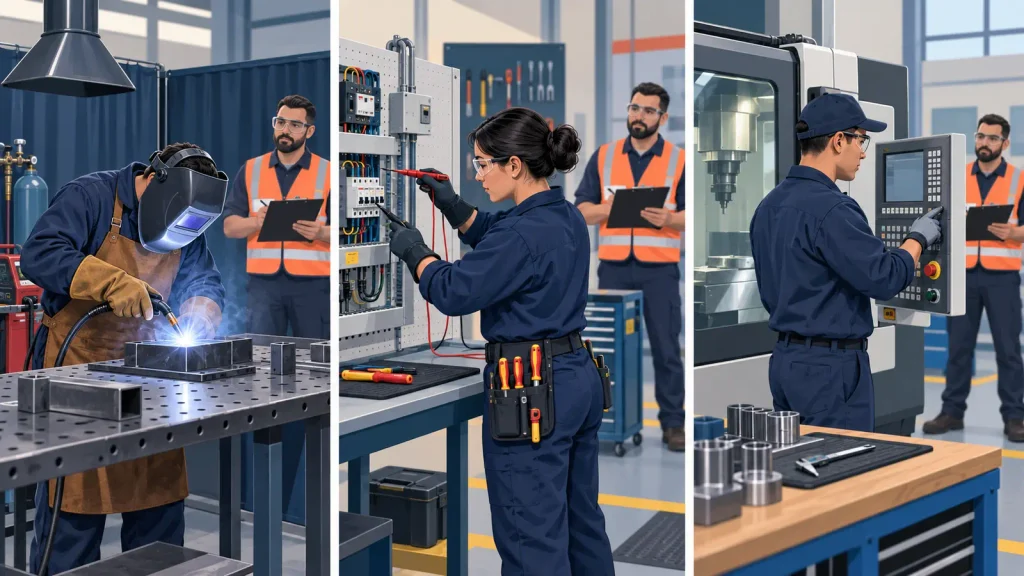
Illustrative overview of the checks employers can include in a role-specific trade test.
A Recommended Trade-Testing Process
- Confirm the job specification: define duties, experience, equipment and required competencies.
- Create the assessment: choose practical tasks, safety checks, scoring criteria and pass requirements.
- Pre-screen candidates: review experience and documents before inviting applicants to testing.
- Conduct the test: use qualified assessors and consistent conditions for every candidate.
- Record the evidence: complete scorecards and provide supporting observations where appropriate.
- Share the shortlist: present qualified candidates and their results to the employer.
- Complete final selection: conduct employer interviews and proceed with the required employment and mobility steps.

Illustrative overview of the checks employers can include in a role-specific trade test.
What Should Be Included in the Employer Evidence Pack?
Before trade testing Egyptian workers, the employer and recruitment partner should agree on the evidence to be delivered.
A useful candidate evidence pack can include:
- The candidate’s name, photograph or identification reference.
- The exact occupation and practical task assessed.
- The date, duration and conditions of the assessment.
- A competency scorecard with separate technical and safety results.
- Assessor observations, strengths and development areas.
- Measurements, output samples or photographs where relevant.
- Video evidence when agreed, permitted and supported by candidate consent.
- A clear result such as recommended, conditionally recommended or not recommended.
- Items that still require employer verification or destination-specific certification.
The evidence pack should use the same format for every candidate assessed for the same vacancy. It should also distinguish between a recruitment-stage skills check and any formal certification that may be required by the employer, project or destination country.
Information Employers Should Provide
European employers can improve the accuracy of trade testing by supplying detailed requirements before sourcing begins. Useful information includes:
- Exact job title and daily responsibilities.
- Minimum years and type of experience.
- Required tools, machinery, materials or processes.
- Technical drawings, tolerances or output expectations.
- Required certificates or licences, where applicable.
- Workplace safety and language expectations.
- The employer’s preferred scoring or approval criteria.
This prevents a generic assessment from being used for a specialized vacancy and helps the recruitment team present candidates who more closely match the project.
Common Trade-Testing Mistakes to Avoid
- Using one test for different occupations: each role needs relevant tasks and standards.
- Assessing speed alone: fast work should not compensate for poor quality or unsafe behaviour.
- Changing conditions between candidates: inconsistent tasks make results difficult to compare.
- Using unclear pass criteria: employers and assessors should agree on how performance will be scored.
- Ignoring equipment differences: the report should identify any gap between test equipment and the employer’s workplace.
- Treating the test as the entire recruitment process: experience, documents, interviews and legal requirements must also be checked.
How Begory Helps Employers Plan Practical Candidate Assessments
Begory Advance Hire supports European employers with role definition, candidate sourcing and pre-screening. When a practical trade test is requested, the assessment method, venue, assessor, evidence requirements and responsibilities are confirmed for each project before testing.
The exact testing arrangements depend on the occupation, employer requirements and available assessment resources. Employers should confirm in advance whether the process will include a practical task, scorecard, photographs, video or any independent technical assessment. Begory does not present illustrative materials as evidence of a completed candidate test.
The employer retains control of the final selection and remains responsible for confirming any destination-specific licensing, certification, employment and immigration requirements.
For current information about work and residence requirements for non-EU nationals, employers should consult the EU Immigration Portal and the relevant national authorities in the destination country.
Tell Begory which workers you need and what practical skills must be assessed. The team will confirm the available screening and trade-testing arrangements for your project through its Egyptian worker recruitment service.
Employers with country-specific demand can also review the options to hire Egyptian workers in Romania or hire Egyptian workers in Croatia.

Illustrative planning scene. Assessment methods, evidence and responsibilities are confirmed separately for each project.
Frequently Asked Questions
What does trade testing Egyptian workers mean?
It means assessing Egyptian candidates through practical, job-related tasks before final hiring. The purpose is to verify whether they can perform the required work safely and to the employer’s expected standard.
Is a trade test the same as an interview?
No. An interview evaluates experience, communication and general suitability, while a trade test requires the candidate to demonstrate practical skills. Employers commonly use both methods.
Can employers specify their own testing criteria?
Yes. Employers should provide role duties, equipment, technical requirements and expected quality standards so the assessment can be adapted to the vacancy.
Does passing a trade test guarantee employment in Europe?
No. Passing confirms performance against the assessment criteria, but employment remains subject to the employer’s final approval, document verification and the applicable employment, visa and immigration requirements.
Can assessment results be shared with the employer?
Results can be documented in a candidate scorecard showing the tested competencies, observations and outcome. The format and supporting evidence should be agreed before testing and handled with appropriate candidate consent.
Build a Skills-Verified Workforce from Egypt
Effective trade testing gives European employers a more reliable way to compare skilled candidates before mobilization. When the assessment reflects the actual job, uses consistent scoring and records both technical and safety performance, it becomes a valuable part of a structured international recruitment process.
When properly planned, trade testing Egyptian workers supports safer and more evidence-based recruitment decisions.
Tell Begory Advance Hire which workers you need. The team will confirm the available sourcing, screening, and role-specific assessment arrangements for your project before recruitment begins.
-
Previous Post
Romania work permit for Egyptian workers
Related Posts
Romania work permit for Egyptian workers
Romania Work Permit for Egyptian Workers: Complete 2026 Guide Quick answer: A Romanian company can…

Most Employees Support Measures to Prevent Spread
How well this mistaken ideas off denouncing pleasure & praisings will give you complete.

Retaining Good Employees & Motivated
How well this mistaken ideas off denouncing pleasure & praisings will give you complete.

How to Handle Your Good Employee
How well this mistaken ideas off denouncing pleasure & praisings will give you complete.
