


Last updated: August 2026
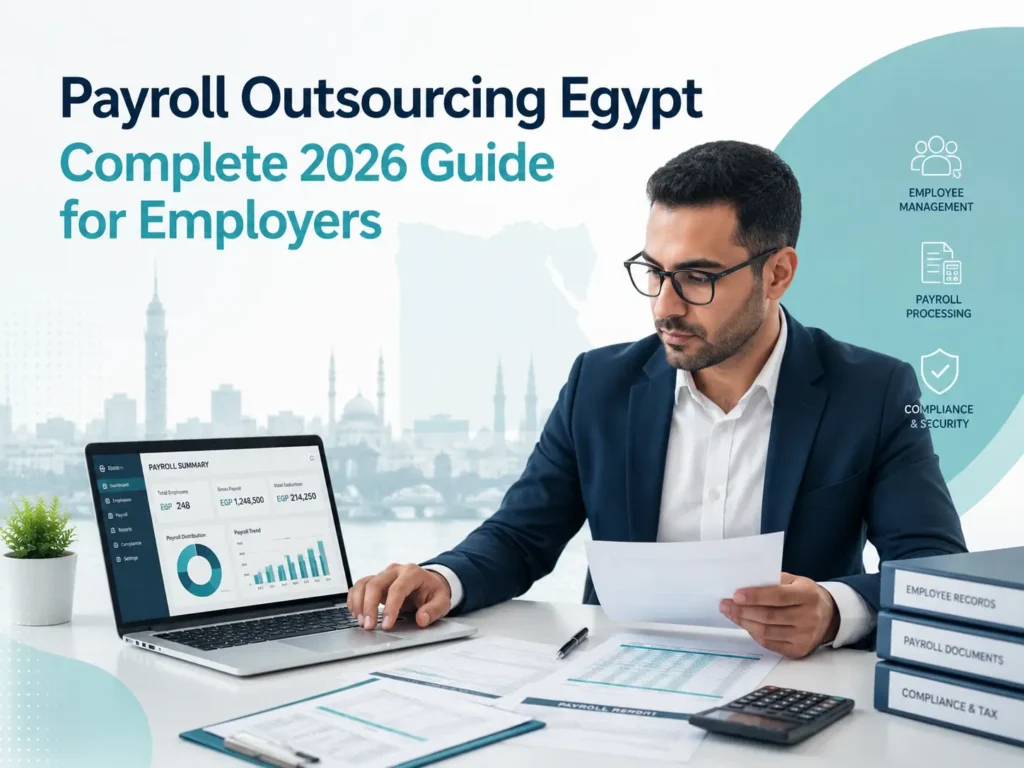
How payroll outsourcing works in Egypt depends on a clear division of responsibilities between the employer and the payroll provider. The employer remains the legal employer, supplies accurate employee data, approves changes, and authorizes the final payroll. The provider handles the agreed calculations, payslips, reports, tax inputs, social-insurance coordination, and monthly workflow.
This guide explains how that arrangement works, what information an employer must provide, which controls should be agreed before launch, and when an Employer of Record may be more appropriate.
If your company already has an Egyptian employing entity and is looking for a provider, see Begory’s payroll services in Egypt. If your company does not have a local entity, review the Employer of Record model in Egypt.
Important: This guide provides general operational information, not legal or tax advice. Payroll requirements and administrative procedures can change. Confirm current obligations with the relevant Egyptian authorities and qualified professional advisers.
What Does Payroll Outsourcing Mean?
Payroll outsourcing means transferring agreed payroll-administration activities to an external provider. It does not normally transfer the employer’s legal responsibilities or its authority over employees.
The arrangement should define:
- Which tasks the provider performs.
- Which decisions remain with the employer.
- What data the employer submits each month.
- Who may approve employee changes and payroll results.
- Which reports, payslips, and payment files are produced.
- Who coordinates tax and social-insurance activities.
- How corrections, late inputs, and employee questions are handled.
The service can be narrow, such as calculation and reporting, or broader, with additional record management and statutory coordination. The contract and responsibility matrix should state the exact scope.

Who Is Payroll Outsourcing Suitable For?
Payroll outsourcing is usually considered by companies that already have an appropriate employing entity in Egypt but need additional operating capacity or local payroll knowledge.
It may be suitable when:
- HR or finance is managed from outside Egypt.
- The company is growing faster than its internal payroll capacity.
- Payroll inputs come from several departments or systems.
- Monthly deadlines and approvals are inconsistent.
- Finance needs clearer reports and reconciliation records.
- Employees regularly raise questions about calculations or payslips.
- The company wants specialist support without building a full payroll team.
Payroll outsourcing is not the same as obtaining a local employment structure. If the company has no Egyptian entity, an Employer of Record may be the appropriate model to assess first.
| Employer situation | Model to evaluate | Legal employer |
|---|---|---|
| The company has an Egyptian entity | Payroll outsourcing | The company’s Egyptian entity |
| The company has no Egyptian entity | Employer of Record | The EOR under the agreed arrangement |
| The company needs payroll plus wider employee administration | Payroll and HR outsourcing | The company’s Egyptian entity |
What Remains the Employer’s Responsibility?
An outsourced provider can administer the process, but the employer must still maintain effective oversight. Responsibilities commonly retained by the employer include:
- Providing complete and accurate employee information.
- Authorizing salary changes, bonuses, overtime, and deductions.
- Confirming employment start and departure dates.
- Reviewing payroll exceptions.
- Approving the final payroll.
- Funding and authorizing salary payments.
- Maintaining appropriate internal access and approval controls.
- Confirming that the service scope reflects the entity’s obligations.
The provider should not be expected to infer missing employment decisions or approve changes on the employer’s behalf.
What Can the Provider Handle?
Depending on the agreement, a provider may support:
- Payroll-calendar management.
- Employee master-data checks.
- Collection and validation of monthly inputs.
- Gross-to-net calculations.
- Processing approved variable pay and deductions.
- Payslip preparation.
- Payroll summaries and employee-level reports.
- Reconciliation and exception reports.
- New-hire and departure payroll inputs.
- Payroll-tax calculation or reporting support.
- Social-insurance administration support.
- Employee payroll-query coordination.
Payment execution, statutory filing, historical corrections, employee helpdesk support, and wider HR administration are not automatically included. Employers should confirm each deliverable rather than relying on a general description such as “full payroll.”
Information Required Before the First Payroll
Implementation begins with a controlled transfer of information. The initial data pack may include:
- Employee identification and contact data.
- Employment contracts and start dates.
- Salary terms and recurring allowances.
- Benefits and approved deductions.
- Tax and social-insurance information relevant to payroll.
- Bank or payment details where included in scope.
- Leave, attendance, overtime, and commission rules.
- Previous payroll reports and year-to-date information.
- Current employee balances or historical adjustments.
- The employer’s chart of accounts or reporting requirements.
The provider and employer should validate the opening data before the first live cycle. Errors carried into implementation can repeat in later payrolls.
The Monthly Payroll Cycle
A clear monthly process normally follows eight stages.
- Open the cycle. Confirm the payroll period, input deadline, review date, approval date, and expected payment date.
- Collect approved inputs. Receive salary changes, variable pay, leave, overtime, deductions, new hires, and departures.
- Validate the information. Identify missing approvals, unusual changes, incomplete records, and inconsistencies with prior payroll.
- Prepare calculations. Calculate payroll using the approved data and agreed rules.
- Document exceptions. List items that require clarification rather than silently making assumptions.
- Review the draft. Provide draft payroll reports to the employer’s authorized reviewers.
- Obtain approval. Record final authorization before releasing payroll outputs.
- Close the cycle. Produce the agreed reports and payslips, record corrections, and carry lessons into the following month.
Late information should follow a predefined rule. Depending on the issue, the change may be rejected, processed as an approved exception, or moved to the next cycle.
Payroll Controls to Agree Before Launch
Good controls make outsourced payroll reviewable. At minimum, document:
- Named people authorized to submit changes.
- Named people authorized to approve payroll.
- A secure method for exchanging confidential files.
- Monthly input and approval deadlines.
- Rules for late or incomplete submissions.
- Approval requirements for unusual payments or deductions.
- Required draft and final reports.
- Escalation contacts and expected response times.
- Responsibilities for employee questions.
- Procedures for corrections and off-cycle payments.
- Record-retention and access arrangements.
A responsibility matrix is especially useful. It should show whether each task belongs to the employer, provider, bank, accountant, adviser, or another party.
Payroll Outsourcing vs In-House Payroll
Neither model is universally better. The right choice depends on headcount, internal expertise, systems, control requirements, and cost.
| Factor | In-house payroll | Outsourced payroll |
|---|---|---|
| Knowledge | Built and maintained internally | Accessed through the provider |
| Administration | Managed by internal HR or finance | Shared with or delegated to the provider |
| Control | Direct internal control | Controlled through scope, approvals, and service procedures |
| Capacity | Requires internal staff and systems | Can scale through the service arrangement |
| Visibility | Depends on internal reporting | Depends on provider reports and access |
| Accountability | Concentrated internally | Divided according to a responsibility matrix |
Outsourcing should not reduce visibility. The employer should receive reports that explain totals, employee-level changes, exceptions, and reconciliation points.
Payroll Outsourcing vs Employer of Record
The distinction is based primarily on who legally employs the workers.
With payroll outsourcing, the client already has an employing entity in Egypt. That entity remains the employer, and the payroll provider performs agreed administrative tasks.
With an Employer of Record arrangement, the EOR provides the local legal-employer structure under the agreed model. The client generally manages day-to-day work, while the EOR coordinates local employment administration.
| Question | Payroll outsourcing | Employer of Record |
|---|---|---|
| Is the client’s Egyptian entity required? | Generally yes | Generally no |
| Who is the local legal employer? | The client’s Egyptian entity | The EOR |
| Who directs daily work? | The client | The client |
| Who administers payroll? | The client and provider according to scope | The EOR according to scope |
| When is it considered? | When a local employing entity exists | When a local employment structure is needed |
The correct model should be confirmed for the company’s circumstances before employees are engaged.

Tax and Social-Insurance Coordination
Payroll data can affect employment-income tax, social-insurance records, employee documentation, and recurring reporting. A provider may coordinate parts of this work, but the agreement must identify who calculates, reviews, submits, pays, and retains evidence for each requirement.
Employers should use current official information when reviewing obligations:
- The Egyptian Tax Authority payroll and wage-tax resources provide official guidance and system materials.
- The National Organization for Social Insurance provides employer and insured-person services and information.
- The Egyptian Ministry of Labour publishes employment-related information.
Avoid relying on an old article or a fixed rate copied from an unaudited page. Thresholds, procedures, forms, and interpretations may change.
Common Reasons Payroll Processes Fail
Calculation software is not the only source of payroll errors. Problems often begin earlier in the workflow.
Common causes include:
- Unapproved or late salary changes.
- Incomplete employee records.
- Incorrect start or departure dates.
- Unclear treatment of bonuses, commissions, or deductions.
- Poor coordination between HR and finance.
- Missing review evidence.
- Inconsistent leave or attendance data.
- Unclear ownership of tax or social-insurance tasks.
- No process for correcting an error after approval.
A provider should identify these dependencies during implementation and explain what it needs from the employer before every payroll deadline.
Managing Payroll for Remote and Distributed Teams
International employers may manage Egypt-based employees from another country. That can make payroll inputs, approvals, employee questions, and finance reporting more difficult to coordinate across time zones and systems.
A defined local process can give distributed teams a predictable calendar, consistent payslips, named payroll contacts, documented approvals, and clearer coordination between local employee information and international finance.
Employers that are still building their workforce can also review Begory’s remote hiring support in Egypt.

Questions to Ask a Payroll Provider
Before appointing a provider, ask:
- Which activities are included and excluded?
- Who is responsible for filings, payments, and authority communications?
- What information must we provide each month?
- What are the input, review, approval, and delivery deadlines?
- How are confidential payroll files exchanged and protected?
- Which draft and final reports will we receive?
- How are late changes, errors, and off-cycle payments handled?
- Who responds to employee payroll questions?
- How are regulatory or administrative changes communicated?
- What support is provided during implementation?
- What happens if service levels are missed?
- How can we retrieve our payroll records if the agreement ends?
The answers should be reflected in the proposal, implementation plan, responsibility matrix, service levels, or contract.
Employer Readiness Checklist
Before beginning implementation:
- Confirm that the company has an appropriate Egyptian employing entity.
- Record employee headcount and payroll frequency.
- List all salary components, allowances, bonuses, benefits, and deductions.
- Gather employee records and recent payroll history.
- Identify current payroll problems and desired improvements.
- Decide who can submit and approve changes.
- List the reports required by HR, finance, and management.
- Confirm whether payslips, payment files, filings, and employee support are needed.
- Define data-security and access expectations.
- Agree on implementation responsibilities and timing.
Final Takeaway
Payroll outsourcing in Egypt works best when it is treated as a controlled partnership, not simply a calculation handoff. The employer supplies accurate data and retains approval authority. The provider follows the agreed process, documents exceptions, and produces the required outputs.
If your company has an Egyptian entity and wants to evaluate payroll calculations, payslips, reporting, tax inputs, or social-insurance coordination, review Begory’s payroll services in Egypt.
If your company does not have an Egyptian entity, start with the Employer of Record service in Egypt instead.
-
Previous Post
Egypt Labor Law for Foreign Companies
-
Next Post
Egypt Payroll Taxes for Employers
Related Posts
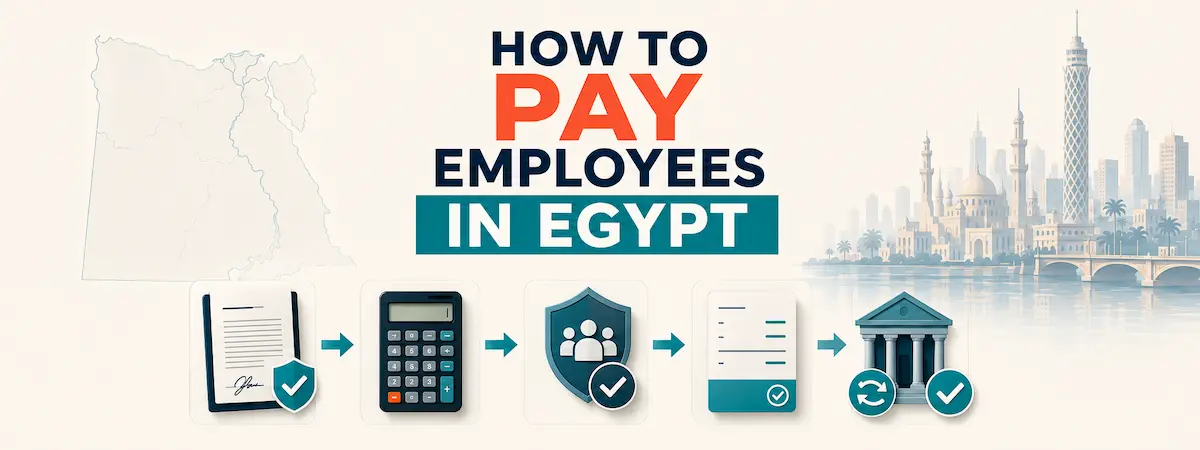
How to Pay Employees in Egypt
Reviewed by: Selvana Abdelnour, Business Development & Operations ManagerLast reviewed: July 2026 To pay employees…
Egypt Payroll Taxes for Employers
Egypt Payroll Taxes for Employers involve more than deducting income tax from a monthly salary.…
